Here are the viruses that help clean up contaminated soil
 pxhere CC0 Public Domain Free for personal and commercial use No attribution required
 An Australian study proposes using bacteriophages to enhance pollutant-degrading bacteria, opening new prospects for soil bioremediation
by Matteo Cavallito
Some viruses could become valuable allies in the fight against soil pollution. This is the premise of a new study from Flinders University in Adelaide, Australia, which proposes an innovative approach to improving the bioremediation of contaminated soils by harnessing bacteriophages, the microorganisms that infect bacteria.
The technique, known as phage bioaugmentation, “offers a compelling new direction for environmental biotechnology, by harnessing the ecological roles of lysogenic phages to enhance microbial function in polluted soils”, explains the research published in Communications Biology. Although still at an experimental stage, this strategy could represent a new frontier in environmental biotechnology.
Soil pollution is threatening ecosystems
Soil and water pollution rank among the world’s leading environmental challenges, with consequences for human health, agriculture and the functioning of ecosystems. “Pollutants such as arsenic, chromium, polychlorinated biphenyls, pesticides, petroleum hydrocarbons, and excess nutrients”, explain the researchers, “disrupt ecosystem function by impairing microbial communities essential for soil health and nutrient cycling”.
These impacts, in particular, “degrade groundwater quality, threatening drinking water resources”. This is why, “safeguarding soil microbiomes is critical for ecosystem resilience, the environment and public health”.
The limitations of bioremediation
Research has long focused on bioremediation, namely the use of bacteria capable of naturally degrading many toxic substances. Three main techniques currently fall within this category:
- Bioventing, which relies on the injection of air into the subsurface to promote bacterial biodegradation;
- Biostimulation, which involves the addition of nutrients to stimulate the growth and metabolic activity of microorganisms already present in the soil;
- Bioaugmentation, which involves the introduction of external microbial strains or consortia into the system.
However, all of these strategies still face significant limitations because they “are constrained by slow degradation and inhibition of microbial activity”. Bioaugmentation in particular “often fails due to dilution, washout, competition, and microbial mortality”. But when supported by the use of bacteriophages, the scientists explain, it could help overcome many of these key limitations.
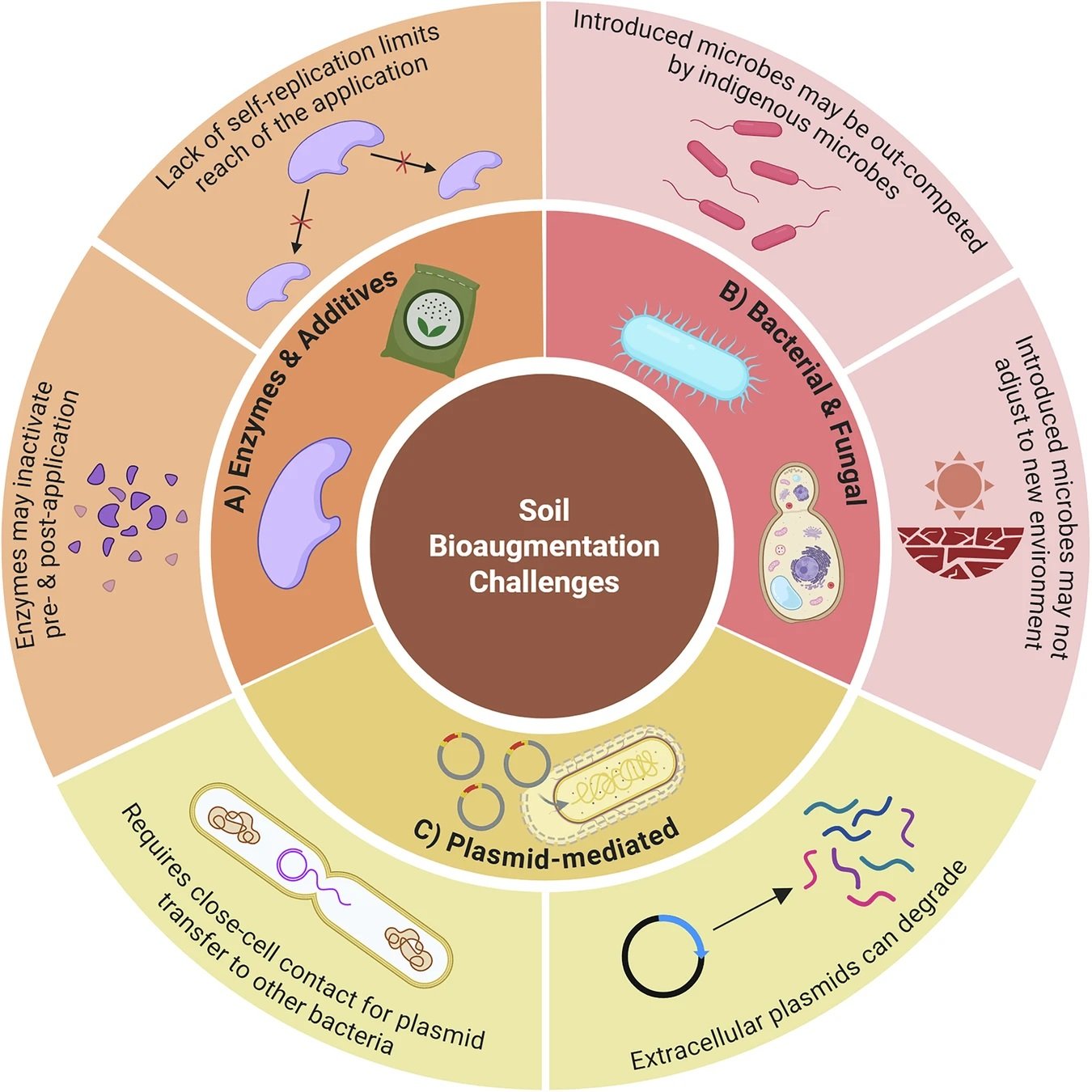
The limitations of the three main bioaugmentation approaches. The use of bacteriophages could help overcome many of these challenges. Source: Romeo, N., Hauptfeld, E., Yang, Q. et al. Phage bioaugmentation reveals the potential of lysogeny for soil bioremediation. Commun Biol 9, 624 (2026). https://doi.org/10.1038/s42003-026-10106-1 Attribution-NonCommercial-NoDerivatives 4.0 International CC BY-NC-ND 4.0 Deed
Bacteriophages can enhance bioremediation
To overcome these limitations, the research team proposes harnessing lysogenic bacteriophages, viruses that infect bacteria without immediately destroying them. Unlike lytic phages, these viruses integrate their DNA into the genome of the host bacterium and can pass it on to subsequent generations. Through this mechanism, they are able to transfer so-called Auxiliary Metabolic Genes (AMGs), metabolic genes that improve the ability of bacteria to tolerate environmental stress and degrade pollutants.
“We propose that leveraging phage–bacteria interactions enhances bioaugmentation over current bioaugmentation techniques”, explain the authors, noting that the study “presents the conceptual framework, summarizes current evidence, and identifies key research priorities”.
The researchers reviewed numerous studies demonstrating that certain bacteriophages carry genes involved in arsenic and chromium detoxification, pesticide degradation, and resistance to a range of environmental contaminants. In other words, the viruses do not directly eliminate toxic substances; instead, they make bacteria more efficient and resilient by enhancing their metabolism, thereby enhancing natural bioremediation.
A new generation of remediation strategies?
Phage bioaugmentation is an emerging technology, and further research will be needed before it can be deployed in real-world applications. “Immediate efforts should focus on validating effective in-soil candidate phage, conducting controlled field experiments, and developing tools to monitor phage integration and AMG expression”, the study emphasizes, while also pointing out that important questions related to biosafety and regulation remain open.
According to the authors, particular attention will need to be paid to the genetic stability of the viruses, the potential for unintended gene transfer, and their effects on natural microbial communities.
Despite these uncertainties, this technology could pave the way for a new generation of environmental remediation strategies by offering several advantages over conventional bioaugmentation. Rather than introducing new bacteria, which are often poorly suited to natural environments, bacteriophages could improve the performance of microbial communities already present in the soil. Moreover, because they are able to replicate and spread among bacteria, they could boost treatment effectiveness over time. Finally, the researchers also envisage the use of engineered viruses to deliver genes specifically designed for the bioremediation of particular contaminants.
 Photo: Thomas Bjørkan CC BY-SA 3.0
 Re Soil Foundation