A fluid could explain the mystery of permafrost terraces
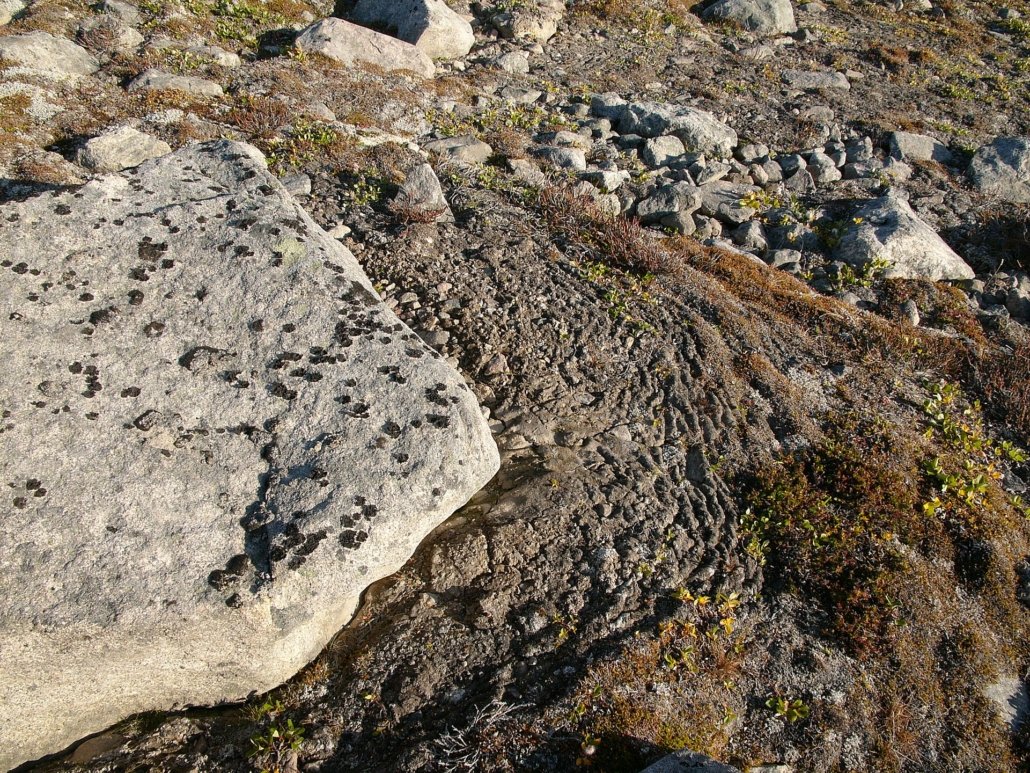 Hannes Grobe Attribution-ShareAlike 2.5 Generic CC BY-SA 2.5 Deed
For decades, scientists have struggled to explain how Arctic permafrost terraces form spontaneously. A new model suggests that their origin may lie in the same physical principles that generate waves in complex fluids
by Matteo Cavallito
The slopes of Arctic regions often display striking natural patterns, including circles, polygons, stripes and large terraces resembling a staircase. They are the result of solifluction, the extremely slow movement of the upper soil layer caused by permafrost thawing. For decades, geomorphologists have sought to understand how these structures form spontaneously, but without success. At least until now.
A new study may provide a convincing explanation by exploring the surprising analogy between this type of movement and the formation of waves in a highly unusual material: oobleck, the non-Newtonian fluid obtained by mixing water and cornstarch.
A geomorphological enigma
The research, conducted by scientists from the University of Rochester in New York and published in AGU Advances, the scientific journal of the American Geophysical Union, aimed to find “an explanation for solifluction terraces that does not rely on the presence of multiple layers, compression, or inertia”. During the warmer months, the surface layer of soil thaws and slowly slides over the still-frozen permafrost beneath it, advancing by only a few millimetres or centimetres per year. Over time, this process creates steps and lobes of ground that can extend for tens of metres.
Oobleck, by contrast, is a non-Newtonian fluid. These substances display specific properties: when deformed slowly, they flow like a cream, while under intense stress they suddenly become much more rigid.
In recent years, several studies have shown that when a layer of oobleck flows down an inclined surface, it can spontaneously develop a series of regular waves. A small bump, the scientists note, slows down the material moving downslope from above, encouraging accumulation and its subsequent transformation into a stable wave. This is where the comparison between two completely unrelated phenomena suggests a curious analogy. The ice “behaves in complex ways, acting at times like a fluid and at others like a solid”, highlights a note from the researchers. “This complexity is due to seasonal variability in water and temperature, as well as the fundamental physics of soil”.
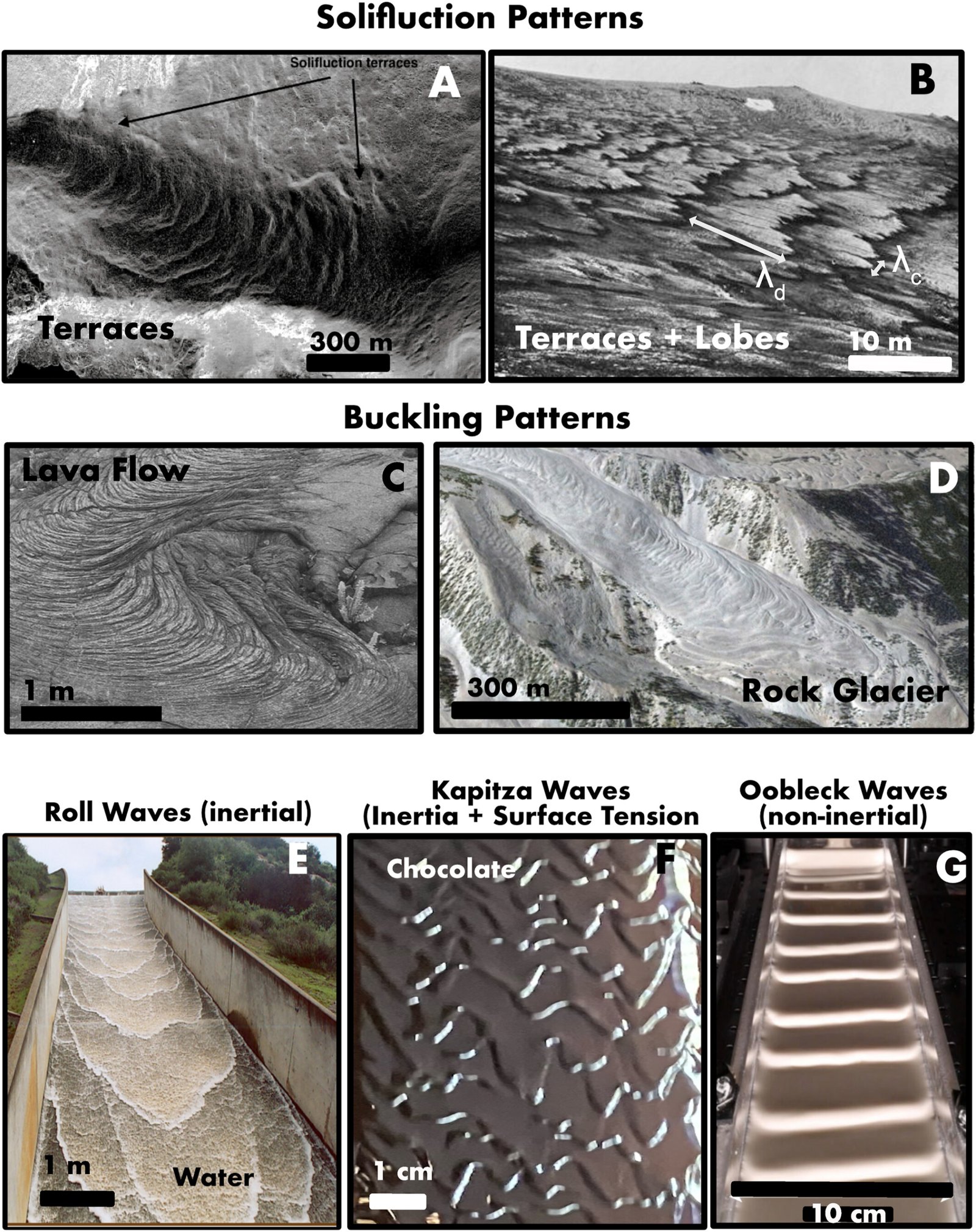
Solifluction terraces and possible analogs explored in the study. (a) LiDAR-derived slope map of solifluction terraces at Niwot Ridge, Colorado. (b) Solifluction patterns in Chicken Creek, AK with downslope wavelength 𝜆𝑑 and cross-slope wavelength 𝜆𝑐 illustrated. Photo by Philip S. Smith. (c) Buckling of a lava flow, from Slim et al. (2009). Photo by Dr. Ron Schott. (d) Buckling on a rock glacier at Mt. Sopris, Colorado. From Google Earth. (e) Inertial roll waves at Turner reservoir, CA. Photo by Victor Ponce. (f) Kapitza waves in a chocolate waterfall. Photo by Chloe Lindeman. (g) Non-inertial experimental oobleck waves, from Darbois Texier et al. (2020).. Source: Glade, R. C., Sleiman, J., Quillen, A.,Cúñez, F. D., & Williams, S. (2026).Exploring potential mechanisms for theinitiation of solifluction patterns. AGUAdvances, 7, e2026AV002392. Attribution 4.0 International CC BY 4.0 Deed
The study
Researchers stress that permafrost does not actually behave like oobleck. The analogy instead concerns the physical mechanism: a local change in the speed of the material can amplify a small irregularity rather than smooth it out. Their idea, therefore, was to use fluid waves as a conceptual model to investigate whether a similar mechanism could occur in frozen soils. The authors first analysed all the main explanations proposed over the years for terrace formation, showing that models based on simple fluids, compression instabilities or rolling waves fail to spontaneously produce the observed patterns.
They then developed a mathematical model treating the ground as a highly viscous fluid and derived a relationship between terrace spacing, soil thickness and slope angle. This relationship was compared with a large database of solifluction terraces obtained through high-resolution imagery from Norway.
The new hypothesis
“Our finding of unconditional stability for our simple fluid formulation”, explains the study, “most likely means that our chosen governing equations are not sufficient to explain the observed instability”. For this reason, they introduced a completely new hypothesis: the effective viscosity of the soil may not be constant but could increase locally around small surface irregularities due to variations in moisture, thermal conditions, vegetation or soil cohesion.
This formulation was confirmed by mathematical simulations, which showed the spontaneous emergence of waves that gradually organize into terraces very similar to those observed in the field. These tend to progressively merge, increasing their wavelength over time, a behaviour consistent with observations from natural landscapes.
A first step towards understanding permafrost evolution
By the admission of the authors themselves, the study does not prove that permafrost follows exactly the same rheological mechanism as oobleck, nor does it identify with certainty the process responsible for terrace formation. At the same time, however, the research proposes a new theoretical framework that appears to explain, for the first time, the spontaneous origin of these structures. “Our work, which includes mathematical theory and computer modeling, shows that solifluction patterns form in a similar way due to spatial differences in soil moisture at the front of bumps on the landscape”, conclude the researchers.
“This demonstrates how patterns in everyday fluids can be compared and contrasted with complex patterns in sediment to better understand how Earth’s surface evolves”.
The next step will be to test this hypothesis directly in the field by verifying whether variations in moisture, temperature or other properties capable of slowing ground movement actually exist in front of terrace fronts. If confirmed, this theory could improve our understanding of how Arctic landscapes evolve at a time when climate change is accelerating the degradation of permafrost, making many slopes less stable and increasing the risk of shallow landslides. Finally, the research notes that structures very similar to Arctic terraces have also been observed on Mars. Understanding their origin could therefore also help reconstruct the climatic history of the Red Planet.
 Sam Beebe, CC BY 2.0
 Photo: Thomas Bjørkan CC BY-SA 3.0
 Re Soil Foundation