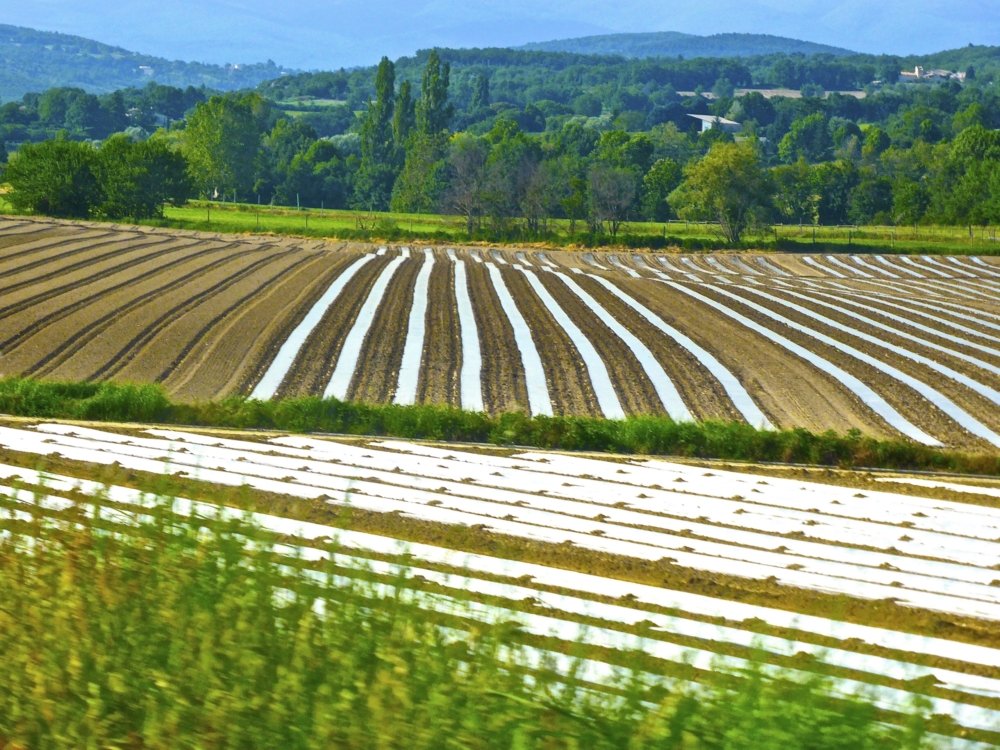
China’s planted forests are growing faster than natural forests
 Rutger van der Maar, CC BY 2.0.
A study of China’s planted forests reveals faster leaf area expansion driven by younger trees and stronger CO₂ responses, but the advantage may not last
by Matteo Cavallito
For nearly half a century, China has transformed its northern territory into one of the largest reforestation experiments on the planet. Launched as early as 1978, the national Three-North Shelterbelt Program, also known as the Great Green Wall, has led to the planting of around 66 billion trees to combat the expansion of the Gobi Desert, reduce sandstorms and increase forest cover. What was not yet known, however, was that in many of these areas, planted forests were showing a faster increase in leaf area than nearby natural forests.
This was highlighted by a study by a team of scientists from Peking University and Beijing Forestry University, which analysed how these ecosystems respond to environmental changes, particularly rising atmospheric carbon dioxide levels. The research was published in Geophysical Research Letters, the journal of the American Geophysical Union.
China has more than 90 million hectares of planted forests
China currently has the world’s largest area of planted forests, which covered 90.31 million hectares in 2020, equivalent to 36.6% of the country’s forested land. The expansion of planted areas has made a significant contribution to the global increase in vegetation cover, but comparing them with natural forests remains complex. Planted forests are often managed to promote rapid growth and, as the study notes, “exhibit rapid growth due to management and selective species cultivation”.
Natural ecosystems, on the other hand, maintain a greater capacity for adaptation thanks to their biological complexity.
So what is the actual advantage of planted forests? To answer this question, researchers sought to distinguish the effect of tree age from the influence of forest type and environmental conditions. In other words, they wanted to understand whether the faster growth of “artificial” forests was simply due to their relative “youth” or whether it depended instead on a different response to global changes.
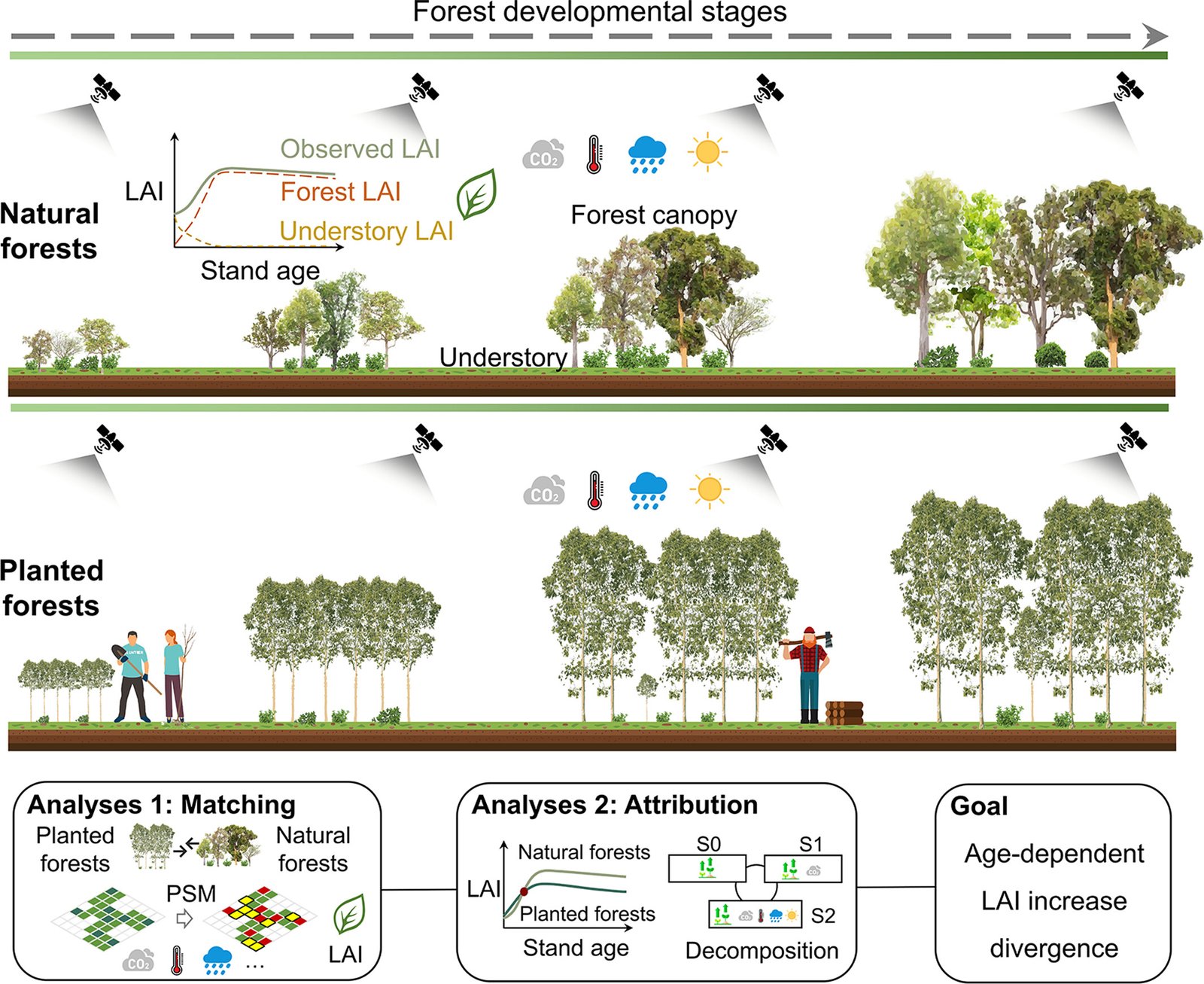
Different leaf area index (LAI) trends between planted and natural forests, driven by contrasting growth responses. To make the comparison as fair as possible, the researchers compared planted and natural forests with very similar environmental conditions and ages using propensity score matching (PSM), a statistical technique that reduces, as far as possible, the influence of external factors. The analysis was then combined with artificial intelligence-based machine learning models, which made it possible to distinguish the contributions of forest age, rising CO₂ concentrations and climate change to LAI dynamics. Image: Yuhang Luo, Yuan Wang, Han Wang, Hongliang Wang, Jiansheng Wu, “Enhanced CO2 Response and Aging-Related Dynamics Drive a Greater Leaf Area Index Increase in China’s Planted Forests in Comparison to Natural Forests”, Geophysical Research Letters Volume53, Issue11 16 June 2026 e2025GL121544 Attribution 4.0 International CC BY 4.0 Deed
Data reveal the growth advantage of planted forests
The analysis used satellite data collected between 2000 and 2022, forest age maps, climate information and machine-learning models. The main parameter examined was the Leaf Area Index (LAI), an indicator of the amount of foliage covering the ground and a measure of vegetation’s capacity for photosynthesis and carbon uptake.
The results show that planted forests “increased their leaf area about ∼2/3 faster than natural forests across China. Even when comparing forests of similar age and growing conditions, planted forests still grew 4.6% faster”.
This difference, in particular, “was largest in mixed and evergreen forests, mainly because planted forests responded more to higher CO2”, the study explains. Planted forests, which are younger on average (34 years of mean tree age compared with 57 years for natural forests), therefore appear to benefit more from the fertilising effect of carbon dioxide during the early stages of growth. The greater vegetation density also enhances evapotranspiration, the process through which plants release water into the atmosphere, potentially contributing to changes in local humidity conditions.
Reforestation helps, but it is not enough
The study provides important insights for the future of global reforestation, but it also offers a significant warning: the advantage of planted forests is unlikely to persist indefinitely. After around 40 years, in fact, the difference begins to narrow and natural forests can catch up thanks to their greater growth capacity linked to ecosystem maturity.
Planted forests, in short, represent an effective tool for increasing carbon uptake, reducing soil degradation and contributing to the fight against climate change.
At the same time, however, they play a complementary, not exclusive, role alongside the protection of existing forests and cannot replace natural ecosystems, which remain essential for maintaining vital environmental services. “Replacing natural forests with plantations is ill-advised and a balanced approach integrating well-designed planted forests with natural forest conservation is essential for coordinated climate and ecosystem objectives”, conclude the researchers.
 Photo: Thomas Bjørkan CC BY-SA 3.0
 Re Soil Foundation