Healthy soils for cities and agriculture: solutions from the States General
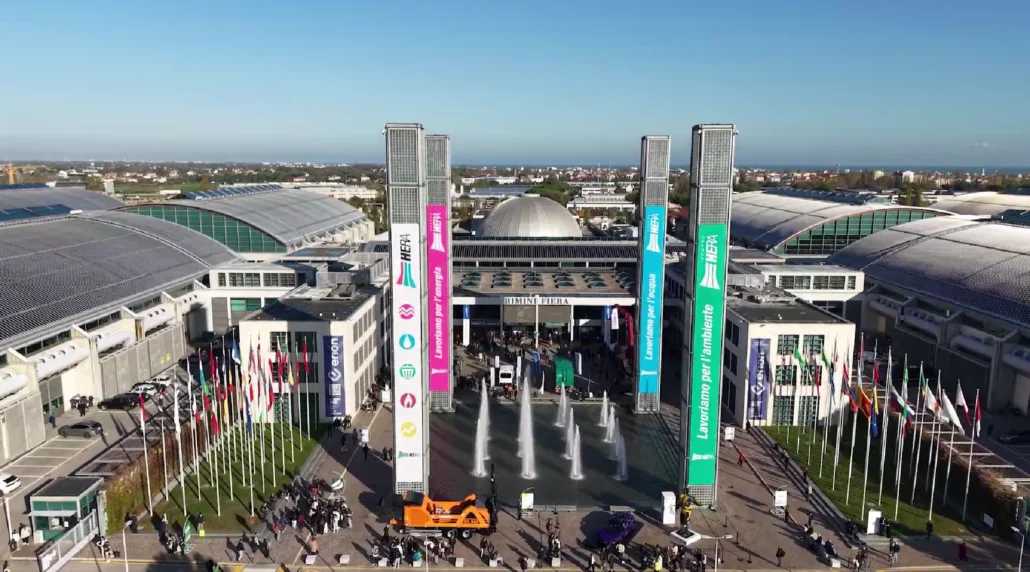 Ecomondo
At the fifth edition of the States General, an event organised by Re Soil Foundation and Ecomondo, speakers discussed how research, regulation, urban land restoration and local trials can help protect and restore soils
by Matteo Cavallito
Protecting soils takes reliable information and people with the skills and support to use it. Linking knowledge with the ability to act is essential if research is to lead to better soil management. Yusuf Yigini, Land and Water Officer at the Secretariat of the FAO Global Soil Partnership, made this point in Rimini on 5 November. He drew on the experience of three programmes: Global Soil Doctors (farmer-to-farmer training), RECSOIL (building and preserving soil carbon) and SoilFER (providing data and maps to guide decisions). He was speaking at the fifth edition of the States General for Soil Health.
Organised by the Scientific and Technical Committee of Ecomondo and by Re Soil Foundation under the theme “Healthy soils for urban areas and sustainable agri-food systems”, the event brought together representatives from public institutions, research and industry. It was chaired by Debora Fino, Professor of Chemical Plant Design at Politecnico di Torino and President of Re Soil, and Roberto Moncalvo, President of Epaca, a Re Soil board member and a former President of Coldiretti Piemonte who also led Coldiretti nationally from 2013 to 2018.
Policies to protect soil functions
Speakers noted that the way soils are protected is changing. The European Union is moving from indirect protection through sector-specific policies towards a common framework built around soil health, resilience and comparable monitoring, explained Panos Panagos, a senior researcher at the European Commission’s Joint Research Centre and head of the project and working group behind the European Soil Observatory (EU Soil Observatory, EUSO).
An evolving legal framework
The legal approach is also changing. A focus on safety is broadening to include the protection of soils for the ecosystem services they provide, said Francesco de Leonardis, Professor of Administrative Law and Environmental Law at Roma Tre University and a member of Re Soil Foundation’s Scientific and Technical Committee.
One milestone was Italy’s constitutional reform of 2022, which enshrined the protection of the environment, biodiversity and ecosystems in Article 9. Under Article 41, private economic activity must not harm health or the environment. The new European rules on nature restoration and soil monitoring are also part of this shift, he added.
Halting land take and restoring urban soils
What is happening on the ground, however, is still a long way from what soil protection policies aim to achieve. In 2025, Italy lost another 102.4 square kilometres of natural soil, or about 3.2 square metres per second, said Michele Munafò, a senior official at ISPRA and scientific lead for the SNPA’s national reports on land take, urban ecosystems and the state of the territory.
Limiting further soil sealing must go hand in hand with restoring land that has already been sealed. More than 212,000 hectares have already been mapped across Italy as potentially suitable for de-sealing and restoration.
Restoring these areas can help soils absorb water, support vegetation and regulate the climate. One example is the former Montezemolo barracks in Cuneo, presented by Alessandro Spedale, a member of Cuneo’s municipal executive, Igor Boni, head of IPLA’s Land and Agriculture Department, and Lorena Losurdo, who works with IPLA and studies the ecosystem services that urban soils provide and the uses they can support. The project involves removing impermeable surfaces and turning the site into an urban woodland while studying the properties and potential of its soils.
Testing and sharing solutions
Finding solutions that work in different places calls for research, testing and participation. This is the approach taken by the European Mission “A Soil Deal for Europe”, said Henri Delanghe, head of the Research and Innovation Unit at the European Commission’s DG AGRI, as he outlined its goals and progress. One way the mission does this is through Living Labs, research and innovation initiatives in which researchers, farmers, businesses, public authorities and citizens work together to develop and test solutions for soil health.
There are now 50 active labs with more than 650 trial sites. The target for 2030 is a combined total of 100 Living Labs and Lighthouses (demonstration farms that use and share good soil health practices).
For these initiatives to succeed and last, they need training, support and opportunities to learn from one another, said Arianna Marucci, Project Manager and Area Manager at the European network ENoLL and a member of the coordination team for the SOILL project. SOILL meets that need through a support structure that connects the labs, provides access to knowledge and assessment tools, and encourages exchange among initiatives working in different settings, including in Italy.
Sharing good practices
There is also much to learn from practices already in use on farms. Drawing on farmers’ knowledge and bringing farmers and researchers together helps identify and share ways to preserve soil fertility, biodiversity and soil functions. As Caterina Capri, Soil Health Specialist at Re Soil Foundation, explained, this is the approach described in “Good practices for healthy soils”, a new report produced on the Foundation’s initiative and distributed last summer.
The publication brings together accounts and contributions from farmers, researchers and experts, and also features the Lighthouse Farms network.
The examples include using compost, digestate and biochar to return carbon and nutrients to the soil, and using biodegradable mulches to reduce the risk of plastic residues building up. These practices connect day-to-day soil management with efforts to make farming systems more sustainable and agroecosystems more resilient. They also make knowledge gained in the field available to others and encourage dialogue between those who study soils and those who farm them.
The role of the circular bioeconomy
Materials used in farming and to maintain green spaces can also contaminate soils if they end up in the environment. Designing products fit for their intended use and testing what happens to them after use is the aim of the SOUL project, said Sara Guerrini, an agronomist at Novamont, an expert in bioplastics for agriculture and a member of Re Soil Foundation’s Scientific and Technical Committee.
The initiative brings together 17 European organisations and one associated partner under the coordination of the Spanish foundation AITIIP. It aims to develop eleven solutions that biodegrade in soil and are made from more than 95% renewable raw materials.
These include mulch films, clips and ties, pheromone dispensers and tree guards. Trials under real-world conditions are planned in five countries to assess the products’ performance, safety and sustainability. The project also considers ways to manage products after use, including reuse, recycling and composting for products that are not designed to remain in the soil. The project shows how the circular bioeconomy can help prevent further soil degradation by reducing the pressures on soils, complementing efforts to restore those already damaged.
 Aethonatic / Wikimedia Commons — CC0
 Krzysztof Ziarnek, Kenraiz / Wikimedia Commons, CC BY-SA 4.0