In the Amazon, diseases follow forest transformation
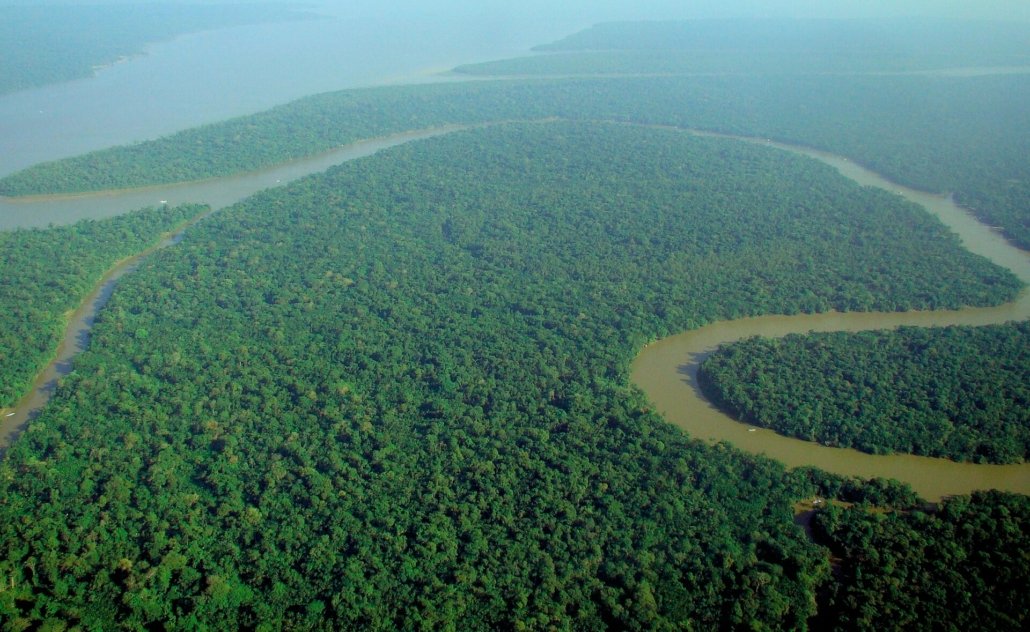 Photo: lubasi, Creative Commons Attribution-ShareAlike 2.0 (CC BY-SA 2.0)
A Brazilian study of more than one million cases of malaria, dengue, Chagas disease and leishmaniasis reveals how diseases cluster in distinct “health landscapes” shaped by different land-use: from forest communities to large-scale agricultural systems
by Matteo Cavallito
The spread of insect-borne diseases across the Brazilian Amazon does not follow random patterns but is closely linked to the way people use and reshape the landscape. This is the conclusion of a study conducted by the Environmental Change Institute at the University of Oxford and published in Communications Earth & Environment. The research analysed more than one million reported cases of malaria, dengue, Chagas disease and leishmaniasis across the region’s municipalities over a five-year period.
The findings, says Milton Barbosa, an ECI researcher and co-author of the study, show that these diseases tend to cluster in distinct “health landscapes”, shaped by the interaction between environmental change, economic activities, social conditions and urban development. In other words, their spread depends not only on the presence of insect vectors — such as mosquitoes, sand flies and triatomine bugs — but also on the environmental transformations driven by human activity.
There is no single Amazon
“The Amazon basin, a biodiversity hotspot, is a complex mosaic of disease landscapes influenced by intricate socio-economic and environmental dynamics”, the study explains. To investigate this, the researchers focused on so-called ecosyndemics, namely the interactions between social, biological and ecological factors that drive the spread of disease. In essence, this approach reflects the long-recognised link between human health, ecosystem balance and models of development.
The Amazon, in particular, encompasses a wide variety of territories, each characterised by different forms of land use and social organisation.
It is also home to numerous Indigenous peoples and, more broadly, to traditional communities and other groups that rely heavily on forest resources and rural economies, engaging in activities such as extracting forest products and subsistence farming. According to the authors, it is precisely this diversity of production systems that creates different levels of exposure to disease.
The geography of disease changes with the landscape
In total, the researchers examined 1,283,391 cases of vector-borne diseases reported across the Brazilian Amazon between 2015 and 2019. Malaria accounted for 75% of all reported cases, followed by dengue (20.1%), cutaneous leishmaniasis (4.3%), visceral leishmaniasis (0.5%) and Chagas disease (0.1%). The results revealed distinct geographical patterns.
In the most remote densely forested areas, for example, “rural multidimensional poverty, forest core areas, and mining activities are the most important shared drivers of malaria and Chagas disease both in urban and rural areas”.
By contrast, areas experiencing the expansion of intensive agriculture, cattle ranching, infrastructure and urbanisation display different risk profiles, with stronger associations between dengue and cutaneous leishmaniasis, or between visceral leishmaniasis, urban poverty, wildfires and environmental change.
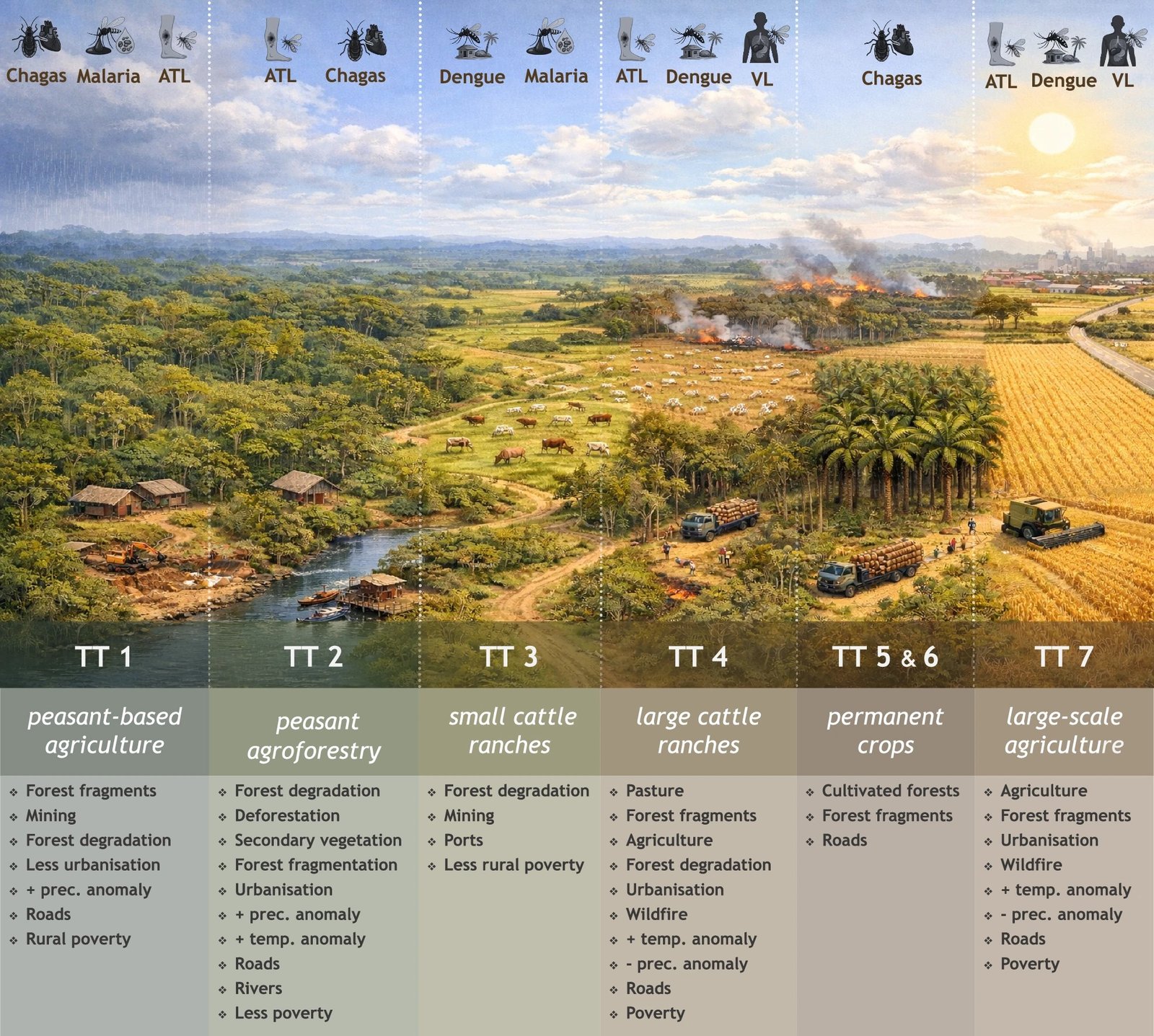
Summary diagrams of technoproductive trajectories (TTs) and their characteristics associated with the corresponding diseases, organised across five dimensions: land cover, mobility, economy (TT class), social conditions and climate anomalies. ATL = American tegumentary leishmaniasis; VL = visceral leishmaniasis. The associations are based on the results of multivariate models. Source: Barbosa, M., Lana, R.M., Dal’Asta, A.P. et al. Vector-borne disease co-occurrence is shaped by agrarian economy and socioenvironmental contexts in the Brazilian Amazon. Commun Earth Environ 7, 590 (2026). https://doi.org/10.1038/s43247-026-03619-4 Attribution 4.0 International CC BY 4.0 Deed
Protecting the forest to safeguard human health
Overall, the study confirmed “the initial hypothesis that economic scenarios—operationalised here through Technoproductive Trajectories (TTs)—considerably influence the biosocial conditions underlying disease clustering in the Amazon region, shaping the ecosyndemic landscapes of vector-borne diseases (VBDs)”. Different forms of land use — from forest conservation to industrial agriculture — alter the habitats of insect vectors, influence human mobility and alter the socioeconomic conditions of local communities.
“TTs are not merely a backdrop”, concludes the study. “Rather, they actively shape how environmental transformations, vector ecology, and socio-economic inequalities converge, ultimately moulding distinct ‘ecosyndemic’ landscapes in the Amazon”. These findings could help public health authorities identify the most vulnerable areas and strengthen epidemiological surveillance, while also informing integrated strategies that combine forest conservation, sustainable development and disease prevention.
 Photo: Thomas Bjørkan CC BY-SA 3.0
 Re Soil Foundation