“Forests and agriculture are not in competition,” FAO says amid COP30
 Peter Prokosch Attribution-NonCommercial-ShareAlike 2.0 Generic CC BY-NC-SA 2.0 Deed
 At the Climate Conference, FAO promotes integration between sectors: “Food security depends on forests; conservation and restoration are crucial actions for increasing productivity.”
by Matteo Cavallito
Global forests perform essential and often underestimated services that strengthen the planet’s agri-food systems. This is why synergies between the two sectors must be promoted through appropriate policies and investments. This is the message launched by the latest FAO report that was released at the 2025 United Nations Climate Change Conference (COP30) in Belém, Brazil.
“Forests and trees are often seen as competing with farming for land, or being peripheral to agriculture, but conserving and restoring forests is in fact crucial to boosting agricultural productivity,” said FAO Forestry Director Zhimin Wu.
The benefits of forests
Published jointly by the Stockholm Environment Institute, Conservation International and The Nature Conservancy, the FAO report emphasizes how deforestation has immediate and measurable effects on climate and agriculture. In addition to mitigating temperatures, these ecosystems sustain rainfall and regulate the water cycle, directly supporting crop productivity, stabilizing local climates, and improving the health, safety, and livelihoods of rural communities.
“A recent study shows that agricultural areas in 155 countries rely on forests in other countries for up to 40 percent of annual precipitation,” the report points out.
This is particulary true for Africa, where, according to the survey, “Almost 50 percent of precipitation derives from transpiration worldwide.” In the continent, moreover, “Congo rainforest, recycles over 40 percent of its moisture locally and contributes over 10 percent of precipitation to remote African agricultural areas.”
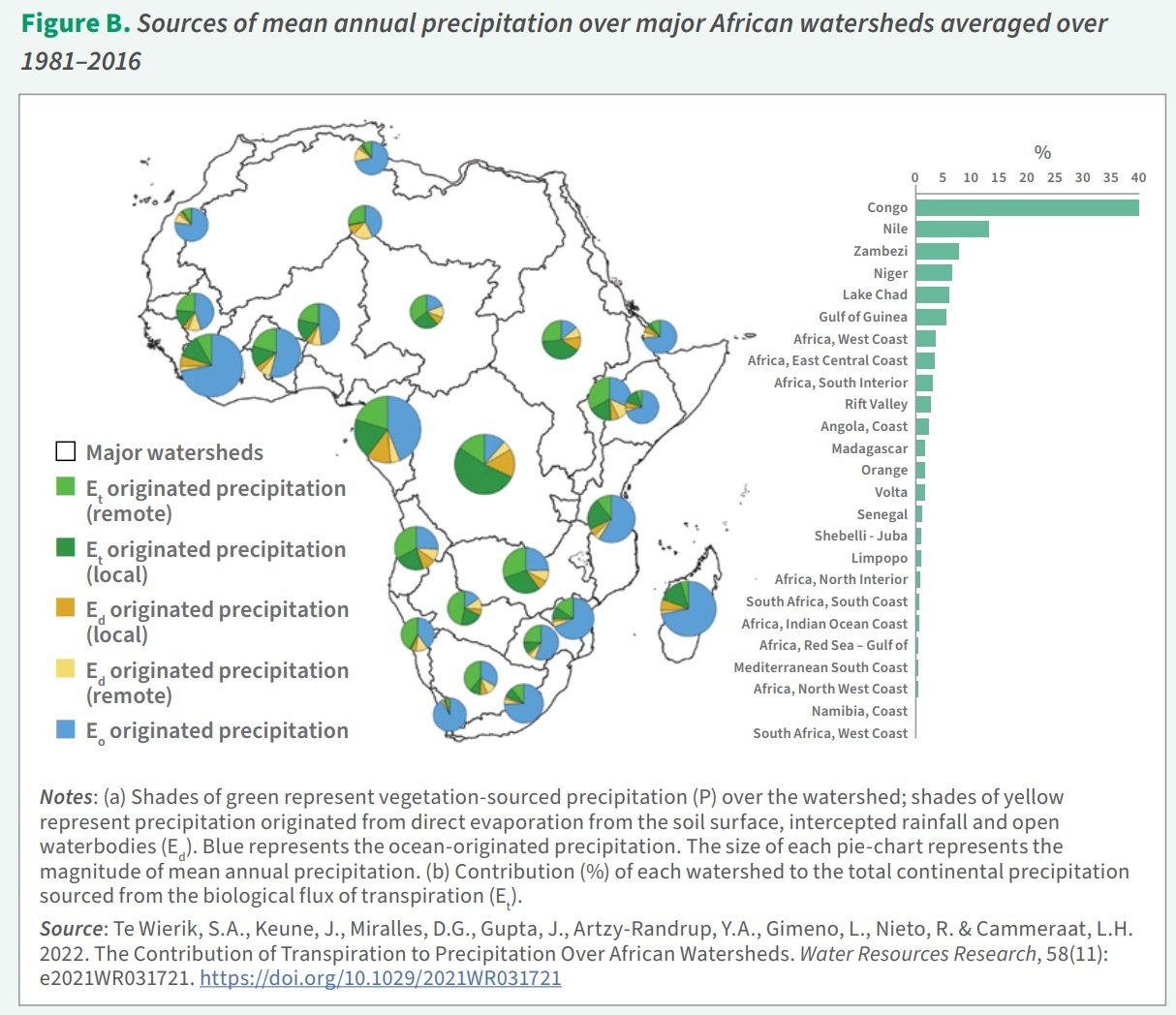
Sources of mean annual precipitation over major African watersheds averaged over 1981–2016. Almost 50 percent of precipitation over the African continent derives from transpiration worldwide, with a disproportionate share originating in the Congo basin. Source: FAO, SEI, CI & TNC. 2025. Climate and ecosystem service benefits of forests and trees for agriculture. Rome, Stockholm, and Arlington. https://doi.org/10.4060/cd7599en Attribution 4.0 International CC BY 4.0 Legal Code
Benefits for climate and agriculture
At local level, the report continues, forests create cooler microclimates through shading and evapotranspiration, reducing heat stress. Conversely, rising temperatures due to deforestation can affect human health. In particular, it is estimated that between 2001 and 2020, deforestation in the tropics contributed to “around 28 000 additional heat-related deaths annually, suggesting that forest loss is both an environmental issue and a potential public health threat.” The benefits for agriculture are also significant.
“Forests and trees deliver other vital ecosystem services – such as pollination, biological pest control, nutrient cycling, erosion control, fodder, mulch, and climate regulation – that enhance crop yields and sustain ecosystem health,” writes the FAO.
Therefore approaches that integrate forests and trees into agricultural systems as as shelterbelts, riparian buffers and forest patches are crucial. These strategies make it possible to “reduce dependence on synthetic inputs, enhance resilience to climate variability, and support the production of diverse, nutrient-dense foods.”
Policies and incentives for forest management
According to the report, restoring even half of the world’s lost tropical forests could reduce surface soil temperatures by 1°C, helping to restore the water cycles and climate regulation functions of forests and trees for the benefit of agriculture and water security. However, concrete initiatives and economic incentives are needed to achieve these goals.
“Policy and incentives must bridge sectors, recognizing sustainable forest management as a multisectoral strategy for food security, public health and climate resilience,” FAO explains.
Finally, farmers, local and indigenous communities must be empowered by involving them in the design of shared solutions and improving monitoring activities. In this sense, “Forest conservation, restoration and sustainable use are sound investments in climate resilient agriculture, rural livelihoods, and global food and water security,” the report concludes. “By promoting forest– agriculture synergies, societies can work towards a more productive, sustainable and equitable future.”
 Jonathan Wilkins Attribution-ShareAlike 3.0 Unported CC BY-SA 3.0 Deed
  Melissa McMasters Attribution 2.0 Generic CC BY 2.0 Deed