Compost protects soil carbon. But climate change is rewriting the rules
 Consorzio Biorepack
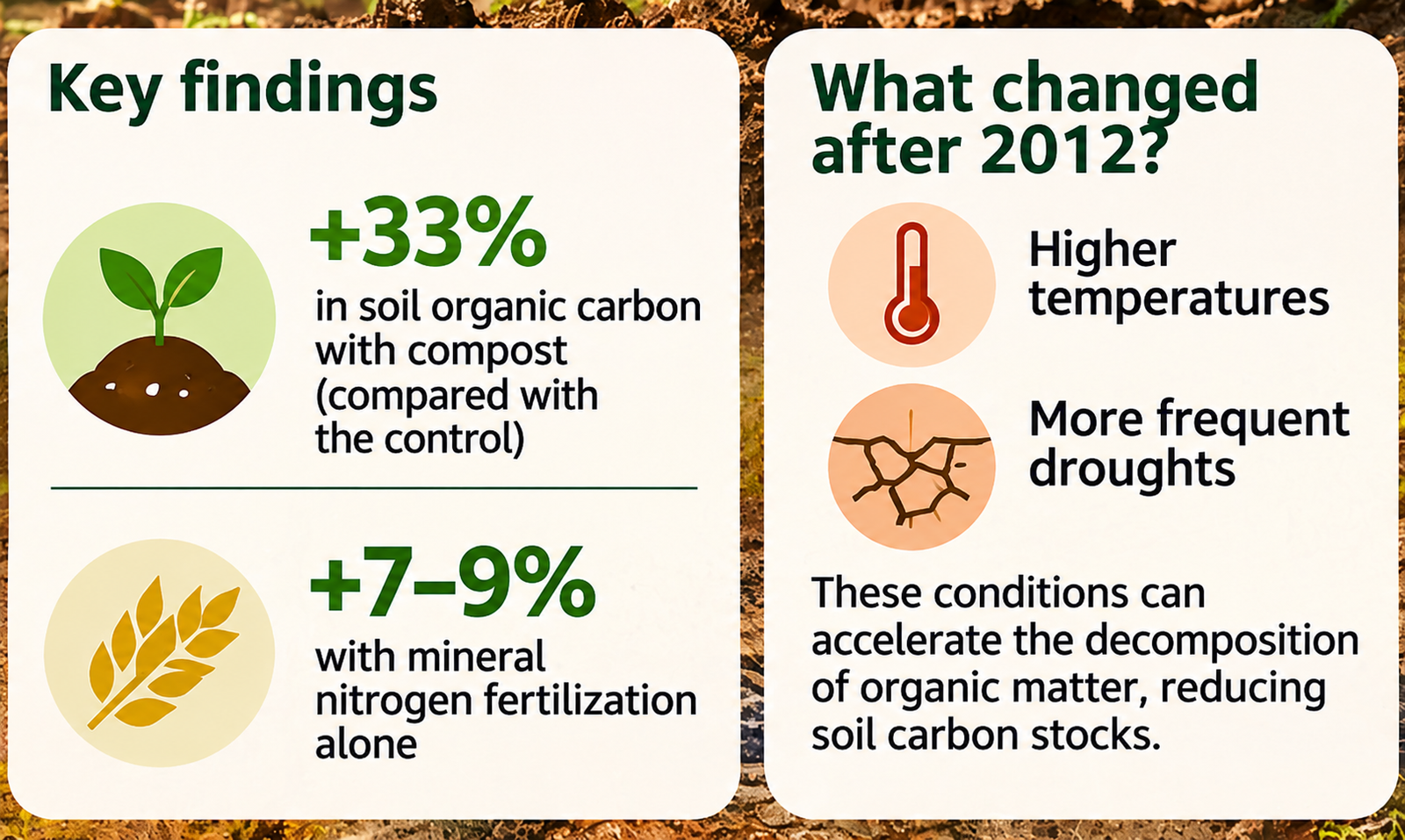
A German study examines 29 years of agricultural trials: compost application increases soil organic carbon by up to 33% compared with untreated soils. However, rising temperatures and drought may be contributing to declining carbon stocks, even where organic matter continues to be added
by Emanuele Isonio
Compost helps agricultural soils accumulate carbon, but global warming could gradually undermine some of these benefits. This is suggested by a study published in the scientific journal Geoderma, which examined changes in soil organic carbon over 29 years of agricultural experimentation in Germany. The findings show that applying organic soil amendments can significantly increase soil carbon stocks, but also that these stocks may decline even when fertilization practices are maintained.
The research, led by David I. Schubert and conducted by a team including scientists from the Technical University of Munich, the Bavarian State Research Center for Agriculture and the Thünen Institute, examined a long-term field experiment carried out between 1994 and 2023 in Puch, Bavaria. The aim was to understand how different agricultural management strategies affect the soil’s ability to store carbon over time and what role climatic conditions may play.
Twenty-nine years of compost application and fertilization
The researchers compared agricultural plots subjected to different treatments: green manure, three types of compost, and varying levels of mineral nitrogen fertilization. The findings confirmed the importance of organic inputs in maintaining soil organic matter.
Even the highest level of mineral nitrogen fertilization produced an increase of between 7% and 9%, but its effect was considerably smaller than that of organic amendments.
One significant finding concerns crop productivity. Although nitrogen fertilization substantially increased yields and, consequently, the amount of crop residues returned to the soil, this greater input of biomass did not translate into a comparable increase in carbon stocks.
The amount of organic material entering the soil is therefore not the only determining factor. The properties of soil amendments and the processes governing the decomposition and stabilization of organic matter also play a crucial role.
Carbon stocks began to decline after 2012
The most interesting finding emerges when examining the entire time series. During the early years of the experiment, soil organic carbon levels increased, reaching relatively high values around 2012. After that, however, the trend reversed.
Carbon stocks began to decline across all treatments, including those that continued to receive compost and those with increasing inputs of crop residues.
The decline coincided with rising temperatures and more frequent drought episodes at the experimental site.
To investigate the potential role of climate, the researchers used different configurations of the RothC model, a tool designed to simulate changes in soil organic carbon over time. Model configurations that explicitly accounted for climatic conditions reproduced the observed changes more accurately.
The findings suggest that warming temperatures and changes in soil moisture conditions may have contributed to accelerating carbon losses through the decomposition of organic matter. However, they do not establish with certainty that climate change was responsible for the entire decline observed after 2012.
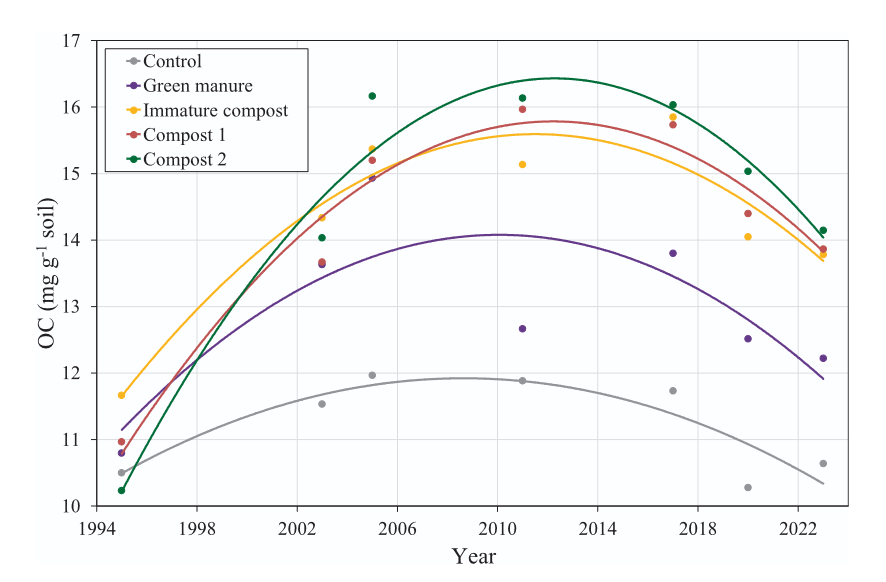
Development of soil organic carbon (OC) contents in the plough layer (0–20 cm) with different organic amendments (mean of the mineral N levels) from 1995 to 2023. Points represent measured OC values, and curves represent second-order polynomial regression models fitted to the temporal OC data Volume 474, 2026. SOURCE: David I. Schubert, René Dechow, Christopher Just, Michael Diepolder, Axel Don, Ingrid Kögel-Knabner, Florian Ebertseder, Martin Wiesmeier – From sink to source: long-term soil carbon trends in cropland soils under high organic matter inputs, Geoderma, Volume 474, 2026.
Why warming can alter the soil carbon balance
Soil organic carbon is the result of a dynamic balance. On one side are inputs of plant material, roots, crop residues and organic amendments; on the other are the biological processes that break down organic matter and release some of its carbon into the atmosphere as carbon dioxide.
Higher temperatures can accelerate the activity of microorganisms responsible for decomposition when sufficient moisture is available. Drought, on the other hand, can temporarily slow this activity, while subsequent rewetting may trigger renewed bursts of microbial activity.
The overall effect therefore depends on the interaction between temperature, water availability, soil characteristics and agricultural management.
In the Bavarian experiment, the findings indicate that compost applications helped mitigate carbon losses compared with less favourable treatments, but were unable to prevent the overall reversal of the trend.
This is also an important consideration for carbon farming strategies, which aim to increase carbon stocks in agricultural soils through sustainable management practices. Carbon accumulated over a given period cannot automatically be considered permanent: its persistence must be monitored over time, taking environmental conditions into account.
Compost remains a valuable resource, but it is not enough on its own
The study’s findings do not call into question the benefits of compost. On the contrary, they confirm that organic amendments can significantly increase carbon levels in agricultural soils compared with management practices that do not include organic inputs.
However, the research highlights a limitation of strategies based solely on adding organic matter: in a changing climate, maintaining or increasing soil carbon stocks may become progressively more difficult.
For this reason, the authors emphasize the need to combine organic amendments with additional soil management practices, tailored to soil characteristics and local climatic conditions.
The experiment was conducted at a single site in southern Germany, meaning that its findings cannot be directly extrapolated to all agricultural regions of Europe. Nevertheless, it offers valuable insights for Mediterranean regions, where rising temperatures and increasingly frequent droughts are already placing additional pressure on soils.
The key conclusion is that preserving soil carbon depends not only on how much organic material is added, but also on the ability to protect it over time. Climate change could make this challenge even more difficult, just as agricultural soils are becoming increasingly important in strategies to mitigate greenhouse gas emissions.
 Ecomondo
 Aethonatic / Wikimedia Commons — CC0
 Krzysztof Ziarnek, Kenraiz / Wikimedia Commons, CC BY-SA 4.0