
Climate change puts Europe’s last peatlands at risk
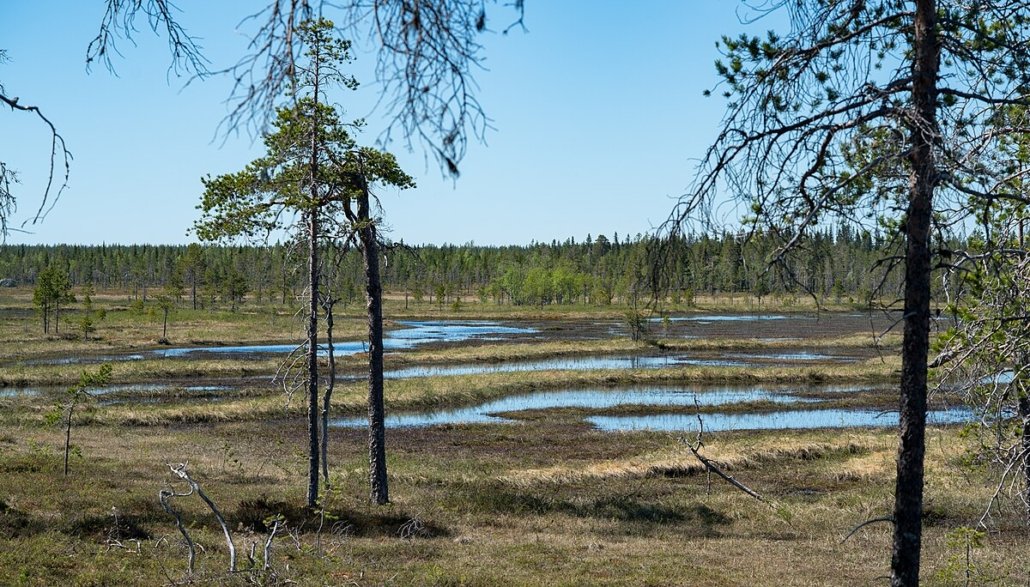 SiberianJay Attribution-ShareAlike 4.0 International CC BY-SA 4.0 Deed
Currently, a study has found, only 7% of continental peatlands can be considered intact. But climate pressure is increasing, and in the coming years the situation could worsen
by Matteo Cavallito
Climate change “will massively impact” the functioning of peatlands across Europe, sparing only those located in the coldest and wettest areas. This is stated by a study from Wageningen University in the Netherlands, conducted within the WaterLANDS project, a programme led by University College Dublin that brings together 32 organizations from the research, industry, public institutions and non-profit sectors across 14 European countries.
The research analysed the distribution of these particular ecosystems by mapping their probability of survival under future scenarios. To date, scientists argue, only 7% of the original surface area of continental peatlands has remained intact, and their climatic boundaries are changing.
A fundamental ecosystem
“Globally, peatlands store twice as much carbon as forests. Conservation of these ecosystems is vital in preventing the return of massive amounts of carbon to the atmosphere,” says the study published in the journal Environmental Research Letters. “With climate boundaries of ecosystems shifting, choosing to restore wisely has never been more important”. Characterised by a distinctive biodiversity, peatlands have long attracted the attention of scientists for their role in climate mitigation, as they are particularly suited to carbon storage, even though the effectiveness of this process can vary considerably across different regions of the planet.
Over the centuries, however, peat extraction and agricultural conversion have progressively reduced the extent of these environments. This phenomenon is demonstrated by the comparison between the historical and current spatial distribution of peatlands carried out by researchers using soil as an archive.
93% of European peatlands no longer have functioning peatland ecosystems
“We set out to assess how climate boundaries of peatlands in Europe may shift with climate by (1) deriving relationships between peatland distributions and climate variables and (2) using these relationships to project peatland distributions into the future,” the authors explain. Today, they add, “We estimate that 93% of European peat soils do not longer have functioning peatland ecosystems”.
The study, the researchers explain, can contribute to restoration efforts which, they argue, should now be developed on a large scale.
After in the past, as a statement points out, these efforts “have often been too localized or fragmented to make a significant difference to the re-establishment of ecosystems and species.” But what might peatlands look like in the future in the absence of regeneration initiatives? The study also answered this question.
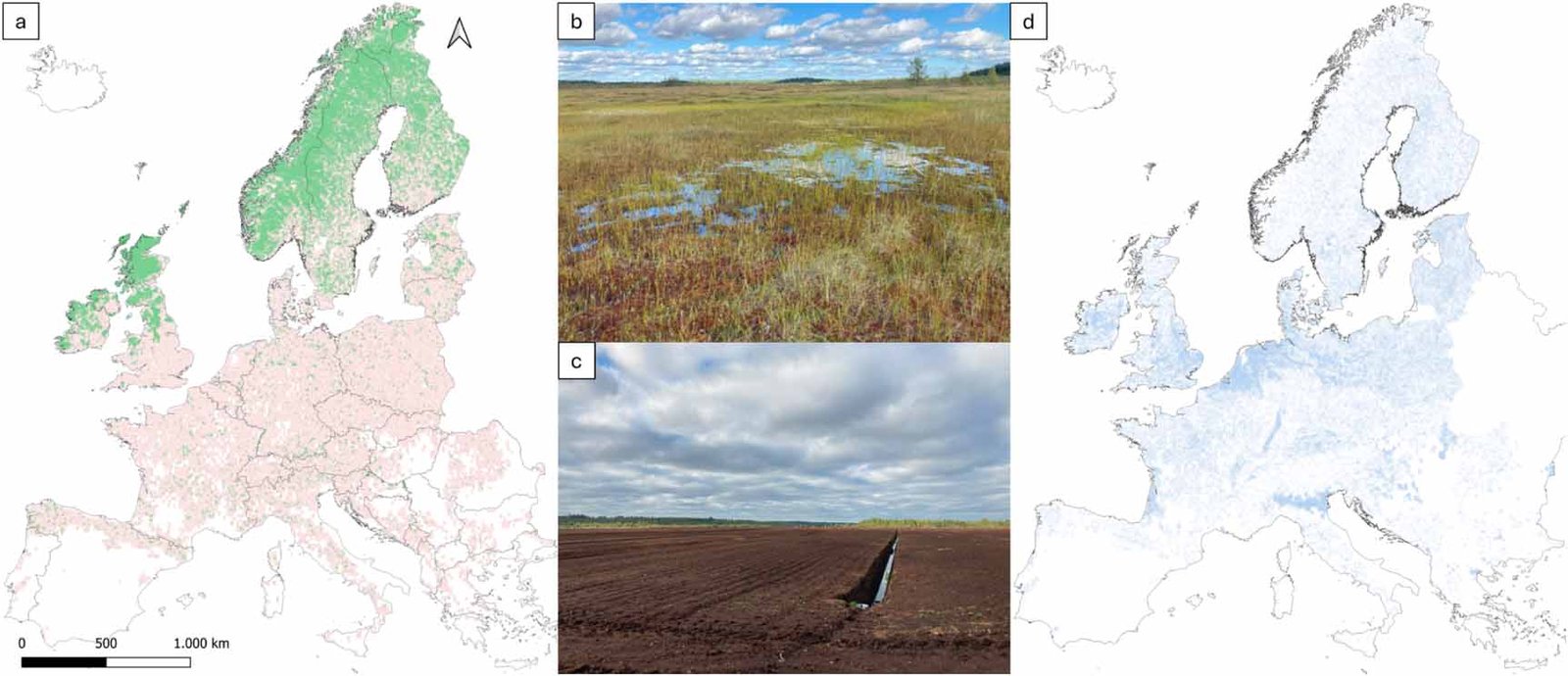
(a) The distribution of functional (green) and non-functional (red) European peatlands (b) functional open mire (c) non-functional drained peatland (d) the distribution of potential European peatlands. Photos: Juul Limpens Enahu Tahitu et al 2025 Environ. Res. Lett. 20 124033 DOI 10.1088/1748-9326/ae2142. Attribution 4.0 International CC BY 4.0 Deed
For the remaining 7%, climate pressure is increasing
The researchers, in fact, mapped the climatic conditions characterizing the “surviving” areas and projected them into the future considering two different scenarios: the first assumes an evolution of average temperatures in line with the Paris Agreement in a low-emission world (about +1.5 °C by 2100 compared to pre-industrial levels); the second, on the other hand, envisions a strong increase already in the coming decades (+3 °C by 2050).
Most of these ecosystems, they explain, will have to face increasing pressure. ” The climate conditions for the remaining 7% of peatlands may remain best in Northern Scandinavia, the Western islands, and higher elevations within the European mainland,” the study explains. Conversely, “climate suitability for peatlands will significantly decrease through most of Southern, Central, and Eastern Europe,” the study concludes.
 Jonathan Wilkins Attribution-ShareAlike 3.0 Unported CC BY-SA 3.0 Deed
  Melissa McMasters Attribution 2.0 Generic CC BY 2.0 Deed


