Street trees provide less cooling during droughts
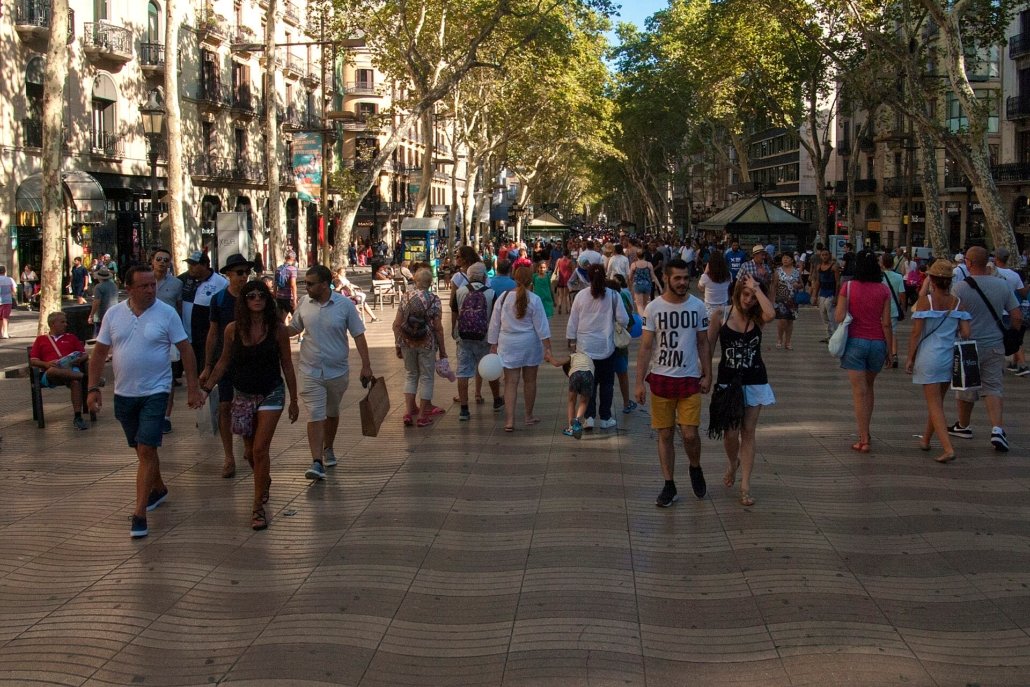 Zietz, CC BY 3.0 (Attribution 3.0 Unported).
A study in Barcelona shows that low soil moisture reduces tree transpiration during heatwaves. Preserving foliage is crucial on the hottest days
by Matteo Cavallito
When drought and extreme heat strike together, trees lose much of their ability to cool urban areas. With little water available in the soil, trees transpire less just as the heat intensifies. As a result, their daytime cooling effect is weaker than it is when the soil is moist. That is the finding of a study by the Universitat Autònoma de Barcelona (ICTA-UAB).
“Our findings confirm that street trees can substantially mitigate pedestrian heat stress in highly-compact Mediterranean cities through the combined effects of air-cooling and shading, although the relative contribution and climatic resilience of these mechanisms differ considerably”, write the authors of the study, published in Urban Climate.
Trees and permeable soils help counter urban heat islands
The urban heat island effect, the temperature difference between a city and its surrounding rural areas, is intensified by surfaces such as asphalt and concrete, which absorb heat and limit the amount of water that can soak into the ground. Trees help in two ways. Their canopies block sunlight, shielding pedestrians from direct exposure and limiting how much streets and building façades heat up. Through transpiration, their leaves release water taken up by the roots as vapour, helping to cool the air.
By reducing urban heat, tree cover can also benefit public health, as comparisons with scenarios involving canopy loss suggest. Drought, however, can undermine these benefits.
“As the soil dries, reduced stomatal conductance limits evapotranspiration, progressively weakening the air-cooling potential of street trees”, the study continues. The authors add: “Under severe drought, the physiological cooling function may become sufficiently suppressed so that tree canopies contribute to sensible heat to the surrounding air, as absorbed radiation is no longer dissipated through latent heat fluxes”.
Severe drought can cut trees’ protection against heat stress by up to four-fifths
To quantify these effects in Barcelona, the researchers adapted a microclimate model known as BEP-Tree that simulates heat exchange between buildings, street surfaces, trees and the air. They modified the model to account for how soil moisture affects tree transpiration and to estimate pedestrian heat stress. The simulations covered both typical summer days and heatwave days under moist, dry and very dry soil conditions.
In simulations of the heatwave with moist soil, air temperatures between 11 a.m. and 5 p.m. were on average 1.7 °C lower on streets with more trees than on streets with fewer trees.
To assess pedestrian heat stress, the authors used the Universal Thermal Climate Index (UTCI), which combines air temperature, humidity, wind and radiation. On the hottest day, with moist soil, higher tree density lowered the index by 1.6–3.1 °C, depending on the location. During the heatwave, 69% to 96% of the benefit estimated for moist soil was retained under dry soil conditions. In the severe drought scenario, that share fell to 20–69%. In other words, severe drought can erode up to four-fifths of the trees’ heat mitigation benefit.
Tree canopies remain crucial
The results show that canopy shade still offers substantial protection when water scarcity limits the trees’ ability to cool the air. “By reducing direct solar radiation and lowering surface temperatures, canopy cover preserves large reductions in radiation exposure even when transpiration is constrained”, the study explains.
“This distinction is particularly important because it indicates that the principal thermal adaptation value of street trees in drought-prone climates may lie less in evaporative cooling and more in the persistence of structural shade”.
Foliage density remained constant in the simulations. In practice, however, prolonged drought can harm tree health and reduce canopy cover just when shade is needed most.
Keeping streets shaded on the hottest days
These findings are particularly relevant to Mediterranean cities, where climate change is making drought an increasing concern. In this region, “one of the main challenges facing the city is ensuring that trees maintain sufficient foliage during drought periods, and especially during heat waves, which is precisely when shade is needed the most”, said Ricard Segura-Barrero, a researcher at the Institute of Environmental Science and Technology at the Universitat Autònoma de Barcelona and the study’s first author, in a statement.
The study identifies two equally important priorities: choosing and protecting species that can retain their foliage through the summer and preserving the water available in the soil.
“For cities where water scarcity limits natural soil moisture availability, irrigation or water-sensitive urban design may be necessary to preserve tree performance during extreme heat and drought”, the authors conclude. “Supplemental irrigation can help maintain canopy vitality, delay foliage loss, and sustain cooling services during critical summer periods”.
 Photo: AusAID / Department of Foreign Affairs and Trade, CC BY 2.0
 Consorzio Biorepack
 Ecomondo