For agrivoltaic systems, soil protection must begin during construction
 obi Kellner, CC BY-SA 4.0
A German study finds severe soil compaction even in the areas available for cultivation between solar panels. Soil protection measures during construction are essential, particularly in sandy soils, which struggle to recover
by Matteo Cavallito
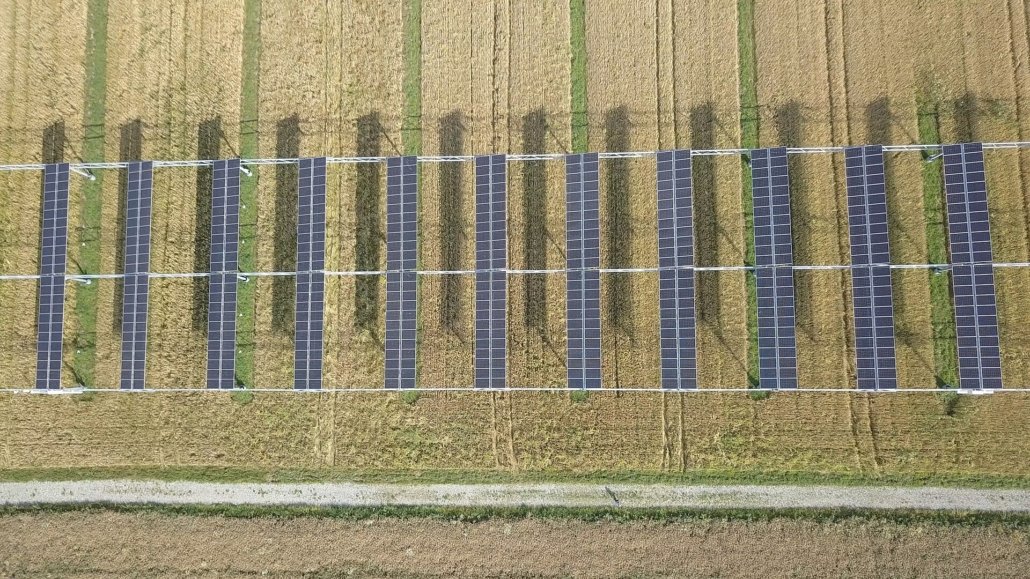
Generating solar power and growing crops on the same land. This is the promise of agrivoltaics, an integrated system in which the two activities can coexist, despite the challenges, provided that preventive measures are adopted to protect the soil from the planning stage onwards. This is the finding of a study by the Leibniz Centre for Agricultural Landscape Research (ZALF) in Germany, published in Scientific Reports.
To prevent compaction and reduce risks to agricultural productivity, “we suggest that pedological construction supervision should become standard practice for Agri-PV projects, ensuring soil protection measures are integrated into planning, construction, and restoration”, the authors write.
The problem of compaction
Agrivoltaic installations can contribute to the energy transition by reducing competition for land between food production and electricity generation. However, their construction involves the use of heavy machinery, which can compress the soil and reduce its porosity. Much research has focused on how solar panels affect growing conditions. To date, researchers have paid less attention to the damage caused during construction.
This includes compaction, which can hinder root growth and water infiltration, potentially affecting yields. Natural recovery is particularly difficult in sandy soils.
“In contrast to finer-textured soils, sandy soils lack shrink–swell capacity and exhibit lower biological activity, both of which limit their natural ability to recover from mechanical disturbance”, the authors note. The risk increases when machinery moves across the site under unfavourable soil moisture conditions. Protecting soil structure is therefore an integral part of the installation’s sustainability.
Examining the soil
The research examined an installation built in autumn 2024 in Müncheberg, Brandenburg, on predominantly sandy land. During construction, which coincided with 83 millimetres of rainfall, the machinery used included a telescopic handler weighing almost 18 tonnes and an excavator weighing more than 23. Compaction also affected the cultivable areas between the panels. “In our study, soil compaction occurred around pole bases (due to direct construction impacts), but also across the wider agricultural area between the poles”, the study explains.
Subsequent measurements, compared with those from a nearby area unaffected by construction, revealed average bulk densities of 1.67–1.69 grams per cubic centimetre at depths of 70–75 centimetres, with individual readings reaching 1.86–1.99. However, the absence of measurements taken before construction means that not all deep soil compaction can be attributed to the building work.
At depths of 20–25 centimetres, penetration resistance reached 3.7–4.1 megapascals, roughly twice the value (2 megapascals) typically used as an indicator of a major impediment to root growth. “These values are well above the thresholds known for these soil types, beyond which plant root growth is restricted”, Kathrin Grahmann, a researcher and the study’s lead author, explained in a statement. “In the case of sandy soils, such as those examined in our study, this is particularly problematic because they find it difficult to recover on their own.”
Preventive strategies must become standard practice
At the site examined, the study notes, the contractors had taken no specific precautions to protect the soil. Only after construction was complete did they begin tillage operations and introduce alfalfa cultivation over several years to help the compacted soil recover. Although the research did not directly measure yield losses, it highlighted the risks associated with this type of construction work when adequate protective measures are absent.
The case study also led the researchers to recommend preventive measures to reduce the risk of land damage, starting with supervision of construction work by soil specialists. Other practices include “careful planning of construction timing, load restrictions during wet conditions, and the use of mitigation techniques such as controlled traffic lanes and temporary trackways”, the authors conclude.
 Oded Gilad, CC BY-SA 4.0
 Hans Hillewaert, CC BY-SA 4.0
 Blonder1984, CC BY-SA 3.0