Higher elevations offer less and less protection against drought in Swiss forests
 Hans Hillewaert, CC BY-SA 4.0
A study highlights the declining benefits of higher elevations for forest resilience. The protective function of forests could be at risk in the long term
by Matteo Cavallito
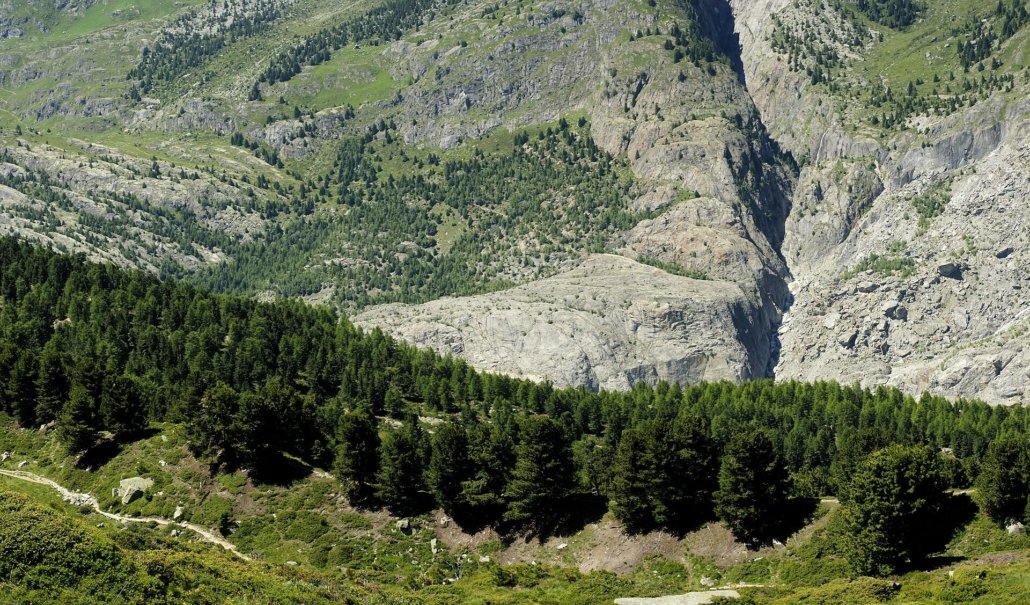
Higher elevations are offering forests less protection from the effects of drought. Evidence of this trend comes from Switzerland, where even forests growing above two thousand metres show signs of decline, while their ability to withstand and recover from extreme events is weakening. These are the findings of a study by the Bern University of Applied Sciences and the Swiss Federal Institute for Forest, Snow and Landscape Research (WSL), published in Frontiers in Forests and Global Change.
Analysing four decades of data on protective forests, the authors found a gradual weakening of the link between elevation and drought resilience. “The historical advantage of higher altitudes against drought stress is diminishing, suggesting a convergence of acclimation levels where drought stress thresholds are increasingly exceeded across all belts, regardless of altitude”, the study explains. “This convergence, however, does not yet translate into uniform structural responses”.
A natural defence under pressure
In Switzerland, protective forests cover around 540,000 hectares, accounting for 44% of the country’s forest area. As the authors note, they help reduce the risks associated with avalanches, rockfalls, landslides, floods and sediment transport. “The protective effect depends on forest structural traits, such as the stand basal area, the stem density and/or the canopy cover. Its stability depends not only on the current forest structure but also on the trees’ capacity to cope with their environment.”
The problem, however, is that warming and droughts that are becoming increasingly frequent are weakening this defence.
These changes could therefore compromise the long-term protective role of these forests, which help shield people and infrastructure from natural hazards. “Even as high as at 2,200 meters altitude, the number of trees per stand is reduced due to the decline or death of large, dominant trees in particular”, explained Estelle Noyer, the study’s first author. “This causes a progressive decline of these precious forests which protect against natural hazards”.
Forty years of forest data
The researchers used National Forest Inventory data collected between 1983 and 2022, examining between 891 and 1,543 sample plots, depending on the period, at elevations ranging from approximately 282 to 2,219 metres. They selected protective forests with no signs of fire and no forestry interventions in the ten years before each survey. They combined tree measurements with a water stress index based on temperature and precipitation, alongside satellite observations of canopy moisture. Stands were classified as growing or declining according to changes in basal area, the sum of the cross-sectional areas of tree trunks measured at breast height (1.3–1.5 metres above the ground).
This measure “integrates distinct processes: tree growth, mortality and ingrowth, and serves as an essential metric for assessing the protective effect of forests”.
In the colline belt, the proportion of declining stands rose from 11.1% in the first interval to 30.4% in the last. In the upper subalpine belt, after falling to 10.3%, it rose again to 18.8% in the most recent period. These patterns therefore vary with elevation. Overall, the slowdown in stand growth is primarily linked to net changes in tree numbers, while the average growth of individual surviving trees can remain stable.
Recovery becomes crucial
The signs of vulnerability in declining forests are also changing: in earlier periods, lower resistance during drought was the main issue; in the most recent survey period, a reduced ability to recover afterwards becomes more apparent. The authors suggest that the most vulnerable trees have been progressively lost, leaving individuals able to withstand the initial stress but weakened by repeated events.
At the highest elevations, the study also notes, declining stands have recently shown a greater contribution from smaller trees to growth. It remains unclear, however, whether this represents a lasting adaptation.
To preserve the protective role of these forests, the study recommends targeted interventions. “Accelerating the transition toward drought-tolerant tree cohorts through targeted silvicultural intervention will be critical”, the authors note. “Particularly at low and intermediate altitudes where decline trends are most pronounced and the protective effect most immediately at risk”.
 Blonder1984, CC BY-SA 3.0
 Gareth James CC BY-SA 2.0 Attribution-ShareAlike 2.0 Generic
  Mokkie/Wikimedia Commons – CC BY-SA 3.0