Nitrogen doubles the regeneration speed of tropical forests
 Photo: pxhere CC0 Public Domain Free for personal and commercial use No attribution required
 When provided with adequate nitrogen tropical forests can recover from deforestation twice as fast as they would under normal circumstances, a research led by the University of Leeds has found
by Matteo Cavallito
An adequate supply of nitrogen in the soil would allow tropical forest areas to accelerate the regeneration process. A discovery which provides important insights for planning strategies to recover deforested areas through favorable climate solutions. This is claimed in a research led by the University of Leeds and described in a statement as “the world’s largest and longest experiment to see how nutrients affect forest regrowth in areas cleared for activities such as logging and agriculture.”
The study, which also involved the Smithsonian Tropical Research Institute in Panama, the Cary Institute of Ecosystem Studies in Millbrook (NY), in the United States, and the universities of Glasgow, Yale, and Princeton, as well as Cornell and the National University of Singapore, was published in the journal Nature Communications.
With sufficient nitrogen, regrowth speed doubles
For the experiment, researchers identified 76 forest plots in Central America, each about one-third the size of a soccer field and of varying ages. For each of them, they analyzed tree growth and death for a maximum period of twenty years. They then subjected the land to four different conditions: treatment with nitrogen-based fertilizers; application of phosphorus-based fertilizers; application of products containing both elements; no application. The authors found that soil nutrient levels strongly influenced tropical forest regrowth. But that’s not all
In fact, in the first 10 years, trees that had access to sufficient nitrogen recovered twice as fast as those that did not receive enough.
“Nutrient limitation of aboveground biomass accumulation shifts from strong nitrogen limitation in young forests to no evidence of nitrogen or phosphorus limitation in older secondary or mature forests,” the study explains. “Nitrogen addition increases aboveground biomass accumulation by 95% in recently abandoned pasture and 48% in 10-year-old forests. Conversely, we observe no influence of nitrogen on older forests and no evidence of phosphorus limitation at any stage.”
Managing nutrients
Nitrogen is an essential element for soil nutrition. However, its accumulation can cause significant environmental damage, starting with soil eutrophication—i.e., excessive nutrient enrichment—and, through leaching, water pollution. The use of nitrogen fertilizers meets the needs of the experiment, but this practice, the authors point out, is not systematically replicable.
“While directly fertilizing forests might meet nutrient requirements more rapidly,” the study states, “ts feasibility is questionable given the cost and risks of increasing fertilizer-related energy consumption and emissions of the powerful greenhouse gas nitrous oxide.” Instead, the researchers suggest that forest managers should rely on alternative techniques such as planting legumes, which naturally fertilize the forest.
Nitrogen limitation deprives forests of 700 million tons of carbon
The study has important implications for climate change. Tropical forests are, in fact, key global carbon sinks thanks to the sequestration ability of their plants. Nutrient deficiency in the soil therefore not only affects plant growth but also overall carbon absorption.
“We estimate that nitrogen limitation may prevent the sequestration of up to an additional 84o million tons of CO2 per year between 2020 and 2050 with a mean 690 million tons per year and a range of 470 to 840 tons per year,” the study explains.
This is roughly equivalent to two years of greenhouse gas emissions produced in the United Kingdom. The authors therefore suggest adopting three practices to promote carbon sequestration. First, native tree species that fix nitrogen could be included; second, reforestation could focus on areas with higher nitrogen deposits. Finally, reforestation could focus on nutrient-rich soils.
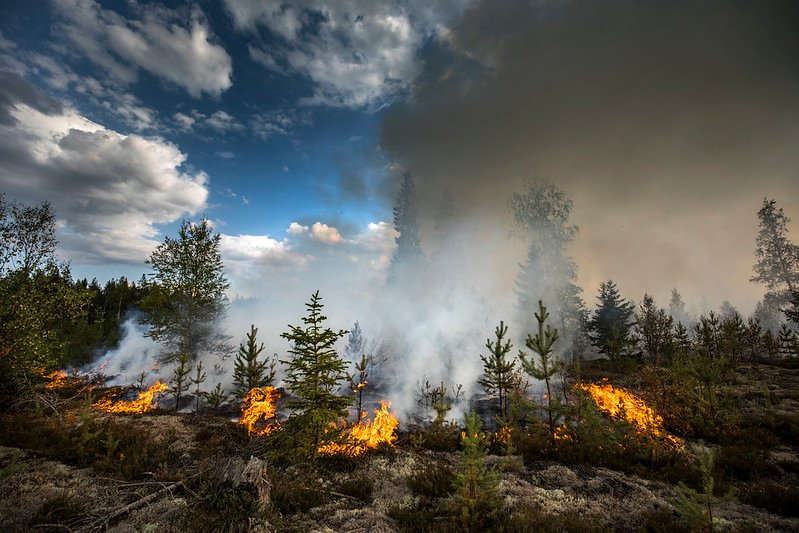 © European Union 2018 (photo by Pavel Koubek), CC BY-NC-ND 2.0
 Penn State. Attribution-NonCommercial-NoDerivatives 4.0 International, CC BY-NC-ND 4.0 Deed.
 Eric Guinther, CC BY-SA 3.0