How war is contributing to environmental degradation in Ukraine
 Ministry of Defense of Ukraine, Taras Gren Attribution - Share alike 2.0 Generic CC BY-SA 2.0 Deed
 EU Commission’s snapshot: conflict in Ukraine has contributed to the devastation of the land by releasing toxic elements that can cause serious health consequences
di Matteo Cavallito
“While Ukraine has made significant progress in climate action since the 2010s, and undertaken efforts to align its environmental strategy with EU standards, Russia’s invasion in 2022 has contributed to environmental devastation due to the release of potentially toxic elements resulting from military activities.” This is the strong verdict of the European Commission’s Joint Research Centre on the collateral damage of war.
Although not comparable to the human costs of the conflict started in February three years ago following the Russian invasion, these serious consequences nevertheless represent a major problem for a nation that can count on a vast forest heritage and one of the most productive agricultural soil on the Planet: the chernozem. The picture is included in the report “Status of Environment and Climate in Ukraine” released in recent weeks.
Emissions had decreased by nearly two-thirds in 30 years
Between 1990 and 2021, Ukraine’s greenhouse gas emissions decreased by 62.5 percent, the report notes. However, with the post-pandemic recovery the figure increased by 7.5% from 2020. The war then caused a 23-26% reduction measured in 2022 and related to the destruction of energy and industrial infrastructure. But it also generated additional emissions in the first 18 months of the conflict. In addition, between 2018 and 2022, annual average concentrations of nitrogen dioxide (NO₂) and formaldehyde (CH₂O) exceeded limits set by national standards.
In Kyiv, PM10 and PM2.5 levels were below EU limits but above the more stringent WHO guidelines.
For the state of the waters, judgment remains suspended: “The Black Sea is under a lot of pressure from human activities, resulting from nutrient and contaminant overload (including microplastics), intensive marine traffic, climate change, fishery and invasive species.” However, “environmental monitoring since the start of the war is not possible due to inaccessibility of the coast and inability to perform marine surveys.”
Fires destroyed nearly one million hectares of forest in 2024
Among the most endangered habitats are forests, which in Ukraine cover one-fifth of the land area and represent one of the largest cover in Europe in absolute value. According to the study, there are now 1.7 million total hectares affected by the war. That is about 15 percent of the country’s forest cover. “Since the outbreak of military activities in February 2022, the pressures on forest resources expanded due to intense deforestation and habitat destruction, and the threat of explosive remnants and wildfires” the report explains. And this phenomenon is not entirely new.
Indeed, in recent decades, “climate change has increased the risk of large forest fires, especially in the last five years. Wildfires account for 45-65% of the Ukrainian forest cover losses every year.”
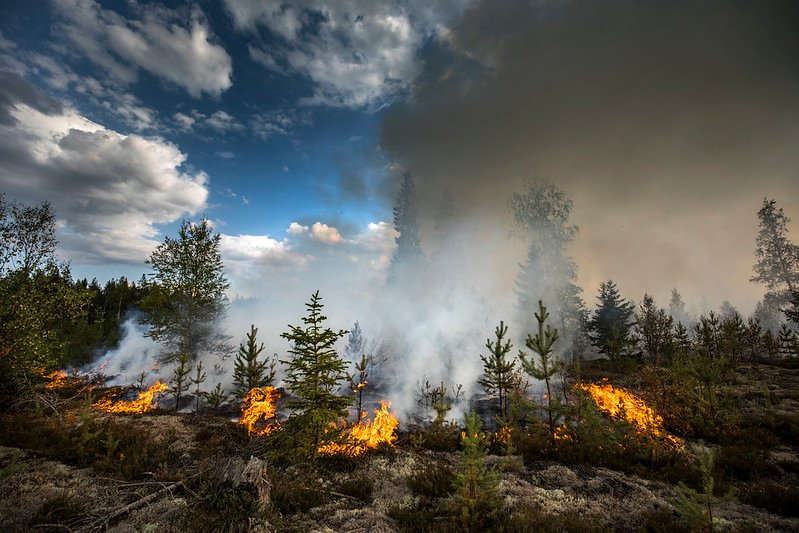
According to satellite images, Ukraine experienced record-breaking fires in 2024 that burned 965,000 hectares of forest, more than double the total area affected by flames in the same year in the European Union. “Most major fires occurred during dry and hot weather, along the frontlines,” the report explains.
Soil degradation in Ukraine
One of the biggest problems experienced by Ukraine is soil degradation affecting one of the country’s main natural resources. A soil that is essential for agriculture and national and international food security. “Soil health is of great importance in Ukraine considering that agriculture is one of the main economic activities, accounting for 11% of GDP, 60% of exports worth EUR 23.3 billion in 2023,” the report explains.
Among the main forms of degradation is erosion, a process that affects about 40 percent of agricultural land.
The loss of fertile stratum, which compromises the productivity of soils, has been fostered for years by the use of intensive and unsustainable agricultural practices. These include strategies such as deep plowing and the absence of crop rotation. Moreover, war has created an additional emergency. Indeed, the conflict “contributed to devastation by releasing toxic elements, such as lead, mercury, and arsenic that may cause serious consequences for public health by penetrating into food chains.”
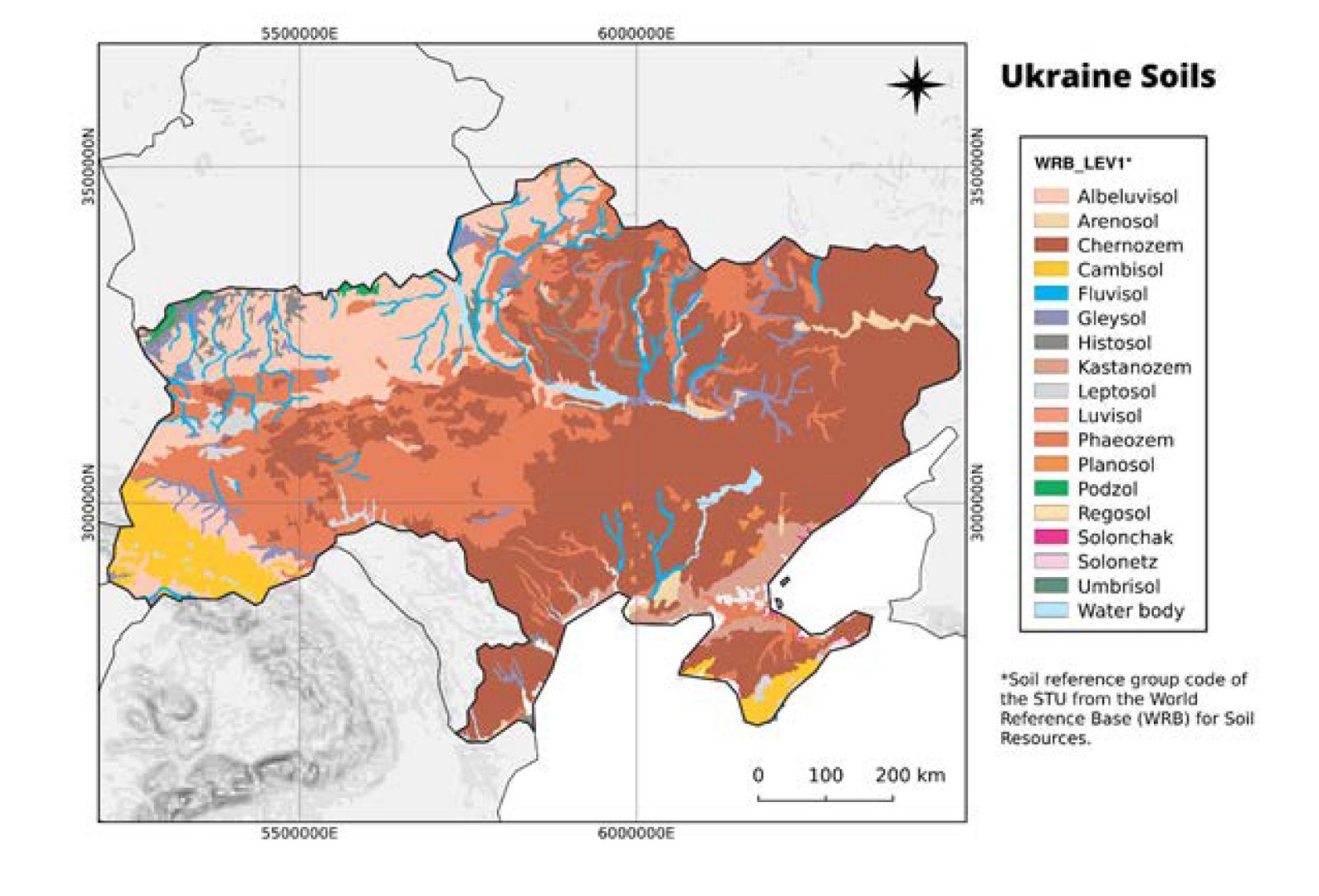
Soil map in Ukraine. The central, southern and eastern areas of the country are notable for the presence of chernozem, one of the most productive soils in the world. Source: European Commission Joint Research Centre, “Status of Environment and Climate in Ukraine“, Publications Office of the European Union, Luxembourg, 2025, JRC141480. Attribution 4.0 International CC BY 4.0 Deed
War makes monitoring more difficult
The Russian invasion, the report recalls, has multiplied environmental pressures. Explosions, troop movements and the use of munitions are events that contribute not only to soil contamination and degradation but also to the destruction of vegetation covers and the impairment of their ecological function. But there is one more problem: the presence of mines and remnants of war. This, in fact, hinders both the adoption of recovery practices and monitoring.
The national soil observation system is currently fragmented and insufficient, the authors continue. The war, then, has made many areas inaccessible and disrupted several sampling activities.
There is also a lack of a coherent national strategy and updated tools for soil health assessment. At present, in short, it becomes very difficult to assess relevant phenomena such as compaction, acidification, salinization and loss of organic matter. And it becomes equally complex to take targeted remedial action. In the future, it will therefore be crucial to strengthen remote monitoring capacity, introduce conservation farming practices, remediate soils that are contaminated and have been made hazardous by the presence of war remnants, and, finally, integrate soil protection into climate reconstruction and adaptation policies.
 © European Union 2018 (photo by Pavel Koubek), CC BY-NC-ND 2.0
 Penn State. Attribution-NonCommercial-NoDerivatives 4.0 International, CC BY-NC-ND 4.0 Deed.
 Eric Guinther, CC BY-SA 3.0