
Invasive plants threaten Arctic biodiversity
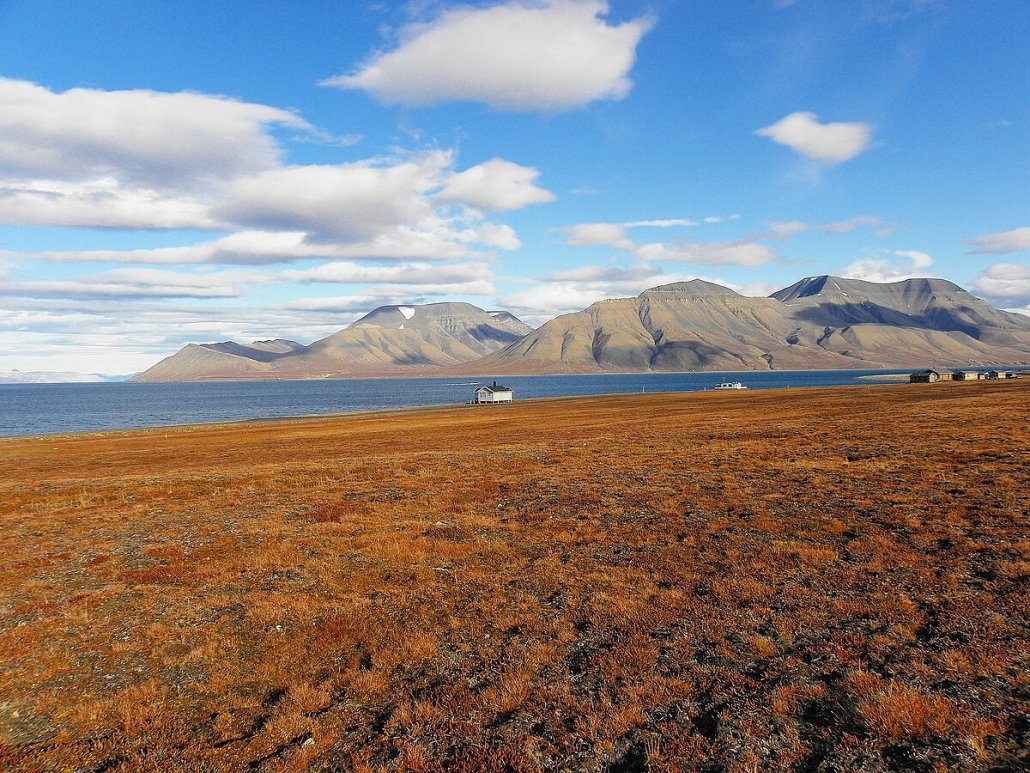 Billy Lindblom Attribution 2.0 Generic CC BY 2.0 Deed
 Biodiversity at risk: Norwegian research provides a picture of the growing presence of invasive plants on Svalbard. “We need to prevent the phenomenon,” scientists explain
by Matteo Cavallito
The biodiversity crisis spares no one. Not even the most remote and isolated territories of the planet, which are also victims of an increasingly widespread and worrying phenomenon: the assault of new plant species. Here is how it works: non-native varieties compete with local plants, reducing their presence and negatively impacting the balance of the ecosystem. A worldwide phenomenon that, for some time, has also been affecting the distant Svalbard Islands in the Arctic Ocean archipelago. This was revealed in a study by the Norwegian University of Science and Technology in Trondheim.
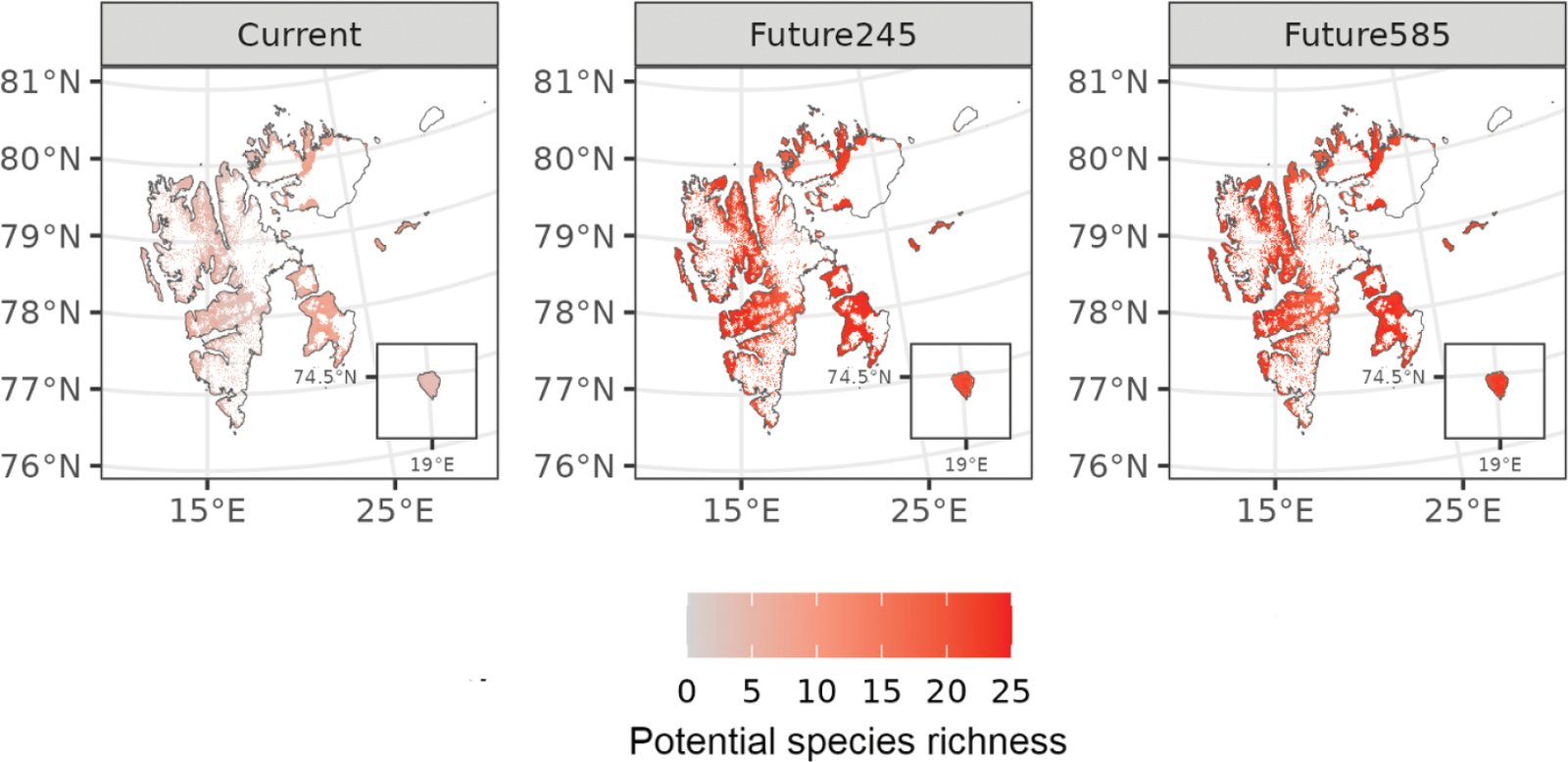
Potential richness of non-native vascular plant species across Svalbard under current and two future climate scenarios. SOURCE: Speed JDM, Pertierra LR, Westergaard KB (2024) The potential area of occupancy of non-native plants across a warming high-Arctic archipelago: Implications for strategic biosecurity management. NeoBiota 93: 157-175. https://doi.org/10.3897/neobiota.93.114854
More and more non-native plants are found in Svalbard
‘So far, the Arctic has managed to avoid one of the most serious threats to biodiversity on Earth,’ says a statement from the same university. “This is also true for Svalbard, but things could change very quickly, and the researchers want to find out how to counteract this threat.” The thing, the Norwegian scientists explain, is that new, non-native plant species are increasingly being found in the archipelago. A phenomenon that inspires two possible explanations.
“Increased human activity heightens the risk of new plant species being introduced. And climate change increases the risk of invasive species establishing themselves,” explains Kristine Bakke Westergaard, researcher and co-author of the study.
On one hand, there is the problem of the lack of controls on incoming visitors and the potential contamination from soil and seeds transported unknowingly through clothes and shoes. On the other hand, the changing environmental conditions of the land make it more suitable for plant species that would not once have been able to develop.
The study
The research provided an initial picture of the situation. ‘’To facilitate the development of biosecurity measures on the rapidly warming and highly trafficked (by people, ed.) archipelago of Svalbard,‘’ the authors explained, “we generated ecological niche models to map the bioclimatic niche potential of 27 non-native established or door-knocker vascular plant species across Svalbard.”
At the same time, the researchers identified areas at greatest risk of widespread occupancy. Reaching some important conclusions.
“Under the current climate the three species with the highest threat in terms of broad potential area of occupancy and known invasion potential were Deschampsia cespitosa (a tufted hairgrass, ed.), Ranunculus subborealis subsp. villosus (a species of meadow buttercup, ed.) and Saussurea alpina (Alpine saw-wort, ed.),” the study further explains.
Climate may worsen the situation
At the moment, research suggests, the uninhabited islands of Edgeøya and Barentsøya in the east of the archipelago, and Bjørnøya in the south, where the weather station is located, represent the areas most at risk. But in the future, no area can claim to be immune to the phenomenon.
“under future climate, most of the considered species have potentially wide distributions across the archipelago,” the authors point out.
In this situation, the authors therefore stress the need for urgent action. The authorities, they explain, should act quickly to limit the spread of non-native species by prioritising the prevention of contamination.
 Melissa McMasters Attribution 2.0 Generic CC BY 2.0 Deed
  Angal insect Attribution-ShareAlike 4.0 International CC BY-SA 4.0 Deed
  ECHO
ECHO 


