
Heat and drought drive carbon loss in tropical forests

A warmer and drier climate will impact the carbon balance of forests in the future, says a US study. The phenomenon will accelerate the loss of the oldest element and reduce the supply of the new one
by Matteo Cavallito
Climate change will promote the loss of carbon from tropical forests due to warming and drying soils. This is according to a research by the Lawrence Livermore National Laboratory (LLNL), a research centre of the US Department of Energy, published in Nature Communications. The investigation, which involved scientists from Colorado State University and the Smithsonian Tropical Research Institute, highlighted in particular how the phenomenon occurs through the degradation of the organic element that has been stored for the longest time.
Focus on carbon balance
Tropical forests, the authors note in a statement, exchange more CO2 with the atmosphere than any other terrestrial biome and store nearly one-third of global reserves of the element in the soil. Significantly, the rate of interchange characterises the balance of the element itself. Forests located in the tropics also have the shortest average residence time for carbon on Earth (6-15 years),
This means that ‘any change in carbon inputs or outputs (including CO2 emitted by soil) could have large and relatively rapid consequences for tropical ecosystem carbon balance and carbon-climate feedbacks’.
In the future, estimates say, the tropics will be subject to a hotter and drier climate with more intense drought phenomena. The consequences, of course, will be obvious. ‘Tropical forests account for over 50% of the global terrestrial carbon sink, but climate change threatens to alter the carbon balance of these ecosystems,’ the study explains.
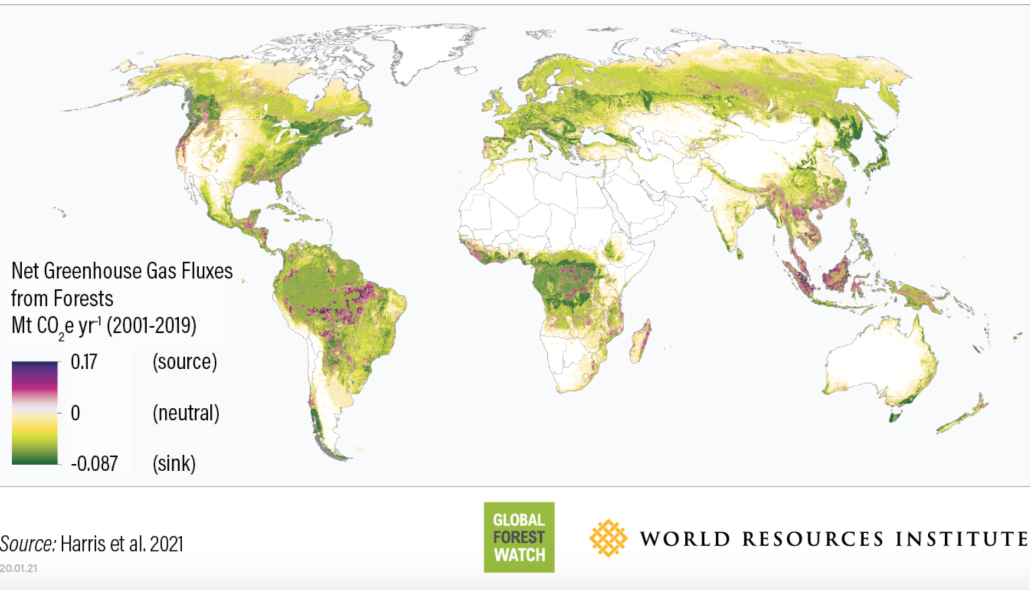
Net greenhouse gas flows from the world’s forests. Period 2001-2019. SOURCE: Global Forest Watch.
The study
The research was conducted in the tropical forests of Panama where the authors heated some portions of soil under different conditions. Then, they analyzed the effects on the element. ‘We show that warming and drying of tropical forest soils may increase soil carbon vulnerability, by increasing degradation of older carbon,’ the authors explain.
‘In situ whole-profile heating by 4 °C and 50% throughfall exclusion each increased the average radiocarbon age of soil CO2 efflux by ~2–3 years, but the mechanisms underlying this shift differed’.
Heating, in particular, accelerated the decomposition of older carbon. Drying reduced that of newer carbon. These results imply that ‘both warming and drying, by accelerating the loss of older soil carbon or reducing the incorporation of fresh carbon inputs, will exacerbate soil carbon losses and negatively impact carbon storage in tropical forests under climate change’.
Forest degradation and ‘non-recoverable’ emissions
Unlike previous studies, which have focused historically only on total emission fluxes, the research finally reveal mechanisms and their impact on different types of carbon. Thus adding new knowledge on the phenomena affecting tropical forests whose degradation, the experts explained, generates irreparable damage. Last year, for example, research by the University of Bristol and Brazil’s National Institute for Space Research (INPE) observed how forest restoration only compensates for a minority share of the CO2 emissions associated with deforestation.
The researchers, in particular, showed how restored forest areas in the tropics remove enough carbon each year to offset 26% of the carbon emissions initially released into the atmosphere from previous deforestation. Regeneration initiatives, in other words, would only recover a quarter of the amount lost.
 Melissa McMasters Attribution 2.0 Generic CC BY 2.0 Deed
  Angal insect Attribution-ShareAlike 4.0 International CC BY-SA 4.0 Deed
  ECHO
ECHO 


