
Sea level rises threatening wetland carbon
 Photo: Nandaro Attribution-ShareAlike 3.0 Unported CC BY-SA 3.0 Deed
 Rising sea levels threaten carbon storage capacity by altering microbes and vegetation, US researchers say
by Matteo Cavallito
Coastal wetlands – including marshes and mangrove forests – are limited in size but they store nearly half of all the carbon in ocean sediments. Rising sea levels, however, put this crucial mitigation service at risk. This threat is widely known to researchers at the University of Southern California who have been studying for some time the dynamics occurring in the wetlands of the Upper Newport Bay Ecological Reserve, an estuary located in Orange County, in the southern part of the state.
The goal? ‘To develop methods to predict and mitigate carbon loss, quantify the amount of carbon at risk, and identify restoration techniques to ensure continued carbon capture and storage well into the next century,’ explains David Bañuelas, research coordinator quoted in an article published by the same university.
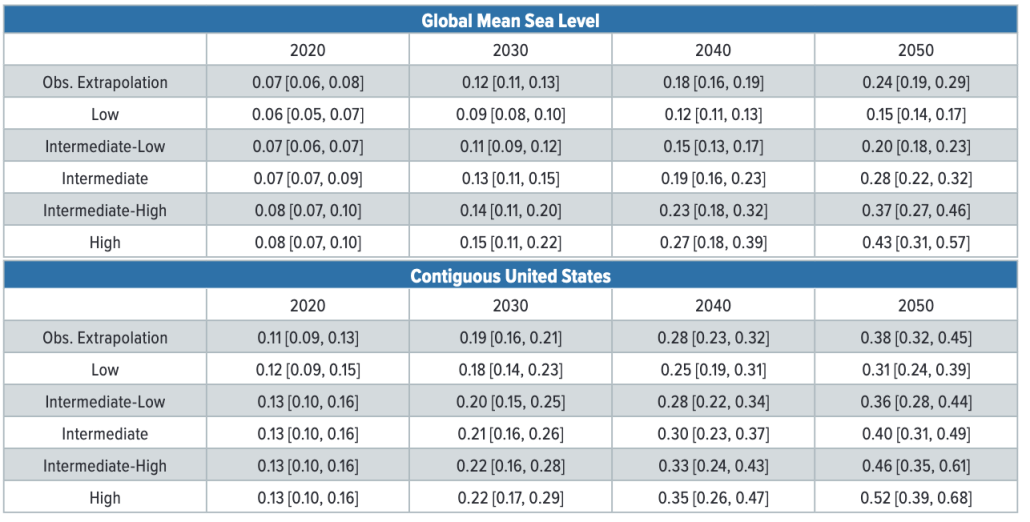
Sea-level rise predictions. The table presents assumptions based on observation and five predictive scenarios for both global mean sea level and sea level in the contiguous United States. The change in mean level is expressed in metres. SOURCE: The Sea Level Rise Technical Report 2022 – NASA, NOAA, EPA, FEMA, Department of Defense, Department of Homeland Security.
Salt endangers the carbon cycle
Soil microorganisms play a crucial role. In these areas, they absorb CO2 and convert it into organic matter that is made available to other living things in the food chain. Vegetation, which captures carbon dioxide from the atmosphere and sequesters it in the soil, also contributes to the process. The problem, however, is that rising sea levels cause salt water intrusion, altering the presence of microbes and making the environment unsuitable for plants.
‘We know that in 50 to 100 years, much of the salt marsh will turn into mudflats, which are actually sources of carbon emissions,’ Bañuelas explained. ‘Without vegetation, a lot of the carbon that would otherwise be stored is going to be released back into the atmosphere’.
In order to understand what might happen in the future scenario, the scientists began collecting water samples in the marsh to study its chemistry and identify microbes. Analyses in the laboratory would allow them to decode the genomic data of the microorganisms to understand their carbon processing capabilities. The idea is to predict the distribution of microbes based on salinity predictions by anticipating and responding to the impacts of climate change.
Creating predictive models
By developing predictive models, the authors continue, it should then be possible to quantify the carbon balance between the ocean and coastal wetlands. Thus inspiring rational decisions to protect vital ecosystems. The results could be useful in assessing similar dynamics in marine coastal and estuarine systems globally.
The same researchers are also conducting similar studies in the Gulf of Mexico, around the Mississippi River, as well as in the Atchafalaya River Delta area in Louisiana.
The importance of forecasting systems has long been known. So is the relevance of wetlands in the protection of biodiversity and carbon sequestration. Two services that are performed effectively not only in coastal areas and that are now increasingly at risk. Recently, a study published in the journal Nature Communications, involving scholars from the Pacific Northwest National Laboratory (PNNL), Lawrence Berkeley National Laboratory and the University of Michigan, for example, explained how climate change will wipe out parts of North American wetlands and disrupt their seasonal regimes.
Coastal areas, a global problem
With regard to coastal areas in particular, much attention in recent years has focused on the unique mangrove ecosystem. According to estimates by the NGO Global Mangrove Alliance, worldwide the specimens of this plant would be able to prevent total emissions of more than 21 billion tonnes of CO2. Their presence, however, is still at risk. Human activities, such as deforestation, and the effects of anthropogenic climate change, starting with rising sea levels, in fact have a major impact.
Between 1980 and 2000, the US think tank One Earth explained, the world lost about 35 per cent of its mangroves. In the 21st century, the situation has improved but not enough. According to the Global Mangrove Alliance, between 1996 and 2016, the presence of these trees declined by a further 4.3% on the planet.
 Melissa McMasters Attribution 2.0 Generic CC BY 2.0 Deed
  Angal insect Attribution-ShareAlike 4.0 International CC BY-SA 4.0 Deed
  ECHO
ECHO 


