Prepsoil designs the future of research and innovation structures
 Prepsoil
Prepsoil project presents two reports on taxonomy and economic sustainability of Living Labs and Lighthouse Farms, key players in developing new ideas and solutions for soil health
by Matteo Cavallito
Classify, guide and empower Living Labs and Lighthouse Farms, key players in the development of new ideas and solutions for soil health in Europe. But also to develop a tailor-made business model dedicated to them that can be declined according to the different types of land use: namely agriculture, forestry, post-industrial and peri-urban areas. These are the main objectives of two reports released in December as part of Prepsoil, the project, launched in 2022 and funded by the Horizon Europe program, that involves several partners, including Re Soil Foundation, in activities to raise awareness and disseminate the goals of the EU Mission A Soil Deal for Europe.
Identifying and classifying innovator subjects
The Prepsoil report on “Living Labs and Lighthouses taxonomy, identification and mapping” introduces tools to classify, guide and empower these innovator subjects by fostering “improved collaboration and knowledge exchange.” Three resources provided by the study:
- Taxonomy and User Guide to guide soil health initiatives by facilitating the exchange of best practices with the support of a user guide. An interactive version of the taxonomy is available on the Prepsoil website.
- Classification of Living Labs and Lighthouses, which, according to the criteria adopted, are divided between actors “fully aligned with the Mission Soil Implementation Plan and criteria,” or “emerging” actors who are working to meet all the criteria. The ranking will be part of the online Atlas of Soil Health Initiatives in Europe.
- Assessment Module to be launched in early 2025 to help the actors themselves assess their alignment with the European Mission criteria.
A business plan
The “Report on Living Labs and Lighthouses Model Business Plans” provides a detailed overview of a business model for innovative subjects according to different land use. Again: agriculture, forestry, post-industrial and peri-urban areas. The model is designed to plan for the growth, expansion and stability of the subjects themselves by identifying:
- The Mission goals to be pursued.
- The specific type of land use the subjects are targeting;
- 14 different key aspects (problems, areas of focus, solutions etc.).
- 41 spheres of intervention.
This Business Model aims to improve the performance and grow the maturity of these initiatives by fostering their economic resilience following initial EU funding. This goal implies the ability to attract diverse sources of funding by involving a wide range of stakeholders and following several recommendations. These include the use of existing networks and partnerships, implementation of governance structures, use of economic valuation of ecosystem services, and more.
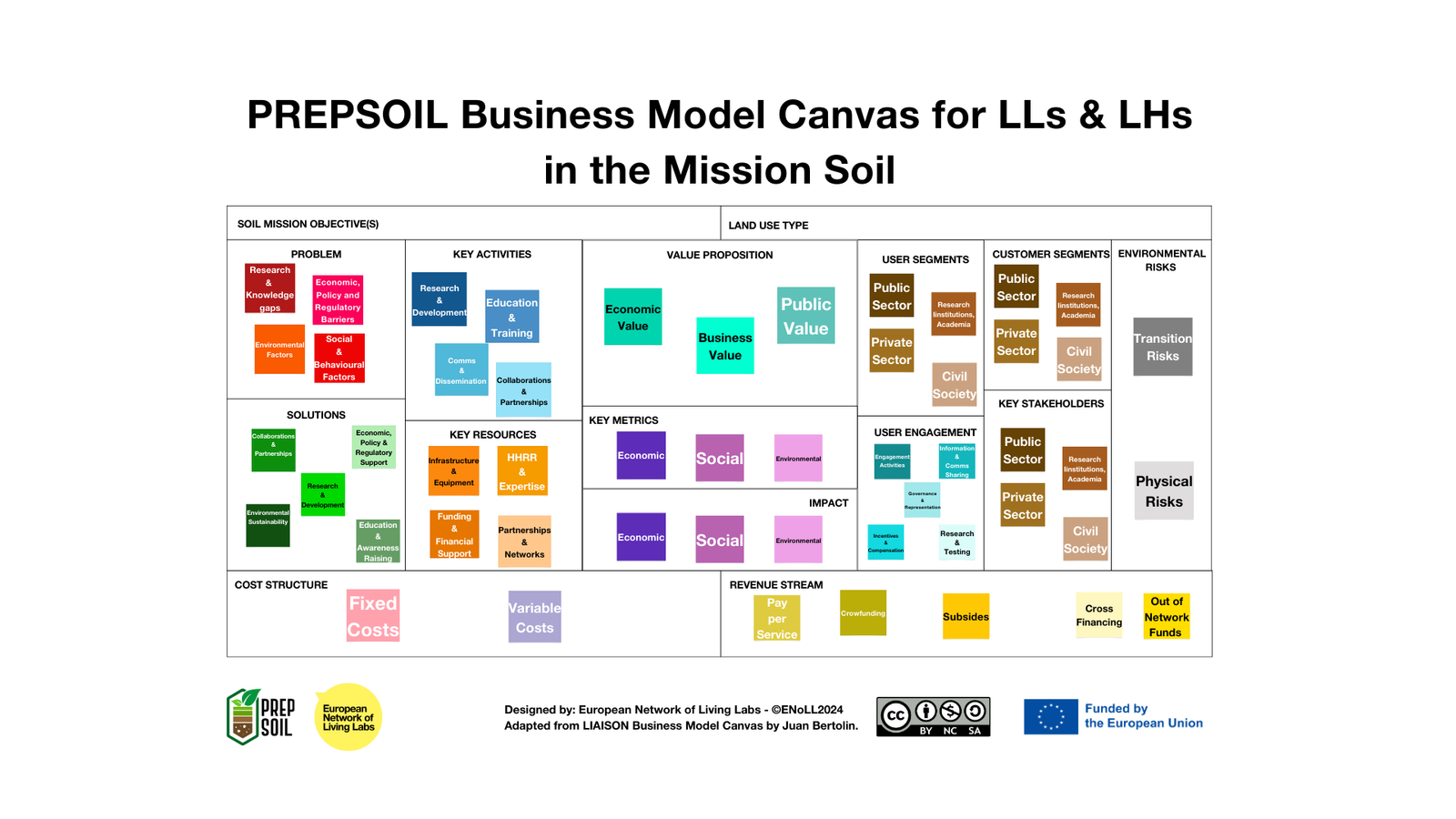
The business model developed by Prepsoil for Living Labs and Lighthouses. Image: Prepsoil CC BY-SA
The Prepsoil Project
The Prepsoil project aims to support the implementation of the European Mission by primarily creating “awareness and knowledge on soil needs among stakeholders in regions across Europe.” This is essential to reach the goal set by the EU: to restore the health of at least three-quarters of European degraded soils by 2030. Today, in fact, the lack of knowledge and awareness of the problem continues to be one of the main critical factors.
For this reason, the approach based on raising awareness and spreading knowledge is considered to be a crucial for the success of the Mission.
For this very reason, those involved in the initiative intend to work to provide assessments and efforts to improve the knowledge base by working together with innovation centers in the area. By reaching, over time, an ever-widening audience that includes universities, citizens, students, teachers, land monitoring agencies and civil society as a whole.
 Melissa McMasters Attribution 2.0 Generic CC BY 2.0 Deed
  Angal insect Attribution-ShareAlike 4.0 International CC BY-SA 4.0 Deed
  ECHO
ECHO