Forests restored by nature can sequester 23 billion tonnes of CO2
 George Shepherd Attribution-NonCommercial-ShareAlike 2.0 Generic CC BY-NC-SA 2.0 Deed
 The estimate, on a 30-year basis, is contained in a study involving American and Australian scientists. Worldwide, spontaneous forest regeneration potentially affects more than 200 million hectares of land
by Matteo Cavallito
Spontaneous regeneration of forests shows surprising potential in terms of the extent of the phenomenon and its contribution to climate mitigation. This is reported by a study by a group of Australian and US researchers published in Nature. The investigation also highlights the cost benefits associated with natural restoration as an alternative to planting practices.
By relying on the work of nature “nations can meet their restoration goals cost effectively,” says Brooke Williams, a researcher at Queensland University of Technology, Australia, and co-author of the study in a statement. “Our model can guide where these savings can best be taken advantage of.”
The benefits of natural regeneration
Forest restoration is considered an essential tool for mitigating climate change in the face of the recognised carbon sequestration capacity of these ecosystems. In recent years, particular attention has been paid to spontaneous regeneration, i.e. the approach that limits human intervention to a minimum. Thus leaving to nature the task of restoring areas that have simply been excluded from grazing or other activities. This restoration takes place through the seeds already present in the soil or dispersed by neighbouring forests. There is no shortage of advantages in this respect.
“In areas where ecological conditions are such that forests can grow back on their own or with low-cost assistance, natural regeneration methods are less costly, for example, US$12–3,880 per ha compared with US$105–25,830 for forest restoration projects in the tropics and subtropics,” the authors explain.
The costs of planting projects, therefore, can be particularly prohibitive, especially for developing countries. By contrast, in addition to being significantly cheaper, they say, initiatives to encourage spontaneous regeneration are also “often more effective than full tree planting in terms of their long-term success rates and biodiversity outcomes.”. For these reasons, in short, “Identifying areas where forests can recover effectively with minimal intervention is critical for achieving forest restoration at scale.”
Among the decisive factors is the presence of neighbouring forests
Using satellite images, the authors identified trends in the tree cover of millions of small areas characterised by natural regrowth over the space of several years.“Those natural patches were the input data for this novel study,” explains Matthew Fagan, professor of geography and environmental systems at the University of Maryland and co-author of the study. This study, he adds, is “the first to predict where future forest regrowth will occur, given observed past regrowth.”
The study was based on the collection of global data describing factors such as soil quality, slope, road and population density, local wealth, distance to urban centres and healthy forests, and more.
The authors found that the factors most strongly associated with high regrowth potential are the proximity of an area to an existing forest, its density and the carbon content of the soil. Proximity to another forest area, in particular, is decisive in providing the area with a variety of seeds that can support regrowth.
250 million hectares can sequester 23.4 billion tonnes of CO2
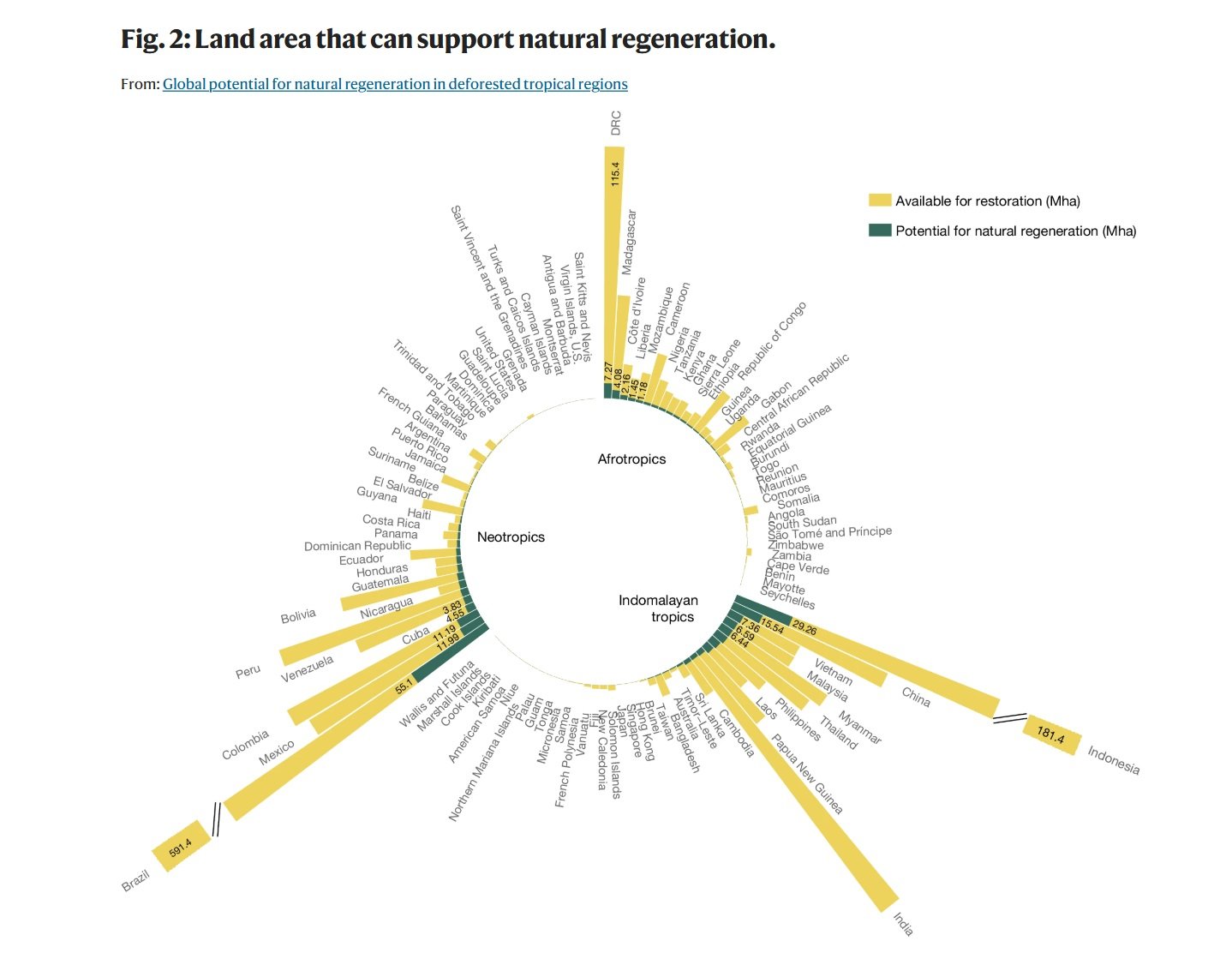
By evaluating the current spatial distribution of the pantropical natural forest based on its evolution from 2000 to 2016, the research points out, it was possible to create a model to quantify the natural regeneration potential in tropical forest biomes. In total, the scientists explain, “We estimate that an area of 215 million hectares—an area greater than the entire country of Mexico—has potential for natural forest regeneration, representing an above-ground carbon sequestration potential of 23.4 billion tonnes of carbon (range, 21.1–25.7 billion tonnes) over 30 years.”
Today, “Five countries, Brazil, Indonesia, China, Mexico and Colombia, account for 52% of this estimated potential, showcasing the need for targeting restoration initiatives that leverage natural regeneration potential”. I risultati, ocncludono, “facilitate broader equitable decision-making processes that capitalize on the widespread opportunity for natural regeneration to help achieve national and global environmental agendas.”
 Melissa McMasters Attribution 2.0 Generic CC BY 2.0 Deed
  Angal insect Attribution-ShareAlike 4.0 International CC BY-SA 4.0 Deed
  ECHO
ECHO