Answers to questions on climate and erosion are 56 million years old
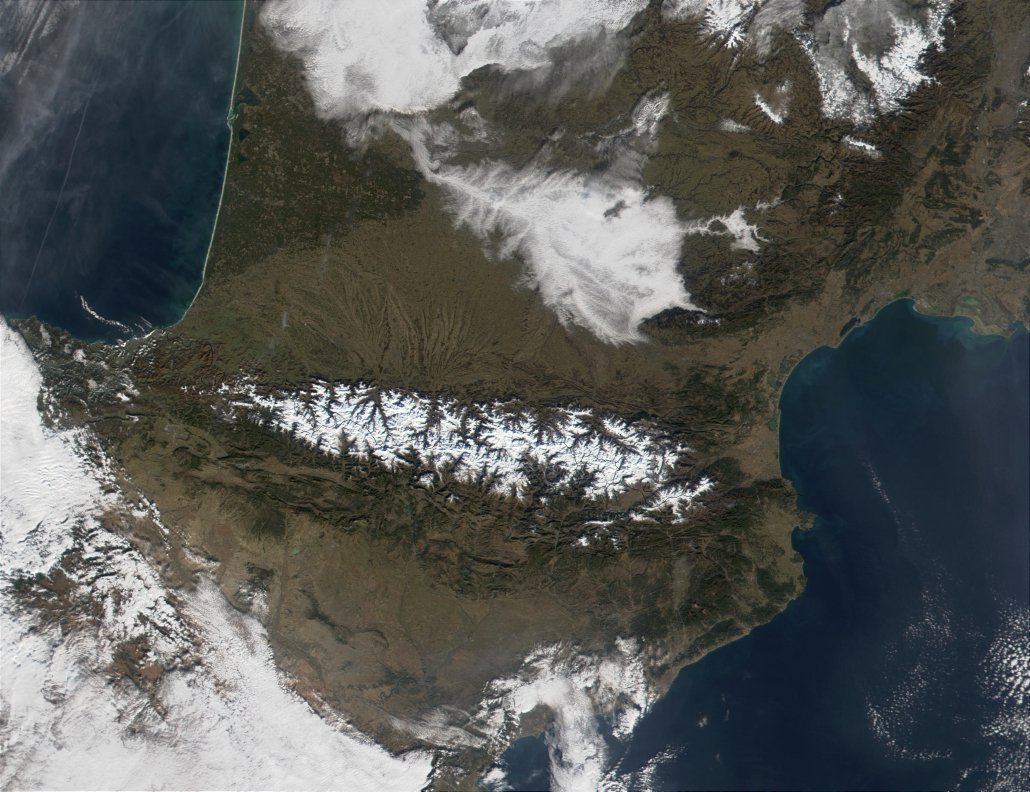 Photo: NASA public domain
 A study by the University of Geneva revealed how erosion in the Pyrenees increased 4-fold during the global warming experienced between the end of the Palaeocene and the beginning of the Eocene. A scenario that could now be repeated
by Matteo Cavallito
The analysis of fossil sediments formed tens of millions of years ago can help us understand the dynamics of soil erosion experienced today in the context of global warming. This is claimed by scientists at the University of Geneva. The researchers, in particular, have focused on remains dating back to the so-called Paleocene-Eocene Thermal Maximum, an exceptional climatic event that occurred 56 million years ago when the Planet experienced an increase in average temperature of between 5°C and 8°C in just 20 thousand years.
The lesson of the Thermal Maximum
This phenomenon, the authors remind, had consequences for the next 200 millennia, leading to widespread species extinctions in flora and fauna. A dynamic that could occur again. “According to recent Intergovernmental Panel on Climate Change reports, the Earth is now on the brink of a similar warming,” says a statement from the university.
This is why scientists have started to study these sediments with the aim of better understanding what has happened and consequently making predictions for the future. “These natural deposits are the result of soil erosion by water and wind,” the statement continues. “They were carried by rivers into the oceans. Now preserved in rocks, these geological archives provide valuable information about our past, but also our future.”
Erosion has increased 4-fold with rising temperatures
The study, funded by the European Horizon 2020 programme, focused on a particular type of sediment: microcodium grains collected in the Pyrenees. This fossil consists of small calcareous prisms no larger than a millimetre in size and, the authors point out, would have formed during the period under investigation in the rhizosphere of the soil, i.e. around the roots of plants. Calcite prisms, moreover, are also present in marine sediments, “proving their erosion on the continent.”
The hypothesis, in short, is that rising temperatures alter the frequency and intensity of rainfall. “This alters the dynamics of river flooding and intensifies sediment transport from the mountains to the oceans,” explains Marine Prieur, researcher and lead author of the research.
For this reason, the greater or lesser presence of these fossil residues becomes an indicator of climate-related erosion. ”By quantifying the abundance of Microcodium grains in marine sediments, based on samples taken from the Spanish Pyrenees, which were submerged during the Palaeocene-Eocene, we have shown a four-fold increase in soil erosion on the continent during the climate change that occurred 56 million years ago,” says Sébastien Castelltort, professor at the University of Geneva.

Soil erosion trends on different continents. SOURCE: FAO, 2019.
Implications for the present
The study, the researchers conclude, highlights how global warming impacts soil erosion. Although the investigation focused on the Pyrenees and each geographical region experiences unique factors, they add, it is also true that the increase in sediment recorded between the Palaeocene and Eocene is a global phenomenon. And, as such, still capable of providing general indications.
The results of the study make it possible to make predictions about climate trends in the future. Above all, they make it possible to better assess the risks of land collapse as a function of the climate variable, but not only. Decisive, according to the scientists, is also the impact of human action that favours and amplifies erosion.
 Rod Waddington Attribution-ShareAlike 2.0 Generic CC BY-SA 2.0 Deed
  Thpelin Attribution-ShareAlike 3.0 Unported CC BY-SA 3.0 Deed