
Are China’s solar parks a viable tool against desertification?
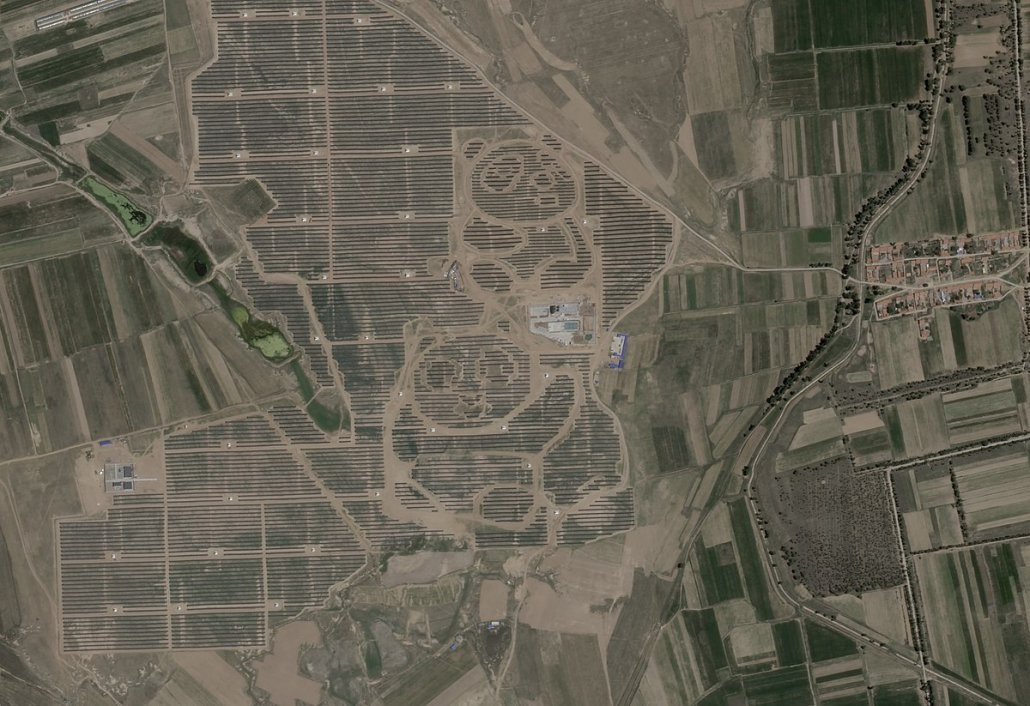 Planet Labs Attribution-ShareAlike 4.0 International CC BY-SA 4.0 Deed
 In China, the expansion of photovoltaic installations is reportedly helping to combat desertification. An interesting hypothesis given the scale of the problem. But the issue is still controversial
by Matteo Cavallito
The expansion of solar parks may be helping to combat desertification. This could be shown by the mostly recent experience of the leading global player: China, of course. This is the hypothesis advanced in an article published in the US website Semafor. But the issue, it should be specified, is not free of controversy. However, the subject remains certainly interesting at least in the debate on the industry’s potential for soil restoration.
Combating desertification in China
“China’s deserts equate to more than a quarter of its total land mass, amounting to almost as much territory as all of India,” writes Semafor. “Since the 1950s the country has been seeking to mitigate the severity and impact of dust storms, and over the longer term, to prevent desert encroachment on urban areas, or fertile, arable land. As climate change makes desertification worse globally, Beijing is upping its focus on the challenge.”
Over the years, China has launched initiatives to combat desertification by relying on different strategies, including the use of cellulose and sea buckthorn.
Different examples of intervention, in short, that have aroused a certain amount of interest, especially for Central Asia where desertification is estimated to threaten the security of half a billion inhabitants. What has happened in solar parks, above all, has taken on particular significance in recent years. With potentially “huge implications globally.”
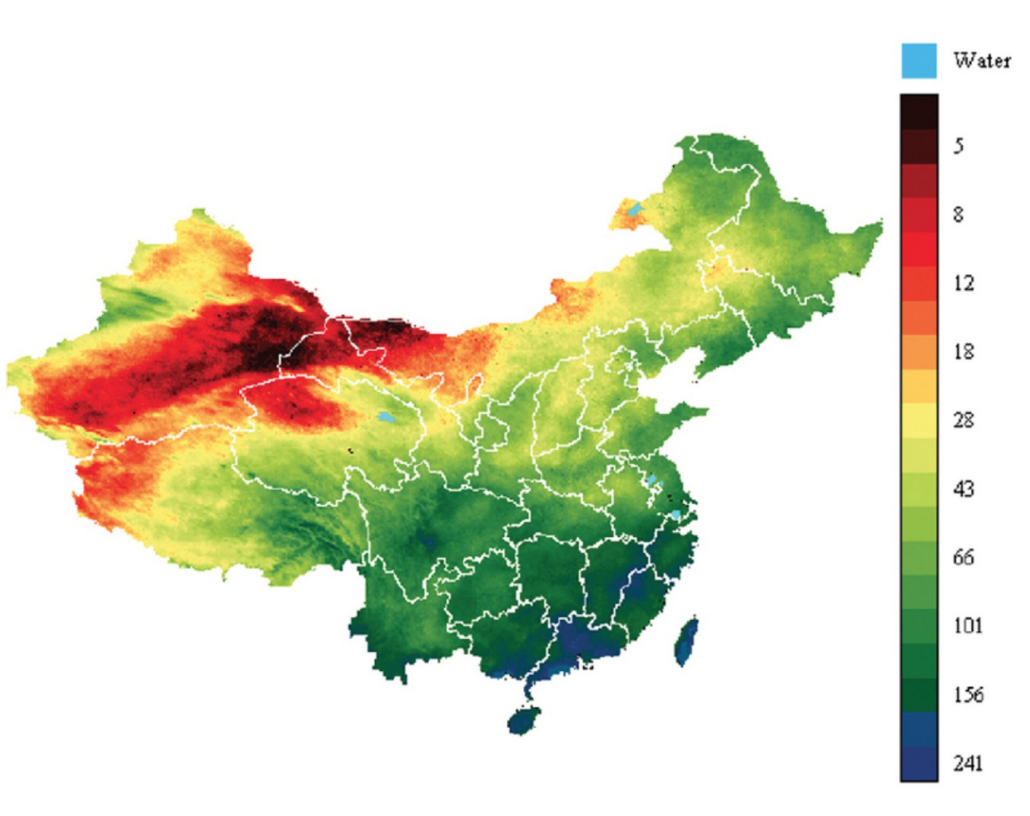
The map shows China’s moisture index. Arid areas, shown in dark red, are the most vulnerable to desertification. The phenomenon is more widespread in 11 provinces and autonomous regions: Xinjiang, Inner Mongolia, Gansu, Qinghai, Ningxia, Shaanxi, Shanxi, Liaoning, Jilin, Heilongjiang and Hebei (FAO 1997). SOURCE: European Space Agency.
Soils have experienced “a significant greening trend”
According to researchers, Semafor writes, solar panels create shade and reduce the wind speed on the ground, thus limiting sand accumulation and creating conditions for plant growth.
A Nanjing University study published in 2022, revealed that about one-third of solar parks in desert areas of China have experienced “a significant greening trend.”
From 2011 to 2018, the study states, “Photovoltaic (PV) power stations in China’s 12 biggest deserts expanded from 0 to 102.56 km2, mainly distributed in the central part of north China. Compared to 2010, the greening area reached 30.80 km2, accounting for 30% of the total area of PV power stations.” Companies in the industry, the website writes, have therefore started looking for crops suitable for growing under the panels. Among these is liquorice, which is able to resist the pitfalls of the environment as well as make the soil more fertile by absorbing nitrogen from the air.
But there is no lack of controversy
However, the website observes, some points remain controversial. The construction of solar farms in the desert, for example, often takes place after dunes have been cut down. This practice would encourage the spread of sandstorms and dust. Another risk, suggested by a study conducted in the Sahara, is then related to the increase in the temperature of the surrounding air, which would be related precisely to the presence of the panels. A phenomenon that could even alter rainfall patterns worsening the effects of climate change.
Not free of concern, finally, is the overall strategy implemented over the past two decades by China in combating desertification. Many doubts, in particular, have been raised by the celebrated Grain for Green program, which since the beginning of the 21st century has been remunerating farmers for planting trees on their soils while also offering them degraded land for restoration. In 2023, a study by a group of researchers from the Chinese Academy of Sciences in Beijing published in the journal Nature judged the results of the initiative to be modest, which, the researchers argued, would also ultimately result in a negative economic balance.
 Melissa McMasters Attribution 2.0 Generic CC BY 2.0 Deed
  Angal insect Attribution-ShareAlike 4.0 International CC BY-SA 4.0 Deed
  ECHO
ECHO 


