Compostable bioplastic residues do not accumulate in soil
An international study fills one of the major scientific knowledge gaps surrounding compostable bioplastics. Any microfragments that may remain after industrial composting do not persist in the soil but continue to biodegrade thanks to microbial activity
by Emanuele Isonio
What happens to biodegradable plastic residues that may remain after the industrial composting of compostable packaging? This has been one of the most debated questions in recent years, especially after some studies detected microscopic fragments in compost produced from the treatment of organic waste.
Now a new study, conducted by researchers from the Universities of Montpellier and Paris-Saclay in collaboration with Michigan State University, provides an important answer: biodegradable microplastics that may remain in compost are not destined to persist in soil but continue their biodegradation process even after the compost is applied to agricultural land.
This finding strengthens the scientific evidence on the role of compostable packaging within the circular bioeconomy and, above all, on its relationship with soil health.
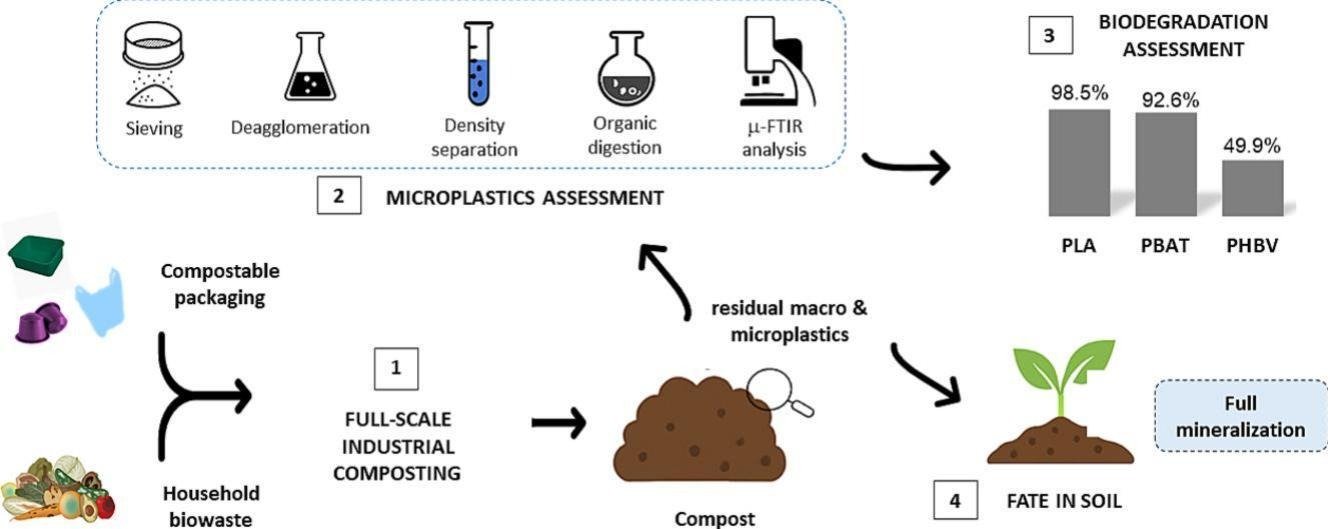
Residual biodegradable microplastics derived from compostable packaging under large-scale industrial composting fully degrade in soil. SOURCE: Heick Abou Coulibaly, Sandra Domenek, Paul Greuet, Matthieu George, Pascale Fabre, Rafael Auras, Emmanuelle Gastaldi.
A study that addresses a key question
The issue is far from marginal. The organic fraction accounts for more than one third of European municipal waste. With the mandatory separate collection of biowaste introduced in 2024, composting and anaerobic digestion are set to play an increasingly important role in waste management and in the production of soil amendments for agricultural soils.
Composting transforms separately collected organic waste into compost, a valuable soil amendment that returns organic matter to agricultural land, improving soil fertility, structure and water-holding capacity.
Increasingly, certified compostable packaging is collected together with food waste. These technological solutions are specifically designed to follow the same biological pathway as organic waste and therefore make it easier for citizens to separately collect the organic fraction of municipal waste.
Previous studies had already shown that these materials disintegrate during industrial composting. However, one question remained unanswered: do the microscopic fragments that may remain represent a permanent accumulation, or are they simply an intermediate stage in the biodegradation process? This is precisely the issue addressed by the new research.
A new analytical method
To answer this question, the researchers developed a new analytical method capable of detecting and measuring particles just a few tens of micrometres in size, far smaller than the thickness of a human hair.
The challenge was considerable. Compost is a matrix extremely rich in organic matter, making it very difficult to distinguish tiny bioplastic fragments from natural residues. After numerous laboratory tests, the authors developed a protocol that makes it possible to extract these particles without altering their characteristics and to identify them accurately using sophisticated spectroscopic analyses.
This methodological advance is one of the study’s main achievements, as it finally makes it possible to accurately measure something that until now has been very difficult to observe.
From composting to soil
Once the method had been validated, the researchers applied it to an industrial composting facility where certified compostable packaging had been processed together with organic waste.
The results confirm that biodegradation during composting is very high. Some materials achieve more than 98% biodegradation, while others exceed 92%. Only one of the polymers studied shows lower values, but the authors explain that this result is mainly due to the shape of the item tested, which slows down the process, rather than to the characteristics of the material itself.
The most innovative part of the research, however, comes next. Residual particles recovered from the compost were placed in contact with agricultural soil and monitored over time.
The result is clear: biodegradation does not stop when composting ends but continues in the soil thanks to microbial activity, leading to the progressive mineralisation of the materials.
Fragmentation does not mean persistence
One of the most interesting aspects of the study concerns a common misconception surrounding biodegradable microplastics. In the public imagination, finding a microscopic plastic fragment automatically suggests a material that is destined to accumulate in the environment.
Compostable bioplastics, however, need to be considered differently, because their degradation process follows a different pathway.
Just as a piece of wood or a leaf gradually decomposes in soil, the biodegradation of bioplastics also takes place in stages. Fragmentation is an intermediate stage, while the process continues until the carbon contained in the material is converted into carbon dioxide, water and new biomass through microbial activity.
The study demonstrates precisely this continuity, distinguishing the temporary presence of microfragments from their actual persistence in the environment.
New prospects for the circular bioeconomy
The authors themselves stress that further research will be needed, particularly to analyse even smaller particles and to assess the long-term effects of repeated compost applications to agricultural soils.
Nevertheless, the study represents a significant step forward. Not only does it introduce a reliable method for quantifying residual biodegradable microplastics, but it also provides new scientific evidence on their behaviour once compost is returned to the soil.
For the circular bioeconomy, this is an important piece of the puzzle. Improving our understanding of the fate of compostable packaging can help make increasingly effective a system that transforms organic waste and certified compostable packaging into a new resource for the soil, helping to protect soil fertility and close the organic matter cycle.
 Oded Gilad, CC BY-SA 4.0
 Hans Hillewaert, CC BY-SA 4.0
 Blonder1984, CC BY-SA 3.0