When El Niño-related drought strikes, Amazon forest turns to chemical self-defense
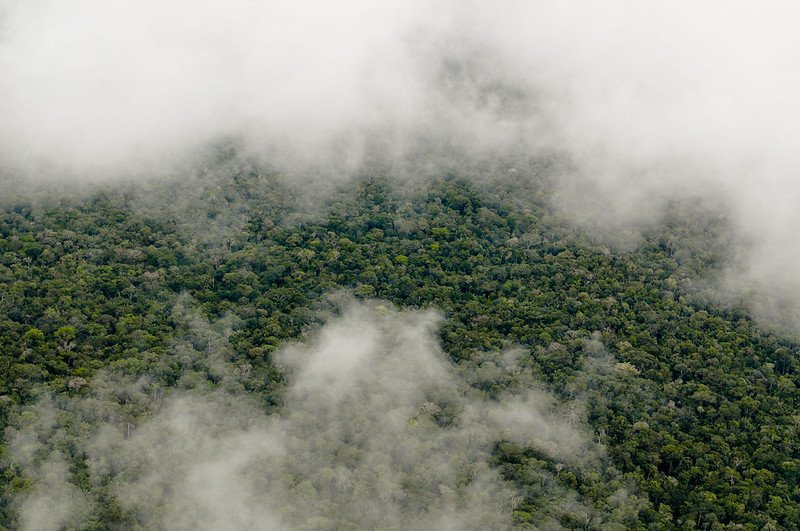 Photo: Neil Palmer/CIAT. Attribution-NonCommercial-NoDerivs 2.0 Generic (CC BY-NC-ND 2.0).
A study shows how the rainforest altered its volatile compound emissions during the most severe drought ever recorded in the Amazon, triggering a mechanism with implications for the atmosphere
by Matteo Cavallito
Between 2023 and 2024, driven by El Niño—the periodic warming of sea surface temperatures in the central and eastern tropical Pacific that occurs at irregular intervals during the Northern Hemisphere winter—the Amazon rainforest experienced, as previously reported, the most severe drought in its recorded history. It was during this unprecedented event that the world’s largest rainforest activated an unexpected chemical defense mechanism. These finding emerges from a study published in Nature Communications Earth & Environment.
The study was conducted by researchers at the Max Planck Institute for Chemistry in Mainz as part of the Amazon Tall Tower Observatory (ATTO), an international research initiative launched in 2009 through a collaboration between Germany and Brazil. International researchers investigated the mechanisms by which vegetation responds to extreme climate events. The project also involved the National Institute of Amazonian Research (INPA) and the Amazonas State University (UEA). Air samples were collected above the forest canopy and subsequently analyzed using gas chromatography and mass spectrometry.
The role of volatile compounds in atmospheric balance
Specifically, the study set out to measure biogenic volatile organic compounds (BVOCs)—carbon-based molecules naturally emitted by vegetation that play a key role in the chemical balance of the atmosphere. Among them, the authors highlight isoprene, the most abundant compound in this class, whose global emissions are estimated at between 450 and 600 million tonnes per year. “Vegetation is the dominant source of biogenic isoprene, with tropical rainforests representing about 80% of the global biogenic isoprene source with ~30% from the Amazon rainforest alone”, the study notes.
The research also shows that the compound is rapidly oxidized in the atmosphere, helping to influence several processes that are fundamental to the climate.
Isoprene emissions affect “the oxidation capacity of the atmosphere, thereby affecting the lifetime of the greenhouse gas methane” and contribute to the formation of “secondary organic aerosol (SOA), which can in turn influence cloud formation”. Understanding how emissions of these molecules change during extreme events therefore also provides insight into how atmospheric processes may evolve under an increasingly warmer climate.
The rainforest’s chemical response to stress
The findings revealed a highly selective response of biogenic compounds to drought. While emissions of isoprene and monoterpenes remained largely unchanged, emissions of sesquiterpenes—the highly reactive molecules produced by trees as stress signals and protective compounds—increased by 122% during the El Niño event. Even more significant was the discovery of unexpected emissions of sesquiterpene alcohols—the major constituents of essential oils extracted from plants and bark—including β-eudesmol, α-eudesmol and γ-eudesmol, observed during the rainy season following the peak of the drought.
According to the authors, this persistence shows that the rainforest’s response does not end when the climate event is over, but continues throughout the recovery phase.
“Previous studies have shown that plant isoprene emission rates remain constant or may even slightly increase during the initial stages of drought, but they then decline under severe drought stress”, the paper explains. For this reason, “the persistence of elevated atmospheric isoprene concentrations observed during the 2023 El Niño dry season therefore suggests that drought stress had not yet reached a threshold sufficient to substantially suppress isoprene emissions”. In other words, the researchers conclude that rising temperatures were the main driver behind the increase in atmospheric isoprene, confirming the role of this molecule in plant thermoregulation.
Amazon soils also play a crucial role
The study also highlighted the contribution of Amazon soils, a factor that is often overlooked in climate models. During the extreme drought of 2023, the sharp decline in soil moisture “constrained soil gas exchange, while associated heat extremes further reduced soil respiration and the capacity of Amazon rainforest soils to consume ambient isoprene”. In other words, the effects of drought extend beyond vegetation, also affecting soil microbial processes and altering the overall balance of volatile organic compounds in the atmosphere.
According to Jonathan Williams, the project leader, the rainforest’s ability to restore normal emissions of biogenic volatile organic compounds could become progressively impaired in the future.
“Between El Nino events, which occur every 2-7 years, the rainforest can revert to the original non-stressed emissions”, he explained in a statement released by the Max Planck Institute. “However, climate models suggest that El Nino events will increase in frequency and intensity in this century, so these emissions may become a permanent feature of the region, altering the overlying atmospheric chemistry”. The researchers conclude that atmospheric chemistry and climate models should now incorporate the uptake of isoprene by soils in order to better represent these processes.
 Photo: Thomas Bjørkan CC BY-SA 3.0
 Re Soil Foundation