Here is how soil bacteria can save crops from salinization
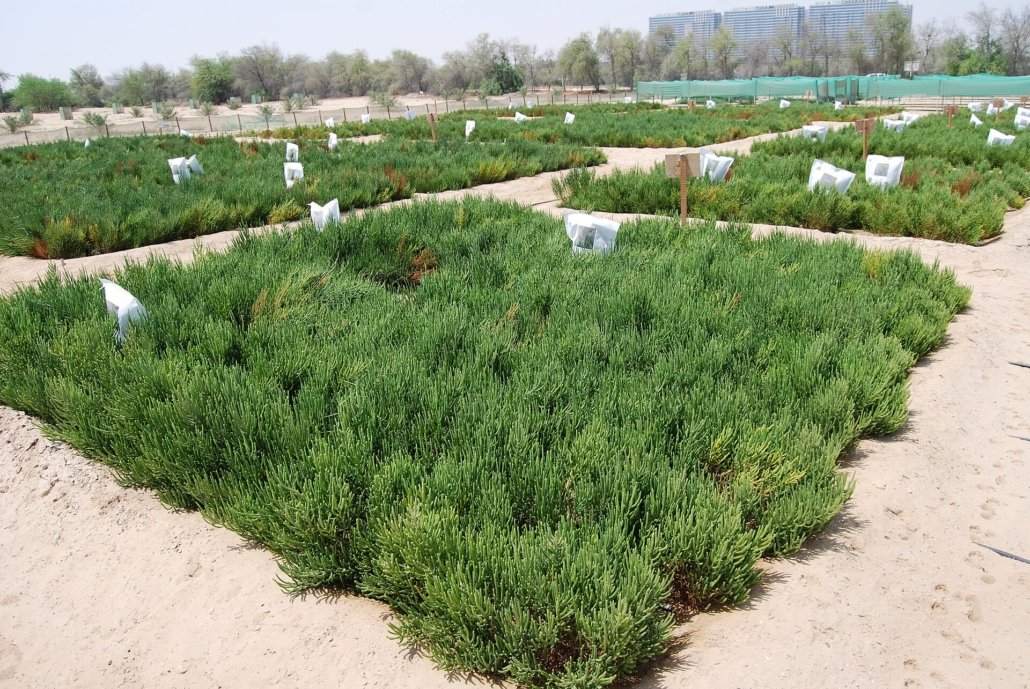 Photo: Charbel El Khouri - International Center for Biosaline Agriculture, CC BY-SA 4.0
 An international study has identified soil bacteria that naturally boost plants’ resistance to soil salinization stress. The discovery opens up new opportunities for an agriculture that relies less on fertilizers
by Matteo Cavallito
Soil salinization is one of the lesser-known yet most significant consequences of climate change. Rising sea levels, intensive irrigation and increasing temperatures, indeed, are all contributing to the accumulation of salt in agricultural soils, gradually reducing their fertility and putting agricultural productivity at risk across vast areas of the world. Against this backdrop, however, some bacteria already present in the soil could prove to be valuable allies.
This is the conclusion of a study led by a team of scientists from the Tobacco Research Institute of the Chinese Academy of Agricultural Sciences in Qingdao, with contributions from the University of East Anglia in Norwich, UK. Published in the journal Science Advances, the research identified a previously unknown mechanism through which specific soil microorganisms enhance plants’ ability to withstand salt stress. The findings might have important implications for the management and restoration of agricultural soils.
Soil salinization affects 1.4 billion hectares of land worldwide
“Soil salinization is a major global threat to soil fertility, biodiversity, and crop yield”, the study explains. “Through climate change, the extent and persistence of salinization are predicted to exceed those observed in recent decades, posing a serious threat to global food security”. The mechanism is well understood: when salt levels in the soil exceed a certain threshold, plants struggle to absorb water and nutrients, growth slows, root systems become weaker and crop yields decline. According to FAO estimates, the phenomenon already affects 1.4 billion hectares of agricultural land worldwide (10.7% of the Earth’s land surface), underscoring the urgent need for new strategies to improve crop resilience.
Over the years, a statement from the British university notes, scientists have increasingly focused on the root microbiome, namely the community of bacteria and other microorganisms that live in close association with plant roots and play a fundamental role in plant health.
“Soil microbiota are key drivers of plant productivity and ecosystem function, and they also play a critical role in enhancing plant survival under saline conditions”, says the research. “Therefore, understanding the interactions between soil microorganisms and plants is essential for improving crop performance in saline-affected soils and for supporting sustainable agriculture”. However, the underlying dynamics of these interactions are still not fully understood. The study therefore sought to fill some of these knowledge gaps, with the specific aim of identifying the biological mechanisms involved.
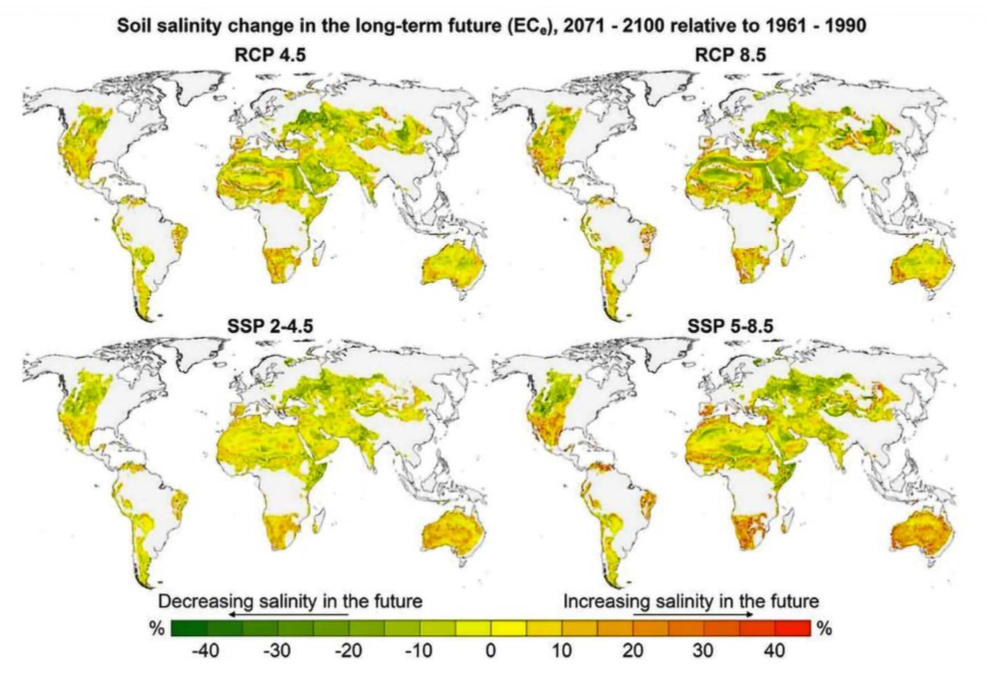
Trends in soil salinization under different climate change scenarios. Worldwide, the phenomenon affects 1.4 billion hectares of land. SOURCE: Hassani, A., Azapagic, A. & Shokri, N. 2021. Global predictions of primary soil salinization under changing climate in the 21st century. Nature Communications, 12(1): 6663. https://doi.org/10.1038/s41467-021-26907-3
Some bacteria are more abundant in the roots of plants grown in saline soils
The researchers analysed the root microbiome of several crop species, including maize, tomato, rapeseed and soybean, grown in different types of salt-affected soils. One recurring pattern emerged: bacteria belonging to the genus Pseudomonas. “were consistently enriched in salt-stressed plant roots across multiple soil types and most crop species”.
The team then compared the genetic makeup of these bacteria with that of other microorganisms, identifying genes particularly effective at tolerating high sodium concentrations. Scientists subsequently inoculated several strains of Pseudomonas into soybean roots and evaluated their effects both in greenhouse experiments and under field conditions. The treated plants developed stronger root systems, exhibited more vigorous growth and produced higher yields than the untreated controls.
Not sodium, but lignin
The most surprising finding, however, concerns the underlying mechanism. Until now, salt tolerance was believed to depend primarily on the plant’s ability to regulate sodium levels in its tissues. Instead, the study found that the main benefit comes from stimulating lignin biosynthesis, the polymer that strengthens plant cell walls.
“Pseudomonads-dependent plant salt stress tolerance was mediated through plant lignin biosynthesis stimulation rather than the canonical mechanism of Na+ homeostasis”,researchers explain while also making it clear that the presence of genes involved in lignin production has significantly increased soybean growth under conditions of high salinity. By contrast, plants genetically unable to produce lignin completely lost the benefits provided by the bacteria.
A new path for the agriculture of the future
The study could have important implications for addressing the impacts of climate change on agriculture. According to the researchers, the soil microbiome could become one of the most promising tools for restoring land currently considered only marginally productive, without increasing the use of fertilizers or other chemical inputs.
In short, the findings suggest that it may be possible to develop microorganism-based biological treatments using microbes already present in the environment to enhance plants’ resistance to the effects of soil salinization.
According to the researchers, the next step will be to identify the most effective ways to use these bacteria on a large scale, while testing their effectiveness across a wider range of crops and under different soil and climatic conditions. If these findings are confirmed, soil microbial communities could become a key component of future sustainable agriculture strategies, helping preserve soil productivity and strengthen global food security.
 Photo: Thomas Bjørkan CC BY-SA 3.0
 Re Soil Foundation