
Snow drought is a growing risk for global agriculture
 Photo: PickPik Royalty-Free photo
 Research from the Hong Kong Polytechnic University shows that snow shortages are affecting nearly half of farmland across the Northern Hemisphere, amplifying risks to global food security
by Matteo Cavallito
Among the impacts of climate change are not only extreme events such as heatwaves, floods, or prolonged periods of drought, but also less visible yet equally insidious phenomena that can deeply affect agricultural production and global food security. One example is the so-called snow drought, which is increasingly widespread in Northern Hemisphere regions where crops depend on winter snow cover. Due to milder winters and reduced snowfall, winter wheat—one of the world’s most important staple crops—becomes more vulnerable to frost and water scarcity, with potentially significant impacts on yields.
An alert comes from a study by The Hong Kong Polytechnic University (PolyU), which used new analytical techniques to assess the impact of the phenomenon and provide new scientific evidence supporting the need for more climate-resilient agricultural systems.
Increasing snow drought conditions
In the colder months, snow cover plays a crucial role for seasonal crops, protecting them from frost and providing a valuable water reserve. Thanks to the high air content within snowflakes, this layer acts as a thermal insulator, trapping ground heat and preventing root freezing. As it slowly melts, it releases water gradually, supporting crop growth throughout the winter.
However, the study notes that over the past sixty years, the frequency of snow droughts in winter wheat-growing areas across the Northern Hemisphere has increased significantly. The share of affected farmland has risen from 46–54% in 1960–1970 to 70–99% in the 2010–2020 decade. These figures indicate that the phenomenon has shifted from a localized risk to a widespread issue.
A new analytical model
“Global crop productivity heavily relies on snow availability, which has declined in many snow-dependent regions due to warmer winters and intensified snow droughts”, the study explains. “However, our understanding of crop yield sensitivity to snow droughts remains limited”. To address this gap, researchers developed a new model called XGB-SHAP. The system combines a machine learning algorithm with so-called explainable artificial intelligence, a tool that makes AI decision-making understandable and therefore more transparent and supervisable.
This approach not only enables the analysis of large datasets on climate and agriculture, but also helps quantify the relative contribution of each factor to wheat yields.
In other words, the method makes it possible to isolate the direct impact of snow droughts from other variables such as temperature and precipitation. It also allows for a systematic analysis of interactions between snow, crops, and water resources, providing a solid empirical foundation for designing more climate-resilient agricultural systems.
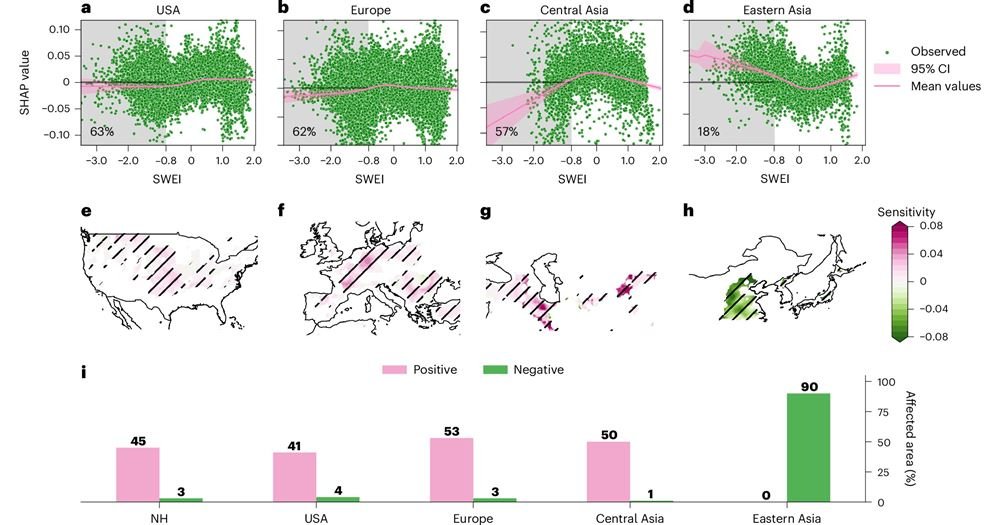
The study found that about 45% of farmland in the Northern Hemisphere has suffered significant negative impacts due to snow drought. Europe, Central Asia and the United States are the most affected regions. Source: PolyU, press release, 27 May 2026
The phenomenon affects nearly one in two fields
Using this framework, researchers found that about 45% of farmland in the Northern Hemisphere has experienced significant negative impacts from snow droughts, with Europe, Central Asia, and the United States among the most affected regions. In East Asia, meanwhile, the yield benefits from longer growing seasons driven by warmer winters are gradually declining, while the balance between water availability and temperature is becoming increasingly unstable.
“Winter wheat croplands have experienced an increase in snow drought frequency (5.3–6.7% more events per decade) from 1960 to 2020”, the study reports.
The data also reveal “a significant increase in yield sensitivity to snow water equivalent index over 25% of Northern Hemisphere winter wheat croplands”. The study further identifies three main drivers increasing wheat vulnerability to snow droughts: “Elevated fertilizer application rates, increased freezing stress and slightly decreased precipitation”. When snow droughts occur, these factors can amplify the risk of yield losses.
Strengthening agricultural resilience systems
“As global warming continues, climate risks are no longer limited to ‘acute stressors’ such as heatwaves, but also include gradually accumulating and far-reaching ‘chronic stressors’ such as snow droughts”, Professor Shuo Wang, a researcher at The Hong Kong Polytechnic University and co-author of the study, explained in a statement. “As winter wheat is a major commodity in global agricultural trade, the effect of its yield variability can ripple through global trade networks, driving up food prices and potentially leading to regional food security crises”.
According to the authors, addressing this challenge requires strengthening the climate resilience of agricultural systems through a set of targeted strategies.
These include developing crop varieties that can withstand both cold and drought conditions, adopting more efficient and sustainable agronomic practices, and integrating snow cover monitoring into agricultural risk assessment and early warning systems. Early identification of areas exposed to snow droughts, and intervention before impacts reach crop yields, will be essential to ensure stable food production. This, in turn, will help safeguard the agricultural sector and the economic security of entire regions worldwide.
 Hans Hillewaert, CC BY-SA 4.0
 Blonder1984, CC BY-SA 3.0
 Gareth James CC BY-SA 2.0 Attribution-ShareAlike 2.0 Generic


