From local action to European strategy: a Policy Lab for the bioeconomy
 BBioNets consortium Attribution-NonCommercial 4.0 International CC BY-NC 4.0 Deed
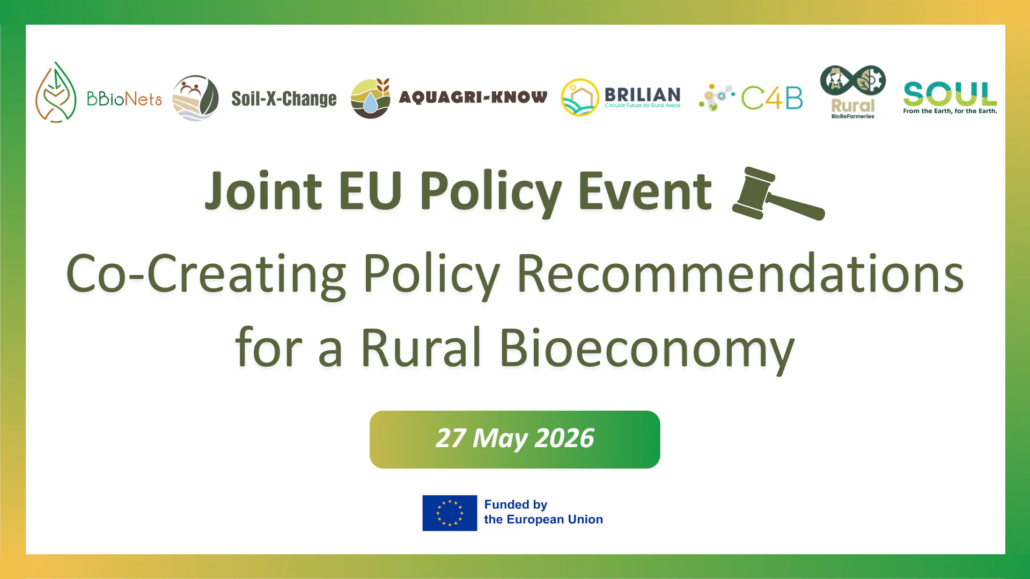
On 27 May in Brussels, a meeting of seven EU-funded initiatives. The aim: to bridge the gap between local experimentation and European policymaking, and to deliver actionable recommendations for the rural bioeconomy
by Matteo Cavallito
Promoting a meaningful dialogue between local innovation and European policymaking in bioeconomy: this is the main goal of the event “Co-Creating Policy Recommendations for a Rural Bioeconomy”, taking place on 27 May in Brussels. This key event will bring together the leaders of seven EU-funded initiatives, who are joining forces to close the gap between on-the-ground experimentation and decision-making processes, while building a shared strategic vision rooted in local experience. And turning accumulated knowledge into shared recommendations.
In-person attendance, by invitation only, is reserved for stakeholders and project partners. However, all sessions will also be available via live streaming (click here to access the registration form).
Four objectives for innovation in the bioeconomy
At the heart of the event is the “Policy Lab”, a dedicated space for exchange and co-creation. Here, participating consortia will combine technical data with practical experience to produce targeted insights aligned with the new European Bioeconomy Strategy. Four main priorities will guide the work:
- consolidating evidence from projects across different countries;
- analysing barriers and opportunities in bio-based value chains;
- developing concrete policy recommendations;
- strengthening dialogue between research and policymakers by shaping a roadmap that reflects the real needs of rural areas.
The programme
The agenda is full. Proceedings will open with a plenary session focused on aligning the strategic priorities of the seven consortia, introduced by the EU CAP Network Support Facility, the operational body supporting the European network dedicated to the Common Agricultural Policy, alongside additional contributions. Two thematic working groups will then follow.
- The first, focused on sustainable resource management, will explore the role of EIP-AGRI Operational Groups—established under the European Innovation Partnership for agriculture—in enhancing the value of soil, water and biomass.
- The second, dedicated to regulatory frameworks and value chains, will examine the legislative developments needed to support fair rural business models and cooperative bioeconomy value chains.
Findings will feed into a final roundtable discussion, where institutional representatives and funding bodies will review and validate the produced recommendations.
Re Soil presents the SOUL project
Re Soil Foundation will also take part in the second working group, presenting the objectives and key features of SOUL (Bio-based in Soil applications with Optimal biodegradation in their Ultimate Life), a project supported by the Circular Bio-based Europe Joint Undertaking and its members, and co-funded by the European Union (GA 101214822). The initiative brings together 18 partners to develop new bio-based products with high renewable content, designed to biodegrade in soil at the end of their life cycle, thereby minimising environmental impact.
The initiative focuses on the development and validation of 11 innovative solutions, made with over 95% renewable raw materials, including agricultural residues, agri-food by-products and low-impact crops.
Designed to be compatible with existing bioplastics processing technologies, these solutions will be tested under real-world conditions in five European countries with diverse climatic profiles. The SOUL innovations are compatible with multiple end-of-life scenarios, including soil biodegradation, composting, reuse and recycling. Ultimately, the project aims to establish a bioeconomy model capable of delivering strong performance across sectors such as agriculture, gardening, leisure and sports while also helping to protect soil quality.
 Hans Hillewaert, CC BY-SA 4.0
 Blonder1984, CC BY-SA 3.0
 Gareth James CC BY-SA 2.0 Attribution-ShareAlike 2.0 Generic