Marine bacteria may serve as a natural soil fertiliser
 RIKEN press release
A Japanese study tested the effectiveness of purple non-sulphur bacteria in providing nutrients to plants. Thanks to their enzymes, these microorganisms take nitrogen from the atmosphere and then incorporate it into proteins
by Matteo Cavallito
The biomass of a particular species of marine bacteria may prove to be a viable alternative to the use of traditional fertilisers. This is supported by a study by researchers at RIKEN, a research centre based in Wako, Saitama Prefecture, Japan. The discovery opens up new opportunities for a global agricultural sector that is still heavily dependent on synthetic nitrogen products, whose massive use has notoriously significant environmental repercussions. These include increased greenhouse gas emissions, contamination of groundwater, and long-term impoverishment of soil quality.
Bacteria absorb large amounts of nitrogen
“Plant-based agricultural systems rely heavily on inorganic nitrogen (N) fertilizers to increase yields and ensure food security for the rapidly growing global population,” the study explains. “However, the production and overuse of synthetic fertilizers lead to significant amounts of greenhouse gas emissions, causing a critical need for the development of alternative and sustainable organic N fertilizers.”
The scientists, a statement from RIKEN says, set out to find a natural source of nitrogen that could replace synthetic fertilisers. They found it in so-called purple non-sulphur bacteria (PNSB).
These microorganisms have enzymes that help them take nitrogen from the atmosphere and incorporate it into proteins. To create an organic fertiliser, the scientists chopped up the dried biomass of these bacteria to create a compound for testing. An initial analysis showed that the nitrogen content amounted to 11% of the total weight of the product. A value “much higher than what is found in other organic fertilizers, including biomass made from other microbes or microalgae,” the researchers explain.
The experiment
The effectiveness of non-sulphurised purple bacteria as fertilisers was tested in the cultivation of spinach. Crops were treated with two inorganic nitrogen fertilisers and the biomass product made with a variable dose of nitrogen (equal to, double or four times that of a conventional synthetic fertiliser). Spinach has proven capable of absorbing nitrogen from the bacteria-based fertiliser. The use of the bacteria-based fertiliser did not affect the acidity or salinity of the soil, which remained normal, similar to that of soil fertilised without the use of nitrates.
“We examined the effects of its application on plant germination and growth (measured by leaf chlorophyll, maximum leaf length, and dry weight) under two different temperature regimes, comparing it to that of a conventional N-containing mineral fertilizer,” the study explains.
In summary, “Application at rates up to four times that of the mineral fertilizer had no negative effects on seed germination and plant growth”. Results “confirm the ability of plants to take up N from the lysed and dried biomass of marine purple photosynthetic bacteria, demonstrating the potential for using R. sulfidophilum as a source of N fertilizer.”
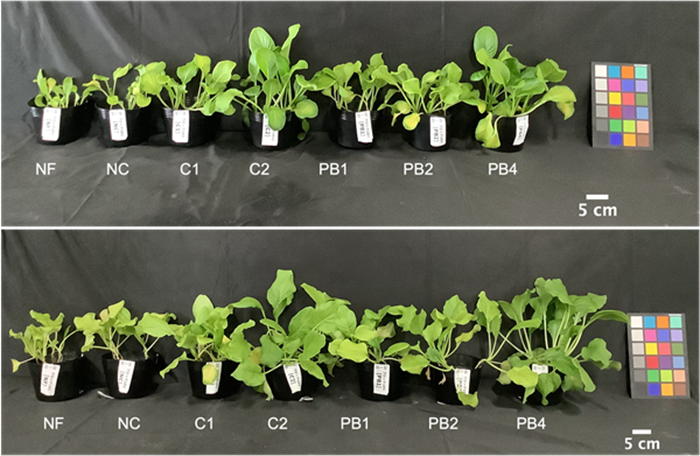
New applications in agriculture
Nitrogen release from biomass fertiliser is relatively slow compared to inorganic products. To achieve the same growth results, the authors point out, it is necessary to use twice as much of the substance in comparison with synthetic fertiliser. The advantages of the bacterial compound in terms of sustainability, however, are obvious: less CO2 emissions and less nitrogen leaching into the environment.
Those so far, of course, are only preliminary data. Further studies, the scientists explain, are now needed to assess the life cycle of the fertiliser and its environmental footprint along the entire production chain. According to Shamitha Rao Morey-Yagi, researcher and co-author of the study, the long-term use of the organic product, in any case, “could revolutionize agriculture” by limiting its negative impact on the environment.
 Jonathan Wilkins Attribution-ShareAlike 3.0 Unported CC BY-SA 3.0 Deed
  Melissa McMasters Attribution 2.0 Generic CC BY 2.0 Deed