Nanoplastics reduce photosynthesis capacity in trees
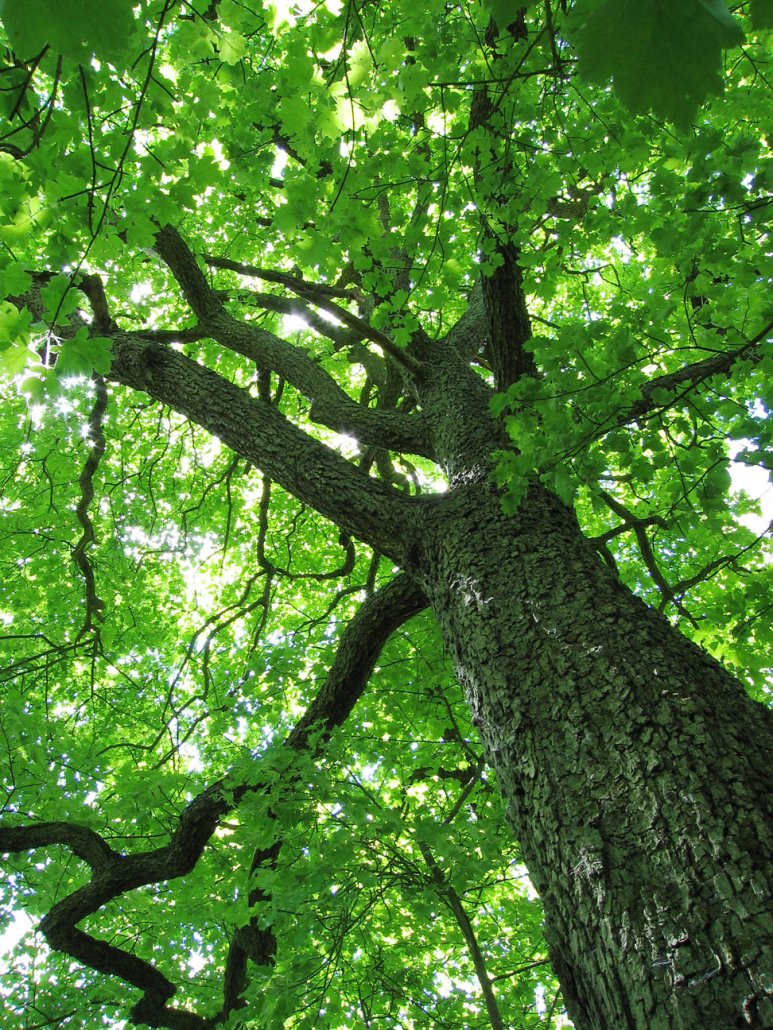 Photo: Andrew Dunn Attribution-ShareAlike 2.0 Generic CC BY-SA 2.0 Deed
 A Swiss study clarifies the dynamics of nanoplastic uptake in trees. While quantifying the impact of the phenomenon on the effectiveness of photosynthesis
by Matteo Cavallito
The uptake of nanoplastics in water by trees negatively affects their photosynthesis activity. But the overall effects of this phenomenon have yet to be fully assessed. This is suggested by a Swiss study involving researchers from ETH Zurich and the Swiss Federal Institute for Forest, Snow and Landscape Research WSL in Birmensdorf.
Nanoplastics uptake in trees
The interaction between tiny plastic fragments and forest trees is a topic that has recently been explored by scientists. The issue is clearly of prime importance in view of the well-known polluting effects of these materials. “Anthropogenic contaminants can place significant stress on vegetation, especially when they are taken up into plants,” the study says.
Moreover, “Plastic pollution, including nanoplastics (NPs), could be detrimental to tree functioning, by causing, for example, oxidative stress or reducing photosynthesis.” There is currently no precise and commonly accepted definition of nanoplastics. The term, in any case, refers to those particles with a diameter of between 1,000 and 100 nanometres, or one thousandth to one ten-thousandth of a millimetre.
The research
“While a number of studies have explored the capacity of plants to take up NPs, few have simultaneously assessed the functional damage due to particulate matter uptake,” the researchers point out. To achieve this goal, the authors cultivated 100 seedlings of two different tree species, the authors explain in a statement: the wild service tree, a Rosaceae family tree found in some deciduous forests, which needs a lot of water, and the the Norway spruce, typical of coniferous forests, which requires little.
The plants, the research continues, were hydroponically grown by absorbing water with the addition of different concentrations of nanoplastics whose presence was later detected in the trees themselves by the researchers.
Over a period of a few weeks, the authors were able to detect between 1 and 2 milligrams of nanoplastics per gram of plant material in the roots. The presence of this material was 10 to 100 times lower in trunks, leaves and needles. Between the two tree species, the note points out, no significant differences were found, an indication that the amount of water intake did not influence the phenomenon. This aspect therefore suggests that plastics do not penetrate the plant through root crevices but are rather absorbed by the root cells and then transported upwards.
The impact on photosynthesis
The most relevant finding of the study, however, relates to the impact on photosynthesis. “Our study shows that both, evergreen coniferous as well as deciduous broadleaf tree species are negatively affected in their photosynthesis by NPs uptake and transport to aboveground organs,” the research highlights. Measurements, in particular, showed that the effectiveness of photosynthesis is reduced by a third in a fortnight in the wild service tree. And by 10 per cent in four weeks in the spruce.
The result is that part of the energy of sunlight is no longer used for photosynthesis, but is dissipated in the form of heat.
The reduction in the effectiveness of photosynthesis, the researchers concluded, had no effect on tree growth. However, considering the brevity of the observation period, just four weeks, it is currently not possible to fully assess the possible long-term consequences. It is difficult, the scientists emphasise, to think that nanoplastics could have lethal effects on plants. But it is nonetheless likely that their uptake may now constitute a further critical factor for trees. In particular those “facing multiple, concurrent stressors from anthropogenic pollution and climate change.”
 Thpelin Attribution-ShareAlike 3.0 Unported CC BY-SA 3.0 Deed
 Jonathan Wilkins Attribution-ShareAlike 3.0 Unported CC BY-SA 3.0 Deed