Corrado (S&D): “Soil Law strikes a balance between ambition and practicality”
 © Mathieu CUGNOT - European Union 2025
The shadow rapporteur for the Socialists and Democrats Group on the new Soil Law approved by the European Parliament: “It is a starting point, which valorizes the knowledge and virtuous experiences of the territories”
by Emanuele Isonio
Hon. Corrado, as shadow rapporteur for your parliamentary group, you closely followed the various stages leading to the approval of the soil monitoring directive. Why do you think it’s right to give a positive assessment of the text finally approved by the European Parliament in recent weeks?
For the first time, the Union has adopted a law that recognizes soil as a living, limited, and precious resource, to be protected like water and air. The approved text is the result of long and complex work, but ultimately strikes a balance between ambition and practicality: a common framework for truly understanding the state of our soils, understanding where to intervene, and providing member states with the tools and support to do so. It is a law that speaks to healthy food, clean water, and safer and more resilient communities.
Healthy soils are essential for better absorbing extreme rainfall, retaining water during droughts, and supporting high-quality agricultural production.
What, if any, was the decisive turning point that led to the agreement?
The turning point came when, after months of blockages and mistrust, it was agreed to emphasize knowledge and monitoring. This wasn’t about imposing new abstract obligations, but rather about creating the scientific and operational foundations for sustainable soil management. From that moment on, negotiations unblocked: Member States understood that without reliable and comparable data, effective policies cannot be implemented or planned. Thus, it was possible to build a solid compromise, based on transparency, cooperation, and a gradual approach.
Rapporteur Martin Hojsík spoke of a “bottom-up” directive, based on subsidiarity. What does this mean?
It means it’s not a top-down regulation, but a common system that leverages the expertise and experience of local areas. Each country will be able to organize its own soil districts, use its own monitoring networks, and set targets based on local specificities, all within a coherent and shared European framework. It’s a pragmatic approach that connects what already works and ensures a comprehensive vision for the entire Union. It’s also a way to restore trust in science and participation, involving farmers, local authorities, researchers, and citizens.
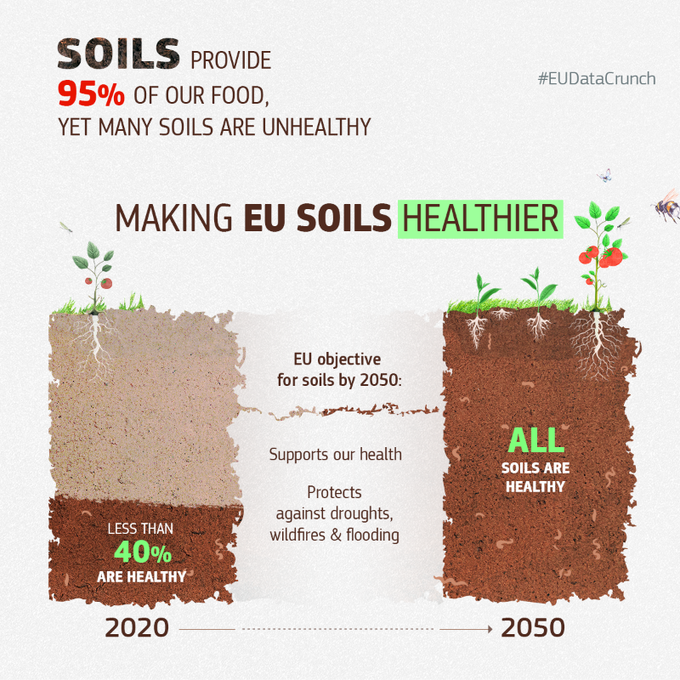
The overall goal of the Soil Monitoring Directive is to restore Europe’s soils to health by mid-century. SOURCE: European Commission
How and to what extent will the Soil Law contribute to achieving healthy soils by 2050?
The directive implements a three-step strategy. First: build a reliable monitoring system to understand the actual state of soils and prioritize identifying contaminated sites, including those affected by emerging contaminants such as pesticides, PFAS, and micro- and nanoplastics. Second: promote prevention and regeneration actions, combating land consumption and incentivizing the remediation of contaminated sites. Third: accompany the transition with training, consultancy, and financial support for land managers. Healthy soils also mean greater carbon and water retention capacity, reducing the impact of floods, droughts, and erosion. The long-term goal—healthy soils across the EU by 2050—will be supported by periodic reviews: the first in seven years, when we will have a complete and comparable picture of the European situation, the basis for a future operational legislative framework with concrete tools and resources.
The JRC reports an alarming figure: 61% of European soils are in an “unhealthy” state. Is the Soil Law ambitious enough to reverse this trend?
My political group and I would have liked a more decisive acceleration, commensurate with the gravity of the data.
But the result must be interpreted correctly: it is not an “end-of-the-road” law, but a starting point. We cannot cure what we do not know.
This directive creates the scientific and political basis for a European soil regeneration strategy, which is also a climate adaptation strategy. It will require continuity, resources, and above all, the political will to implement what is now possible. The message is clear: there is no ecological transition, nor climate security, without healthy soils.
Much will depend on national implementation. What do you expect from Italy? And from an increasingly conservative Europe?
I expect Italy to capitalize on its experience: we have the scientific and technical expertise of ISPRA and regional environmental agencies, but we must make up for lost time in planning and reducing land use. The directive can be an opportunity to align monitoring and action, linking data to territorial planning and climate disaster prevention. And it can support agricultural policies that protect soil fertility and production quality. At the European level, I hope that even those who are wary of environmental policies will recognize that healthy soils mean food, water, safety, and jobs: they are the very foundation of the resilience and prosperity of our communities.
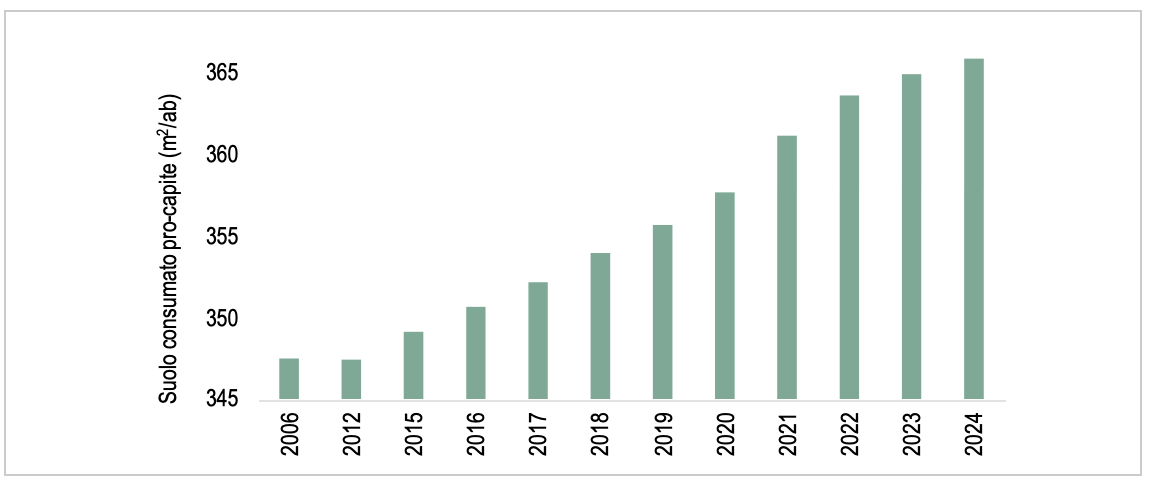
Land consumption per capita at the national level per year. Source: ISPRA processing on SNPA cartography (2025)
Italy is “first in class” in monitoring, but a “Cinderella” in overbuilding. Isn’t that a paradox?
It’s a paradox, but also a challenge. We are among the most advanced countries in soil knowledge, but among those consuming it the fastest. This gap demonstrates that knowledge is not enough unless it translates into coherent policies. The Soil Law helps us do just that: to transform knowledge into action, to ensure that data doesn’t remain in the drawer but guides urban planning, agricultural, and environmental decisions. And it reminds us that soil protection is a battle for public health, safety, and the quality of life for all—because the fertility of the countryside, the stability of the land, and the ability to respond to the climate crises we are already experiencing depend on healthy soils.
 Rod Waddington Attribution-ShareAlike 2.0 Generic CC BY-SA 2.0 Deed
  Thpelin Attribution-ShareAlike 3.0 Unported CC BY-SA 3.0 Deed