This is how iron minerals promote soil carbon sequestration
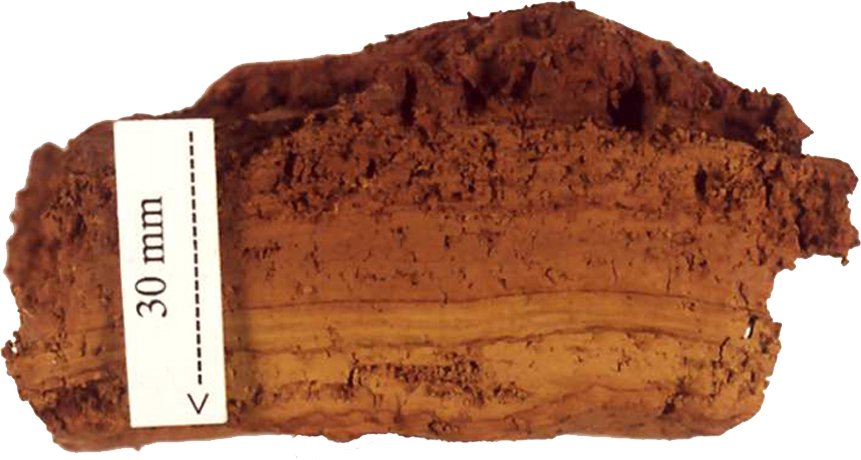 Jerry Bigham Attribution-ShareAlike 3.0 Unported CC BY-SA 3.0 Deed
 Iron oxide minerals trap more than a third of the organic carbon in soil. Among them, a study explains, ferrihydrite uses different strategies to capture different compounds
by Matteo Cavallito
Soil increased ability to sequester and retain carbon is known to be due, in some cases, to the presence of iron oxide minerals. However, the methods used by these minerals to capture the element have been ignored until now. Today, a study by Northwestern University in Evanston, Illinois, published in the journal Environmental Science & Technology, reveals the details.
The study focused in particular on ferrihydrite, a mineral that, the authors observed, uses different chemical strategies to capture and trap the element.
Over a third of soil carbon is retained by iron
Iron oxide minerals, scientists note, are associated with over a third of the organic carbon stored in soil. Among these, Iron oxide minerals trap more than a third of the organic carbon in soil. Among them, a study explains, ferrihydrite is commonly found in soils near plant roots or in soils and sediments rich in organic matter. Although characterized by a positive charge, the study notes, it is able to bind a wide variety of organic compounds, some negatively charged, others positively charged, and others neutral.
To understand how this happens, the authors combined high-resolution molecular modeling and atomic force microscopy to obtain a detailed view of the mineral’s surface.
This allowed them to observe the relationships between surface chemistry and carbon capture. “With these variable charges due to protonation extent of surface hydroxyls,” the study explains, “molecular dynamics simulations revealed binding mechanisms of organic moieties with opposite charges, confirmed experimentally by infrared spectroscopy.”
The surface structure is decisive
In simple terms, after mapping the surface charges in detail, the authors introduced the mineral into organic molecules commonly found in soil, including amino acids, plant acids, sugars, and ribonucleotides. Then, they measured how much of these molecules stuck to the ferridrite and used spectroscopy to check out how this happened. As expected, the overall charge of the mineral was positive. But the surface structure turned out to be key to bringing different compounds together.
The researchers discovered that the surface of ferrihydrite actually contains mixed areas of positive and negative charges. This would explain how it can attract both negatively charged substances such as phosphates and positively charged substances such as metal ions. Furthermore, it does not trap carbon solely through electrostatic attraction. It also uses chemical and hydrogen bonds to bind organic materials.
Minerals capture many kind of organic molecules
“While positively charged amino acids bonded to negative patches on ferrihydrite’s surface, negatively charged amino acids bonded to the positively charged patches,” explain the scientists. At the same time, “Other compounds, like ribonucleotides, are first drawn to ferrihydrite by electrostatic attraction and then go on to form much stronger chemical bonds with iron atoms.” Moreover, “sugars, which form the weakest bonds, are attached to the mineral through hydrogen bonding.”
In summary, thanks to different strategies, iron oxide minerals can trap carbon in different forms, capturing and retaining many types of organic molecules. The results therefore provide new information useful for understanding some of the dynamics that contribute to the sequestration of the element and, ultimately, to the mitigation of global warming.
 Melissa McMasters Attribution 2.0 Generic CC BY 2.0 Deed
  Angal insect Attribution-ShareAlike 4.0 International CC BY-SA 4.0 Deed
  ECHO
ECHO