A new index measures soil health in mangrove forests
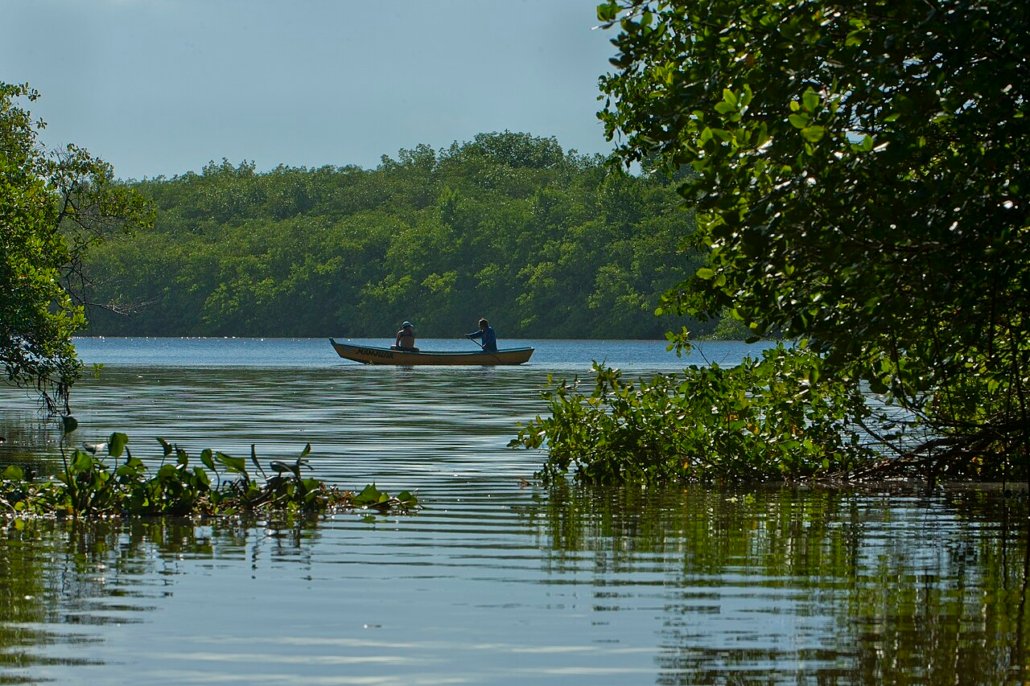 Jonathan Wilkins Attribution-ShareAlike 3.0 Unported CC BY-SA 3.0 Deed
 Brazilian researchers have developed an indicator to measure the ability of mangroves to provide ecosystem services, ranging from biodiversity conservation to carbon sequestration. The greater the soil degradation, the lower the score
by Matteo Cavallito
Deforestation of mangrove forests has a significant impact on soil health. Measuring the impact of this phenomenon, however, is not straightforward, partly because the available tools do not currently seem adequate. For this reason, a group of Brazilian researchers has attempted to offer a new solution by proposing a new indicator capable of assessing the condition of these soils at different stages: degradation, intact condition and recovery.
Described in an article published in the journal Scientific Reports, the Soil Health Index (SHI) ranges from a minimum score of 0 (worst condition) to a maximum of 1 (best) and shows that healthy mangroves can provide ecosystem services at nearly full capacity. In contrast, deforested mangroves provide only a small fraction of these services.
Mangroves sequester 21 billion tons of CO2
Found primarily in tropical and subtropical regions, mangroves grow mainly along low-lying coastlines, lagoons, and river estuaries where saltwater mixes with freshwater. These environments cover 1.4 million hectares in Brazil (making them the second-largest area in the world after Indonesia’s) and host a rich biodiversity, including many marine species, and play an essential role in protecting coastal regions by acting as natural barriers against storms, erosion, and flooding. They also demonstrate an extraordinary capacity for carbon sequestration, which, according to estimates, could prevent total emissions of over 21 billion tons of CO2 on a global scale.
The new index
“Mangrove forests provide critical soil-related ecosystem services (ES), including carbon sequestration, contaminant retention, and nutrient cycling—all closely linked to soil health,” explain researchers from the University of São Paulo, authors of the study. “However, land-use change and pollution increasingly threaten mangrove soils, compromising their functionality and ES provision.” Strategies to combat degradation, they continue, can only be developed based on a careful analysis of soil health using key indicators.
However, they add, “despite their importance, soil health indexing methods for mangroves remain underdeveloped.”
The new index, as noted in an article by the São Paulo Research Foundation (FAPESP), a public entity managed by the local government control, was constructed using a set of variables representing the main physical, chemical, and biological processes responsible for soil function. These include carbon dynamics, soil texture, organic carbon and iron content, contaminant fixation, the nutrient cycle, and the enzymatic activities of soil microorganisms.
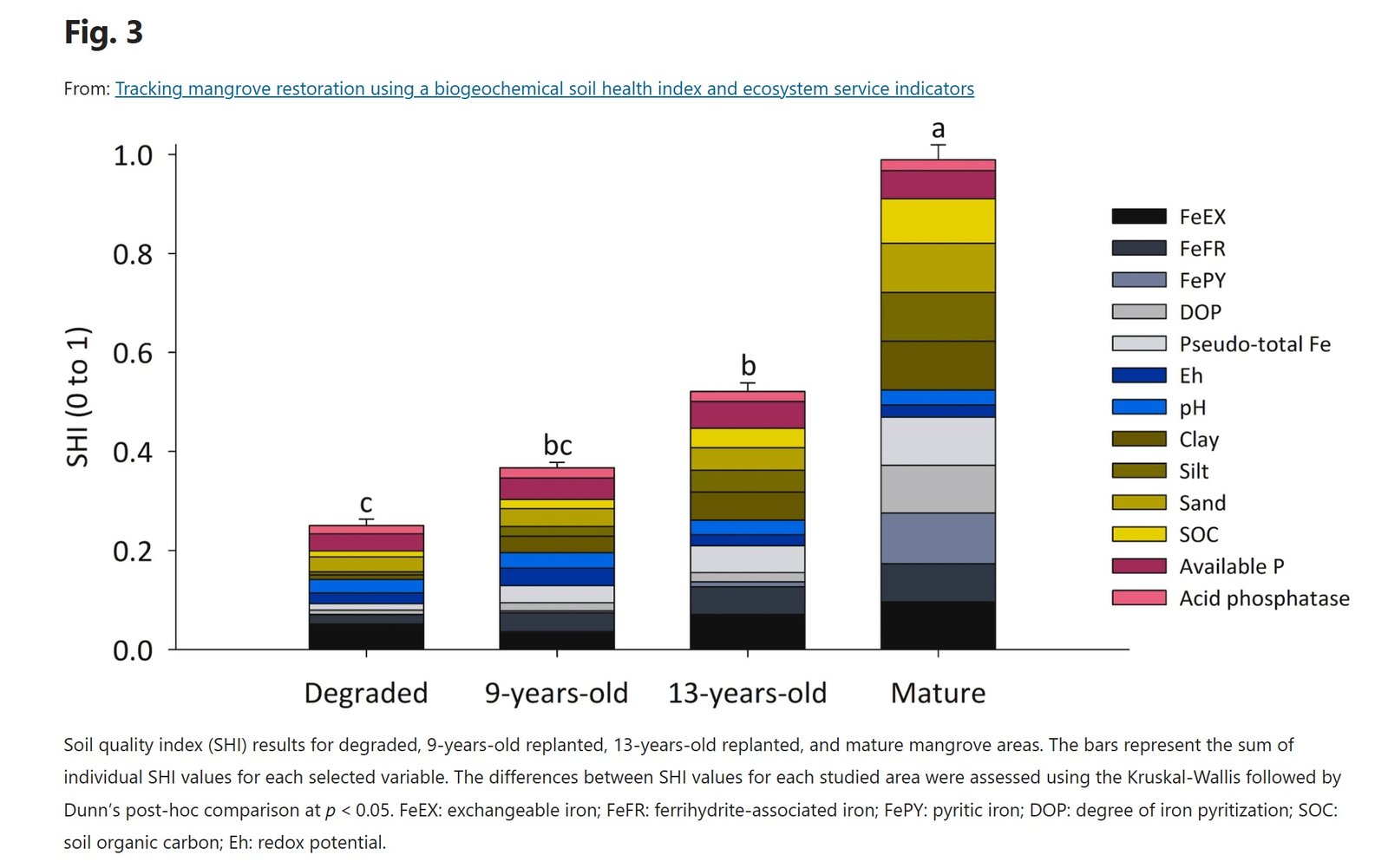
Soil Health Index (SHI) results for degraded mangrove areas, areas replanted 9 years ago, areas replanted 13 years ago, and mature mangrove areas. The bars represent the sum of the individual SHI values for each selected variable. Mature mangroves show the highest scores, while degraded sites show the lowest. The areas replanted nine and thirteen years ago, on the other hand, show intermediate values. Source: Jimenez, L.C.Z., Queiroz, H.M., Cherubin, M.R. et al. Tracking mangrove restoration using a biogeochemical soil health index and ecosystem service indicators. Sci Rep 16, 1236 (2026). https://doi.org/10.1038/s41598-025-30909-2 Attribution-NonCommercial-NoDerivatives 4.0 International CC BY-NC-ND 4.0 Deed
Soil health and ecosystem services go hand in hand
Researchers assessed mangrove forest soils located in the Cocó River estuary in the Brazilian state of Ceará. Here, the SHI index revealed contrasting conditions: “Mature mangroves showed the highest SHI values (0.99 ± 0.03), while degraded sites had the lowest (0.25 ± 0.01),” the study explains.
Regions replanted nine and thirteen years ago, however,“displayed intermediate SHI values (0.37 ± 0.01 at 9 years; 0.52 ± 0.02 at 13 years), indicating gradual recovery.”
The capacity to provide ecosystem services also followed the same trend. Ultimately, the researchers conclude, “the SHI effectively captured soil health changes across degradation and restoration gradients and is a promising tool to inform decision-makers, support conservation planning, and communicate complex data in accessible formats.”
Ecosystems in Danger
According to Hermano Melo Queiroz, a professor in the Department of Geography at the University of São Paulo, as quoted by FAPESP, “the results debunk the idea that the ecosystem is resilient to anthropogenic interventions.” In contrast, he explains, “We show that it can be degraded at a very rapid rate. But the good news is that the system also recovers quickly, provided that restoration is carried out in an assisted and elaborate manner, respecting the local conditions of the environment in which it’s located.” Finally, the authors note that the index is designed to include ecosystem-specific information across different regions.
Further research is now needed to understand what kind of carbon is accumulating in the restored soils and, above all, how stable it is.
In the meantime, the tool offers important support for conservation efforts aimed at protecting a type of environment that has long been endangered. Between 1980 and 2000, according to estimates by the U.S. think tank One Earth, the world lost approximately 35% of its mangroves. Furthermore, between 1996 and 2016, the planet reportedly experienced an additional 4.3% net loss of these trees. This indicates that the rate of regrowth has not been sufficient to offset the losses, which experts attribute primarily to deforestation and climate change, which contributes to rising sea levels.
 Melissa McMasters Attribution 2.0 Generic CC BY 2.0 Deed
  Angal insect Attribution-ShareAlike 4.0 International CC BY-SA 4.0 Deed
  ECHO
ECHO