Climate change enhances metal release in coastal areas

Events such as rising sea levels, increasing temperatures and changes in precipitation affect metal sequestration conditions in underground estuaries, explains a Swedish study
by Matteo Cavallito
Climate change and rising pressure from human activities generate an increased metal release from the coasts to the oceans. A phenomenon that occurs through emersion from sediments where pollutants remain buried for a long time due to a series of favourable conditions. This is suggested by a study from the University of Gothenburg.
In coastal soils, the authors point out, low oxygen levels and slow decay environments contribute to the sequestration of material, protecting the surrounding marine environments. Coastal sediments and mangroves, in particular, are typical reservoirs of metal pollutants. Climate-related events, however, can increase the uptake of metals by living organisms with negative consequences for them.
The impact of climate on metal release
“Rapidly increasing anthropogenic pressure is driving declining coastal water quality and ecological health,” the study explains. ‘”Globally, population growth and urbanization rates are highest in coastal zones, where the human population is expected to exceed 1 billion by 2060.” Metals accumulate in coastal soil driven by numerous factors including industrial activities, agricultural activities and mining operations. At the same time, subsurface discharge – which includes fresh meteoric water that washes up on the coast and seawater recirculated through coastal sediments – encourages the accumulation of materials.
The problem, however, is that ‘Climate change impacts such as sea-level rise, warming temperatures, and precipitation changes,’ the study explains, ‘are projected to disproportionately affect coastal areas, influencing key conditions for metal speciation in the subterranean estuary.”
More in detail, “Changes in salinity, pH, temperature, hydraulic gradients, land use, and redox conditions alter coastal metal speciation and adsorption behavior, where submarine groundwater discharge may become an increasingly significant source or sink of dissolved metals to the nearshore environment”.
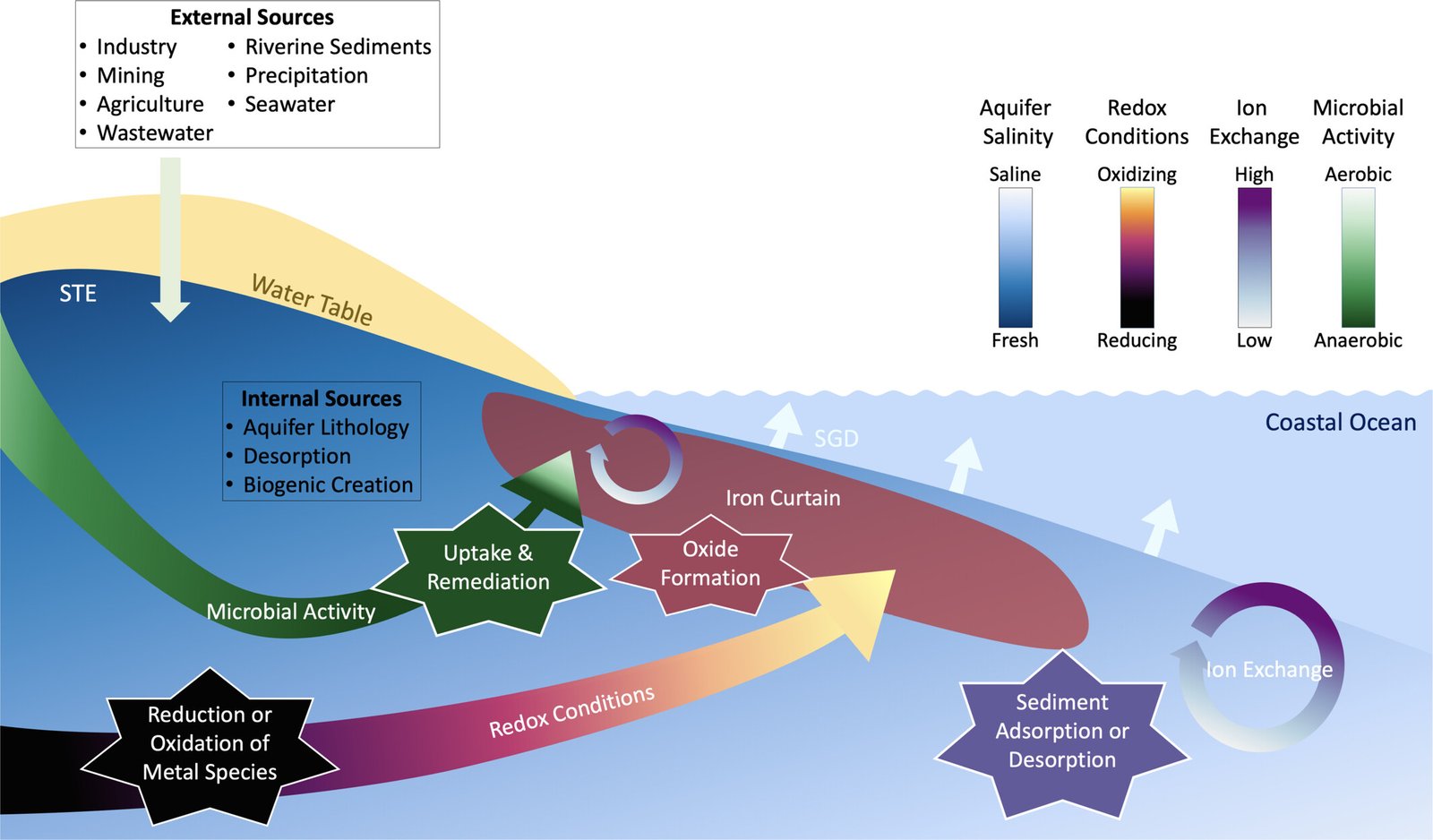
The main processes influencing the behaviour of metals in the underground estuary. Source: Mckenzie et al. “Metals in coastal groundwater systems under anthropogenic pressure: a synthesis of behavior, drivers, and emerging threats”, Limnology and Oceanography Letters, Volume 9, Number 4, August 2024 https://doi.org/10.1002/lol2.10413 Open Access Attribution 4.0 International CC BY 4.0 Deed
Population density is a risk factor
Using data on population density, water treatment rates, mining activities and more, says a statement, the team led by Tristan McKenzie, a researcher in the Department of Marine Science at Gothenburg University, created a model to estimate the variation in risk of increased metal discharges into the ocean based on human activities.
The model suggests that “Areas with the highest metal contamination risk from SGD (covering 4% of the global coast) are those with very high population density, high SGD, and the presence of acid sulfate soils, particularly around densely populated tropical regions.”
Eyes on South-East Asia
The survey found five categories of risk: high population density, high coastal mining and acid sulphate soils, a very high proportion of untreated wastewater, heavy underwater groundwater discharge and rising sea levels. In general, these problems occur mainly in East Asia. “We see that the coasts of Southeast Asia are in trouble,” McKenzie says.
Moreover, he says, “They are experiencing rapid population growth, inadequate water treatment, and climate change is expected to hit these areas hard, according to theIntergovernmental Panel on Climate Change projections. Our model is useful for future research on, and action against, metal pollution.”
Finally, the study reveals that coastal groundwater flows are an important but so far ignored source of ocean pollution. Taking their impact into account is therefore particularly important when assessing the risks of metal releases into the oceans.

 Jonathan Wilkins Attribution-ShareAlike 3.0 Unported CC BY-SA 3.0 Deed
  Melissa McMasters Attribution 2.0 Generic CC BY 2.0 Deed