
The Indian Ocean swallows mangroves. From the Maldives a warning for the Planet
 ahuren Attribution-NonCommercial-ShareAlike 2.0 Generic CC BY-NC-SA 2.0 Deed
 According to British research, rising sea levels are accelerating the death of mangroves. A phenomenon that affects many coastal areas of the planet
by Matteo Cavallito
Rising sea levels, a consequence of global warming, are promoting the partial disappearance of mangrove forests and, with it, the progressive erosion of tropical and subtropical coastlines. The problem is most evident today in the Maldives but also affects many other areas of the planet. This is revealed by a study published in the journal Scientific Reports, which calls into question, among other things, a climatic phenomenon known as the Indian Ocean Dipole, which causes a cyclical variation in the temperature of surface waters.
“Mangrove forests enhance Small Island Developing States’ resilience to climate change, yet in 2020, a mangrove dieback impacted ~ 25% of mangrove-containing islands in the Maldives,” explains the research, which involved a team of scientists mainly from Northumbria University in Newcastle, UK. Some islands, in particular, are reported to have lost more than half of their coverage since 2020.
Mangroves protect against erosion
Mangrove ecosystems, the researchers point out in a statement, contain a wide biodiversity, are vital nurseries for marine species such as crabs, shrimps and fish and, as such, are crucial to the food security and livelihood of many coastal communities. These plants also play an essential role in protecting coastal regions, acting as natural barriers against storms, erosion and flooding.
According to a report by the NGO Global Mangrove Alliance, in particular, mangroves are able to prevent more than 65 billion dollars‘ worth of damage per year by reducing the risk of flooding in territories inhabited by some 15 million people.
Of particular importance, finally, is their exceptional carbon sequestration capacity. According to estimates, the Global Alliance further points out, these trees could, in this way, prevent total emissions of over 21 billion tonnes of CO2.
Sea level rise is decisive
In the course of the investigation, researchers considered elements such as sea level, climate data and satellite images and combined them with field observations of sediment geochemistry and dendrology to investigate the disappearance of mangroves. Wood analysis revealed that dead trees showed greater signs of salinity stress than live specimens. It is precisely the increased presence of salt at root level that would have been a key factor in their disappearance.
The researchers found that the sea level around the Maldives rose at an accelerated rate of more than 3 centimetres per year between 2017 and 2020 due to the aforementioned Indian Ocean Dipole.
Rising waters have had a direct effect on forests. Here, the lack of tidal movement and flooding has prevented mangroves from accumulating the sediment they need to stay above sea level. As a result, the plants lost their resilience and literally drowned.
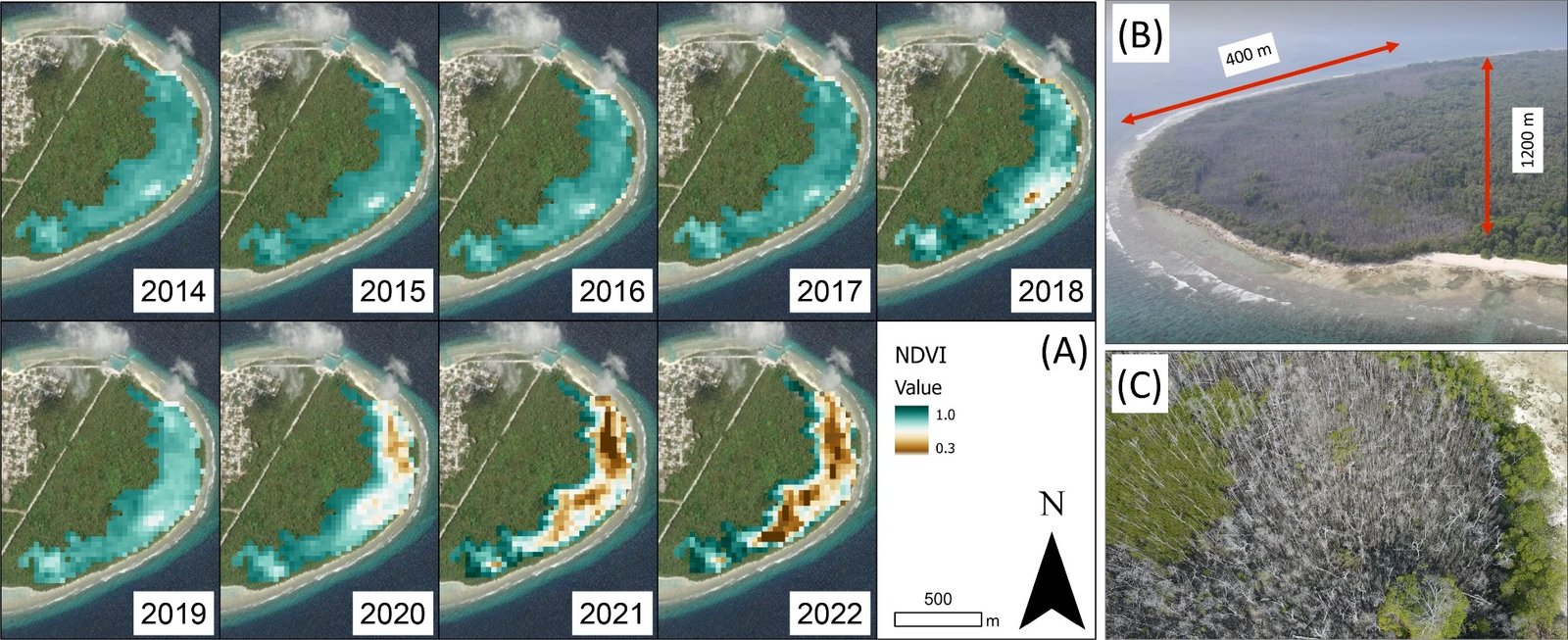
Sea-level rise and extreme Indian Ocean Dipole explain mangrove dieback in the Maldives. Mangrove health through time. (A) Temporal trends in Normalized Difference Vegetation Index (NDVI) on Neykurendhoo island (Imagery source: ESRI, 2023) Software used to generate maps; ArcGIS Pro version 2.9.0, https://www.esri.com/en-us/arcgis/products/arcgis-pro); and (B-C) Oblique aerial drone image of mangrove dieback extent on Neykurendhoo in 2023 (Imagery source: Maldives Resilient Reefs). Source: Carruthers, L., Ersek, V., Maher, D. et al. Sea-level rise and extreme Indian Ocean Dipole explain mangrove dieback in the Maldives. Sci Rep 14, 27012 (2024). https://doi.org/10.1038/s41598-024-73776-z Open Access
A global problem
What happened in the Maldives, the authors explain, is a warning for the rest of the planet. The findings, the study explains, “reveal the vulnerability of mangrove ecosystems to rapid sea-level rise and highlights the urgent need for adaptive conservation strategies in Small Island Developing States.” The phenomenon, after all, has been known for some time. Between 1980 and 2000, the US think tank One Earth reports, the world lost about 35 per cent of the mangroves. During the 21st century, the situation has improved but the problem has not been solved.
Between 1996 and 2016, the planet experienced an estimated net loss of 4.3% of these trees. This is to say that the rate of regrowth has not been sufficient to compensate for the losses. According to the Global Mangrove Alliance, 60% of the losses are related to human activities. Deforestation would be the most impactful factor. Climate change and the consequent rise in sea level further contribute to the total loss.
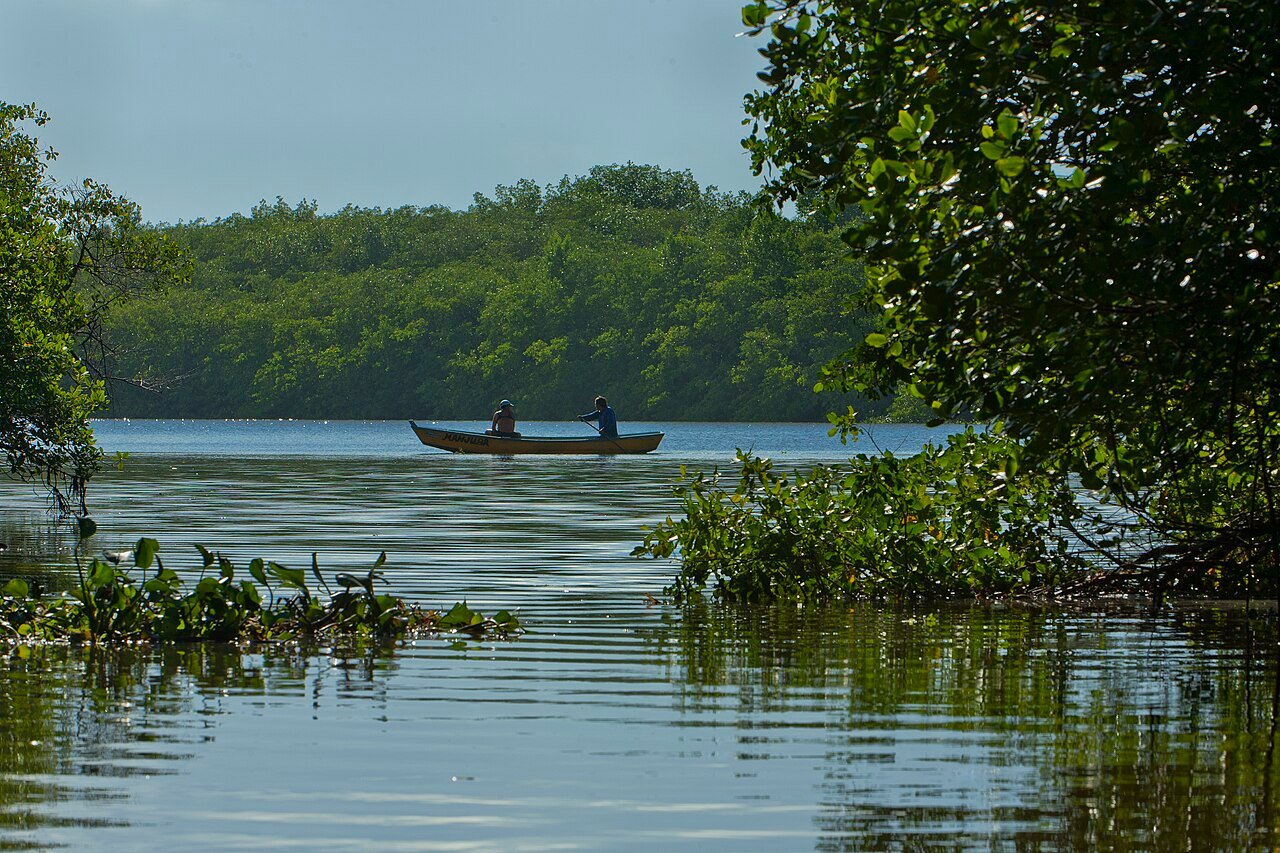 Jonathan Wilkins Attribution-ShareAlike 3.0 Unported CC BY-SA 3.0 Deed
  Melissa McMasters Attribution 2.0 Generic CC BY 2.0 Deed
  Angal insect Attribution-ShareAlike 4.0 International CC BY-SA 4.0 Deed


