Low-contamination soils near Chernobyl could now be cultivated, study claims
 Jorge Franganillo Attribution 2.0 Generic CC BY 2.0 Deed
 Research involving British and Ukrainian researchers hypothesizes the recovery of large areas of the Chernobyl area where cultivation has been officially banned for nearly 40 years. Since 1991 no new reclassification of soils has been done
by Matteo Cavallito
Nearly 40 years after the nuclear disaster that caused its widespread contamination, thousands of hectares of agricultural soils located in the Chernobyl area in northern Ukraine could be returned to farming. This is the opinion of researchers from the University of Portsmouth and the Ukrainian Institute of Agricultural Radiology who, in a recent study, developed a method for re-evaluating land abandoned after the 1986 accident.
“There is a need in Ukraine for re-evaluation of the status of lands outside the Chernobyl Exclusion Zone which were abandoned in the years after the accident,” says the research published in the Journal of Environmental Radioactivity. “Since the 1991 criteria for zoning were put in place, there has been no re-classification of abandoned lands even though radionuclide contamination density and, for radiocaesium isotopes, mobility have both declined.”
Not far from Chernobyl people are still farming
After the April 26, 1986 accident, with some days’ delay the Soviet authorities ordered a total evacuation of the town of Pripjat, the closest urban center to the Chernobyl plant. Still abandoned, the town falls within the so-called “exclusion zone”, an area of about 4,200 square kilometers that lies around the nuclear site and remains completely uninhabited. Two other zones of reduced hazard extend around: the “zone of guaranteed voluntary relocation”, more external and deemed safe, and the “compulsory relocation zone“, which, despite being officially off-limits, has never been fully abandoned.
“The area is home to thousands of people, has schools and shops but no official investment or use of land is allowed,” the researchers explained in a note issued by the University of Portsmouth.
Since the 1990s, they continued, several scientists have argued that soils in the resettlement area could be safely farmed. Despite the bans, moreover, over the years some some farmers have engaged in unofficial production that, over time, has never stopped. This latest study, say the authors, “has confirmed that the farmers were right – crops can be grown safely in most areas.”
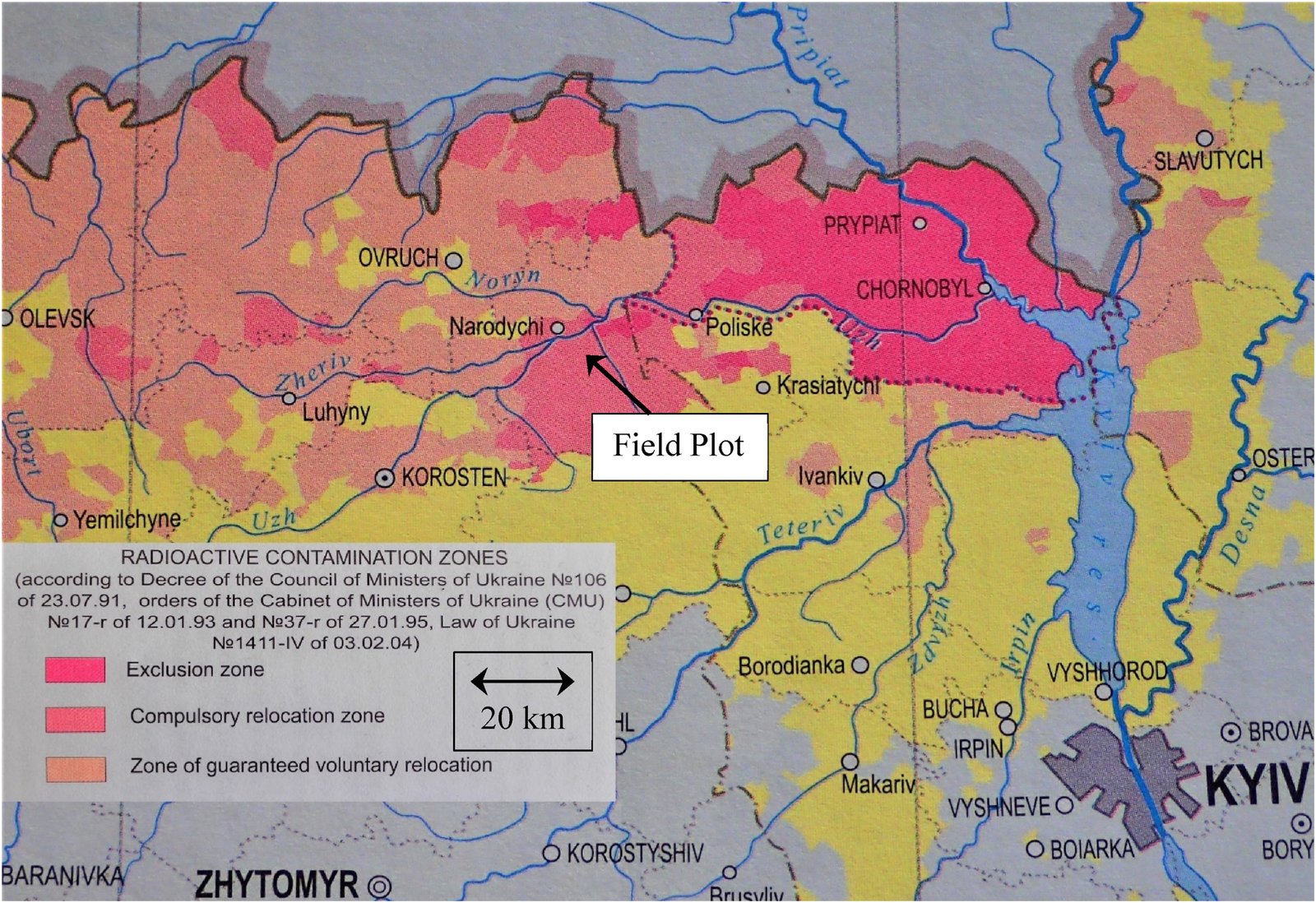
The zoning of the contaminated territory around Chernobyl. Image: J.T. Smith et al., “A protocol for the radiological assessment for agricultural use of land in Ukraine abandoned after the Chornobyl accident”, Journal of Environmental Radioactivity, aprile 2025, 107698, ISSN 0265-931X, https://doi.org/10.1016/j.jenvrad.2025.107698. Attribution 4.0 International CC BY 4.0 Deed
The research
The authors conducted the survey on a test field located near the village of Mezhiliska, about 60 km southwest of the Chernobyl plant. Part of the Compulsory relocation zone, this farmland had been in use for several years and, at the time of the surveys, had mostly natural herbaceous vegetation. In total, researchers collected 19 soil samples within the field at a depth of 25 centimeters.
In the study, the scientists then developed a protocol to assess contamination levels and predict the uptake of radioactive substances by common crops such as potatoes, cereals, corn and sunflowers.
The observed area, it is worth noting, is confined to only 100 square meters. Measurements made with a dosimeter, in any case, reportedly returned encouraging results. “Modelling of uptake of radionuclides in eight key crops shows that the study field could be re-used for agriculture according to Ukrainian regulatory limits,” the authors explain.
“Values well below national limits.”
In the study, in particular, the scientists calculated the soil concentrations of certain isotopes – caesium 137, strontium 90, plutonium 239 and 240 – expressed in kilobecquerels (kBq), a unit of measurement of radioactivity, or the amount of radioactive decays that occur in one second, per kilogram. For cesium, the concentration range is from 2.1 to 38.8 kBq/Kg; for strontium it is from 0.07 to 2.5; for plutonium from 0.002 to 0.038.
These values, say the researchers, “are well below the current Ukrainian national permissible levels for radioactive contaminants in agricultural soils, and pose no radiological hazard to the population if land use is controlled appropriately.”
According to Jim Smith, a professor at the University of Portsmouth and co-author of the research, the results now make it possible to return “valuable farmland back into official production while demonstrating safety for both consumers and workers.” This scenario will, of course, have to be carefully assessed. The study, in any case, could possibly pave the way for the potential recovery of vast agricultural areas in both Ukraine and other regions of the world characterized by long-term radioactive contamination.
 Photo: Pexels free to use CC0
  SOUL
SOUL Vincent Sasseville/Nunataryuk Attribution-NonCommercial-ShareAlike 2.0 Generic CC BY-NC-SA 2.0 Deed https://www.flickr.com/photos/gridarendal/49555909433