Carbon balance in Amazon rainforest shows 370 million tons deficit in a decade
 Neil Palmer/CIAT Attribution-NonCommercial-NoDerivs 2.0 Generic CC BY-NC-ND 2.0 Deed
 Between 2010 and 2020, carbon losses increased due to deforestation and other underestimated phenomena such as fires and fragmentation, according to new study. Emission intensity is higher in protected areas
by Matteo Cavallito
Over a decade, the Amazon Forest has seen a significant worsening of its carbon balance, with a net loss of hundreds of millions of tons. This phenomenon is mainly linked to the impact of human activities, exacerbated by climate events such as El Niño. This is the conclusion of a study published in Nature Communications.
The research, carried out by a group of scientists from various European, Brazilian, and Chinese academic and research institutions, has made it possible in particular to quantify annual variations of aboveground carbon dioxide between 2010 and 2020. The study distinguishes between natural zones and areas influenced by anthropogenic factors and, above all, provides a more accurate assessment of the phenomenon.
Measuring the impact of dofferent phenomena
“The Amazon rainforest plays a central role in the global carbon cycle. Accounting for 14% of the total atmospheric carbon fixed by plants annually, it stores 102 million tonnes in aboveground biomass carbon (AGC, equivalent to 28% of global AGC,” the study explains. However, “Human activity has reduced the carbon storage capacity of the Amazon through deforestation and forest degradation, with 20% of its original extent converted to other land uses and 5.5% of the remaining forests degraded by fire, logging and fragmentation.”
In the Amazon, the research continues, logging decreased at the beginning of the 21st century, but in the last decade the trend has reversed, with the region still losing nearly 8,000 km² of forest each year on average.
To protect the forest, it is first necessary to understand the impact of individual events on the carbon balance, distinguishing between natural causes (climate and other events) and human causes (deforestation, degradation, agriculture). Current satellite analyses make it possible to estimate the amount of biomass and carbon in the forest, but their resolution is too limited to clearly differentiate specific processes. The authors therefore developed a statistical method to convert the coarse data already available into high-resolution maps that distinguish between physiological and anthropogenic changes.
370 million tons of carbon lost in 10 years
The new maps—which have a resolution of 100 meters compared to 25 kilometers for the previous ones—cover the period 2010–20 and allow for a more accurate calculation of the carbon balance. In particular, the authors were able to show the areas with heavy losses and those characterized by a net accumulation of carbon due to regrowth. So: “The total net aboveground biomass carbon (AGC) change reached a maximum as stocks increased by 960 million tons of carbon over 2010–2012 and a minimum when they decreased by 610 million tons over 2010-2018, respectively.”
Over the entire decade, however, the overall balance shows “a net cumulative loss of 370 million tons of carbon, resulting from sinks in undisturbed and secondary forests, (+66 million, ed.) resulting from sinks in undisturbed and secondary forests respectively, offset by sources by other land covers, degraded forests, and deforested areas, respectively (-103 million, ed.)”.
Greenpeace targets Hyundai: “75 of its excavators are at the service of deforestation in the Amazon”
It’s not just deforestation
Deforestation and degradation, in other words, have completely wiped out the benefits of carbon sequestration in intact areas, resulting in a net loss of the element. Forest degradation, in particular, is responsible for about half of the total release, highlighting the impact of sometimes underestimated phenomena—such as fires, fragmentation, and erosion—which, alongside deforestation, cause less visible but equally significant damage.
![Attribuzione del cambiamento annuale del carbonio della biomassa sopra il suolo (AGC) (a); attribuzione delle aree con perdite e guadagni di AGC (b); quota delle perdite totali di AGC [a sinistra] e dei guadagni [a destra] avvenuti in aree influenzate dall’uomo, media 2015-2019 (c); quota della superficie totale con perdite [a sinistra] e guadagni [a destra] che ricade in aree influenzate dall’uomo, media 2015-2019 (d); differenza tra la prima e la seconda metà del decennio nella quota delle perdite totali di AGC avvenute in aree influenzate dall’uomo [a sinistra] e nella quota della superficie totale con perdite che ricade in aree influenzate dall’uomo [a destra]. Fonte: Fendrich, A., Feng, Y., Wigneron, JP. et al. Human influence on Amazon’s aboveground carbon dynamics intensified over the last decade. Nat Commun 16, 6681 (2025). https://doi.org/10.1038/s41467-025-61856-1 Attribution 4.0 International CC BY 4.0 Deed](https://resoilfoundation.org/wp-content/uploads/2025/09/amazzonia-perdita-carbonio.jpg)
Attribution of annual aboveground biomass carbon (AGC) change (a), attribution of area with AGC losses and gains (b); The share of total AGC losses [left] and gains [right] that happened in human-influenced land, averaged over 2015-2019 (c), and the share of the total area with losses [left] and gains [right] that were human-influenced land, averaged over 2015-2019 (d); Difference from the first to the second half of the decade in: the share of the total AGC losses that happened in human-influenced land [left], and the share of the total area with losses that were human-influenced land [right]. Source: Fendrich, A., Feng, Y., Wigneron, JP. et al. Human influence on Amazon’s aboveground carbon dynamics intensified over the last decade. Nat Commun 16, 6681 (2025). https://doi.org/10.1038/s41467-025-61856-1 Attribution 4.0 International CC BY 4.0 Deed
The human factor
In detail, the research notes that between 2010 and 2020, areas affected by human activities lost an average of 242 million tons of carbon, while accumulating only 170 million tons. In other words, the anthropogenic factor is responsible for 43% of the forest’s annual carbon losses and 33% of its annual carbon gains. Finally, human impact was even more pronounced in the two-year period 2019–2020, when deforestation peaked, and in 2010 and 2015, which were characterized by El Niño, the phenomenon of periodic warming of the surface waters of the Central-South and Eastern Pacific Ocean in the winter months, which occurs on average every five years. And there is more.
Losses are more intense in protected areas
The findings of the survey on protected areas and indigenous lands in Brazil are particularly significant, where average carbon losses due to forest degradation rose from 7.8 to 17.1 million tons of carbon per year between the first and second half of the decade, while the amount of carbon released as a result of deforestation grew from 4.9 to 6.8 million tons per year. The absolute figures are obviously higher in unprotected areas (where losses due to deforestation and degradation amount to 53.7 and 56.7 million tons per year, respectively). However, the comparison in relative terms paints a different picture:
The intensity of release—carbon lost per unit of area—and the acceleration of the phenomenon are in fact much higher in protected areas, where the loss per hectare reaches 2.8 tons (+40% in ten years) compared to 1.6 in other areas (+13%).
“The intensification of AGC losses within protected areas and indigenous lands (BPAs) is worrisome and raises concerns about the future of the Amazon rainforest,” the research concludes. “Sustained degradation and deforestation can accelerate regional climate change, thus amplifying climate-related AGC losses. The implementation of policies aimed at reducing emissions due to deforestation and degradation will remain difficult if not based on near real-time and trusted maps, but the present study, together with other recent contributions, shows that this goal is within reach.”
 Jonathan Wilkins Attribution-ShareAlike 3.0 Unported CC BY-SA 3.0 Deed
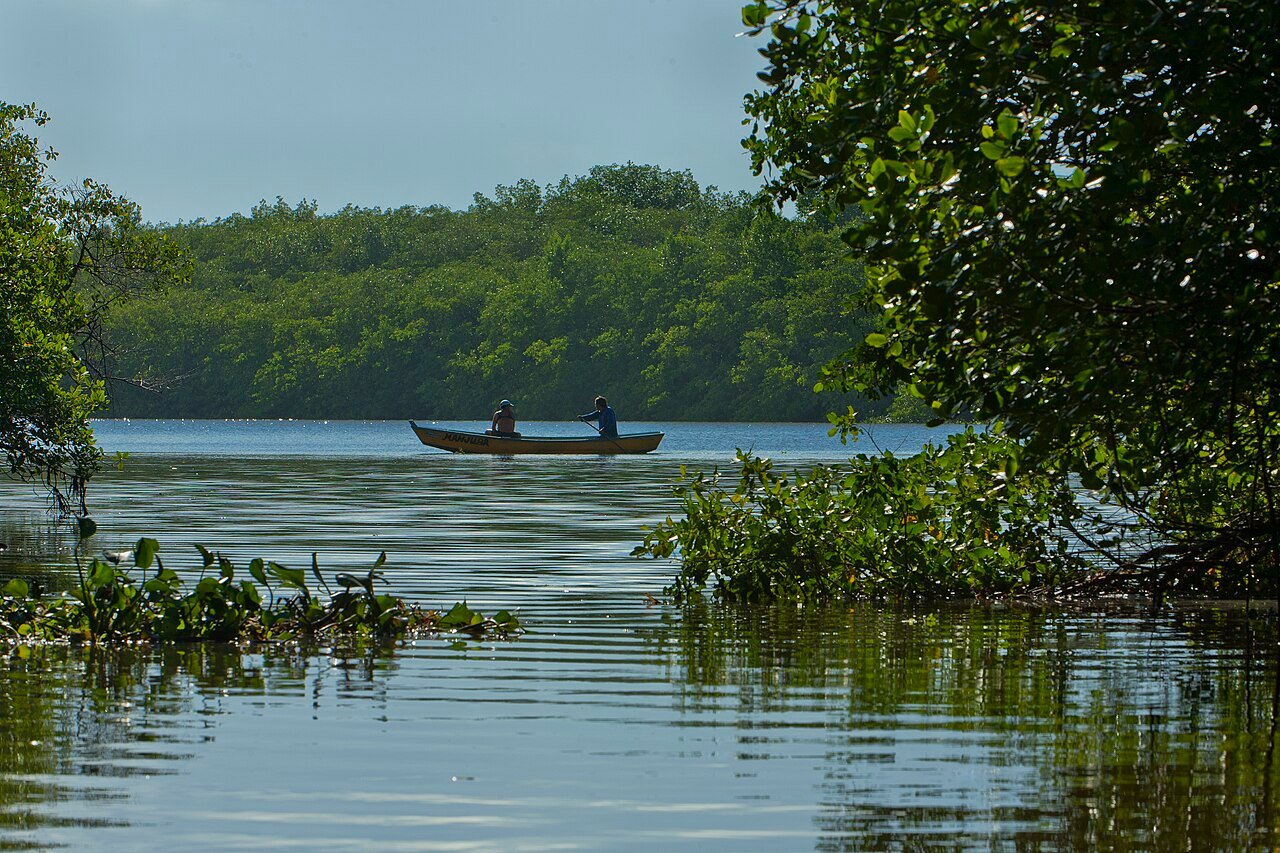
  Melissa McMasters Attribution 2.0 Generic CC BY 2.0 Deed