
‘Biodegradable plastics do not impact ecosystems’

A study in US shows how bioplastics can degrade in an acceptable timeframe and without harming the environment as long as they are disposed of properly
by Matteo Cavallito
Bioplastics do not accumulate in the environment and do not impact ecosystems as long as they are disposed of properly. This is the conclusion of a study published in the journal NPJ Materials Sustainability that looked at several previous studies.
‘Biodegradable plastics have been proposed as an alternative to conventional plastics for many applications,’ the study by Yingxue Yu, a researcher at the Connecticut Agricultural Experiment Station in New Haven, and Markus Flury, a researcher at Washington State University, explains. ‘Here, we critically evaluate the literature on the environmental impacts of biodegradable plastics, including their degradation and ecotoxicity, and discuss their potentials as alternatives for conventional plastics.’
The benefits of bioplastics
Worldwide, the use of conventional plastics is still growing: in 2023 the total use of the material was estimated at 490 million tonnes, an amount that is set to reach 765 million tonnes by 2040. Also increasing, it goes without saying, is waste: today its annual weight reaches 375 million tonnes, which will rise to 615 in the next 15 years. Against this backdrop, bio-based products represent a very important alternative today.
‘The main advantage of biodegradable plastics is that, after their intended use, they can be metabolized by microorganisms into CO2, CH4, and microbial biomass,’ the study states.
This means that ‘biodegradable plastics do not accrue an environmental footprint at their end-of-life’. These materials, consequently, ‘are particularly valuable where recycling and reuse are not readily feasible’. In recent years, the use of bioplastics has affected several sectors, including the agricultural sector with the production of mulch films capable of biodegrading in the soil. And it is precisely this process that has attracted the attention of researchers over time.
Environmental impact concerns
During biodegradation, the study reminds us, products fragment into smaller and smaller pieces, generating micro- and nanoplastics, i.e. particles with diameters of less than 5 and 0.001 millimetres respectively, according to the most widespread classifications (but there is no universally agreed criterion at present). For biodegradable materials, this fragmentation process is generally faster than for conventional plastics.
However, the authors explain, ‘generation of micro- and nanoplastics from biodegradable plastics is a double edged sword: it is a desired process that increases surface area and promotes biodegradation substantially; yet, the micro- and nanoplastics may negatively impact the environment before they completely degrade’.
To properly assess the impact of this phenomenon, three questions must be considered:
- How much micro- and nanoplastics are produced?
- What is the residence time of these micro- and nanoplastics?
- Is the amount of material and residence time detected sufficient to cause negative environmental impacts?
The authors then considered the biodegradation of plastic mulch sheets in the soil in an attempt to provide answers to the three questions.
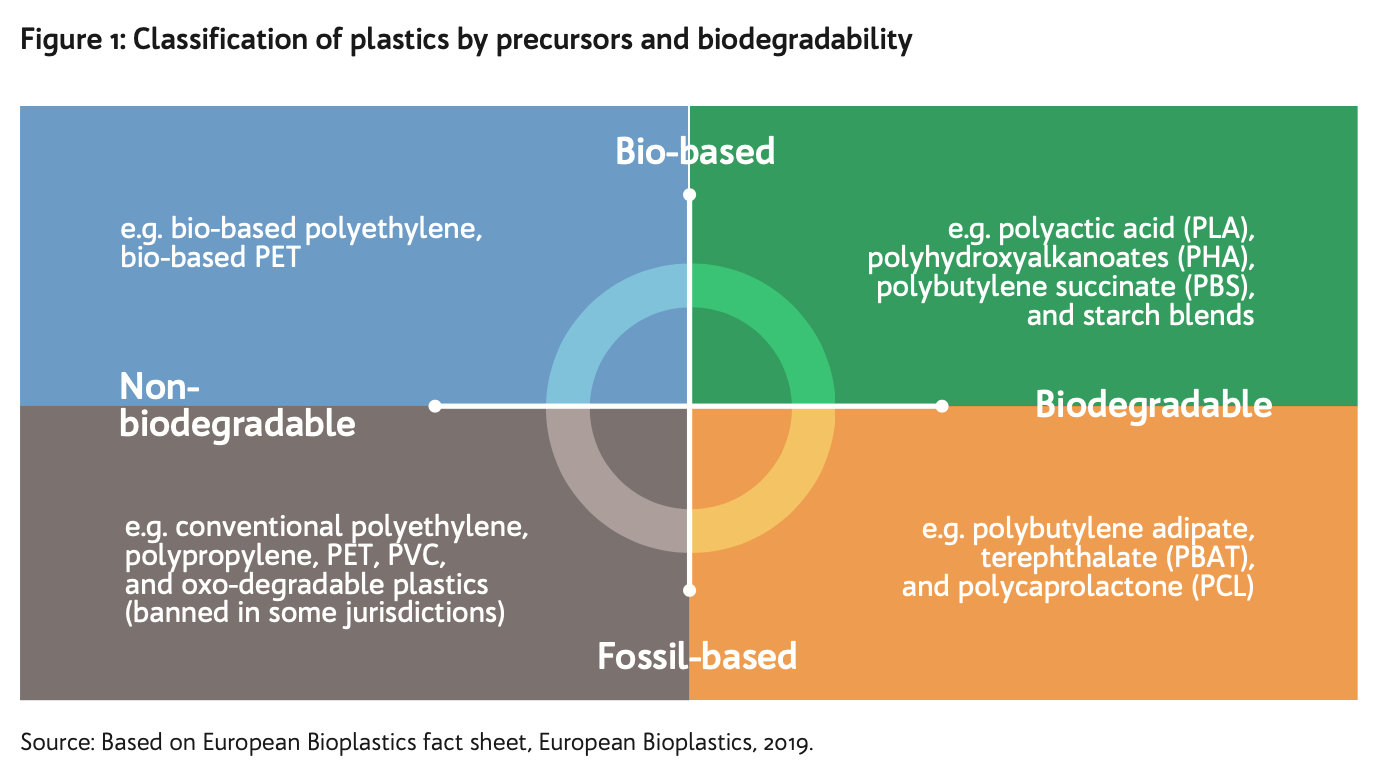
Classification of plastics by origin and biodegradability. SOURCE: Assessment of Agricultural plastics and their sustainability. FAO, 2021.
No harm to the soil
By analysing a typical biodegradable plastic mulch film in the soil with a thickness of 15 micrometres (15 thousandths of a millimetre) and a density of 1,250 kg per cubic metre very similar to that of the soil to which it is applied (1,200 kg per cubic metre), the scientists calculated a mass concentration of 78 thousandths of a gram of plastic per kg of soil. This concentration, measured immediately after processing, decreases over time but increases again with subsequent applications.
‘Repeated yearly mulch applications and an average biodegradation rate of 20% per year result in a steady-state concentration of three times the initial concentration, i.e., a maximal plastic concentration of 56.3 g/m2 or 0.23 g/kg’.
Moreover: ‘Even with the biodegradation rate being 10% per year, the maximal plastic mass concentration in soil would be 0.43 g/kg (= 0.043% w/w) for the residual biodegradable plastics at steady state’. The research, ‘suggests that, provided with proper disposal and full biodegradation, biodegradable plastics, including biodegradable micro- and nanoplastics, would not accumulate substantially in the environment and would be far from reaching concentrations at which negative impacts on ecosystems can be expected’.
Four recommendations from the regulators
Finally, the authors emphasise the importance of proper disposal of biodegradable plastic waste. To ensure rapid decomposition, the scientists also propose calibrating the actual biodegradability against the different environments in which bioproducts are disposed of. There are four specific recommendations for industry and regulatory agencies to undertake a number of measures including:
- checking for the possible presence of additives
- requiring certification of biodegradability of products; and
- providing disposal instructions;
- ensuring adequate processing capacity and accessibility to industrial composting and anaerobic digestion facilities.
‘With proper testing, comprehensive labeling, and effective management, we believe that, for certain applications, biodegradable plastics are a promising substitute for conventional plastics,’ the scientists conclude.
 Melissa McMasters Attribution 2.0 Generic CC BY 2.0 Deed
  Angal insect Attribution-ShareAlike 4.0 International CC BY-SA 4.0 Deed
  ECHO
ECHO 


