How rock outcrops impact soil in the mountains

A Chinese study describes and measures the effect of outcrops on the soil. These create specific localized “hotspots” where soil functions are enhanced. Rock size amplifies effect
by Matteo Cavallito
Rocky outcrops in mountain ecosystems play an important role in soil and promote biodiversity conservation by promoting nutrient release and enhancing soil functions. This is reported in a study by the Chinese Academy of Sciences published in the journal Functional Ecology. “Rock outcrops resulting from various geological processes are common in mountain ecosystems, significantly impacting ecosystem functions in diverse ways,” the study explains.
The essential role of mountain ecosystems
Mountains, the researchers remind, cover nearly a quarter of the Earth’s surface and support about 15 percent of the global population by offering crucial services, from providing fresh water to maintaining global biodiversity and absorbing carbon. Crucial, then, is their impact on the land through their natural degradation. “Weathering processes are vital for the elemental biogeochemical cycles and affect soil nutrient availability,” they explain.
A recent study, for example, “demonstrated that nitrogen weathering from bedrock is a significant source of nitrogen for terrestrial ecosystems, contributing 8 to 26% of the pre-industrial nitrogen budget and 6 to 17% of the modern nitrogen budget.”
Larger outcrops, of course, undergo more intense degradation as a result of greater exposed surface area and, as a result, release more minerals and nutrients, which accumulate in the soil promoting the fertility and growth of plants and microorganisms. Rocks, in short, “play a significant role in shaping the ecological processes and functions of surrounding soils.” However, “their effects on soil functions and processes remain poorly quantified, and the mechanisms behind them are not fully understood.”
The study
To better understand these processes, the authors conducted a field study in the mountainous regions of southwestern China. Here they selected 31 rocky outcrops of various sizes by collecting plant litter and soil samples at different distances: 0-20 cm and 20-50 cm. The researchers evaluated soil functions in five aspects: nutrient supply, microbial growth efficiency, decomposition of soil organic matter, nutrient cycling and plant-microbe symbiosis.
According to the study, soil functions are most pronounced near rocky outcrops, which, by capturing dust, rainwater and litter as well as nitrogen and phosphorus from atmospheric deposition, create particularly favorable conditions in the interaction between rocks, soil, microorganisms and plants. In contrast, “smaller rocks contributed fewer resources, while excessively large rocks limited the accumulation of nutrients and organic matter.”
Distance and size of outcrops are crucial
“Our results suggested that soil multifunctionality and microbial growth efficiency were significantly greater at closer distances (0–20 cm) – approximately 17% and 24% higher, respectively – than at further distances (20–50 cm) from rock outcrops.” The size is also important: “Soil multifunctionality around medium-sized rocks (i.e. 2–4 m) was approximately 40%–60% greater than that around smaller rocks (i.e. 0–1 m).”
Finally, “Further analysis showed that exchangeable calcium and soil organic carbon emerged as the most important intermediary variables connecting rock size and distance to soil multifunctionality.”
The study, in short, showed how rock outcrops create specific “hotspots” where soil functions are enhanced. In the future, the researchers conclude, “surveys and models of mountain ecosystem functions should incorporate factors such as rock size and distance from rocks to enhance assessment accuracy.”
 Photo: Pexels free to use CC0
  SOUL
SOUL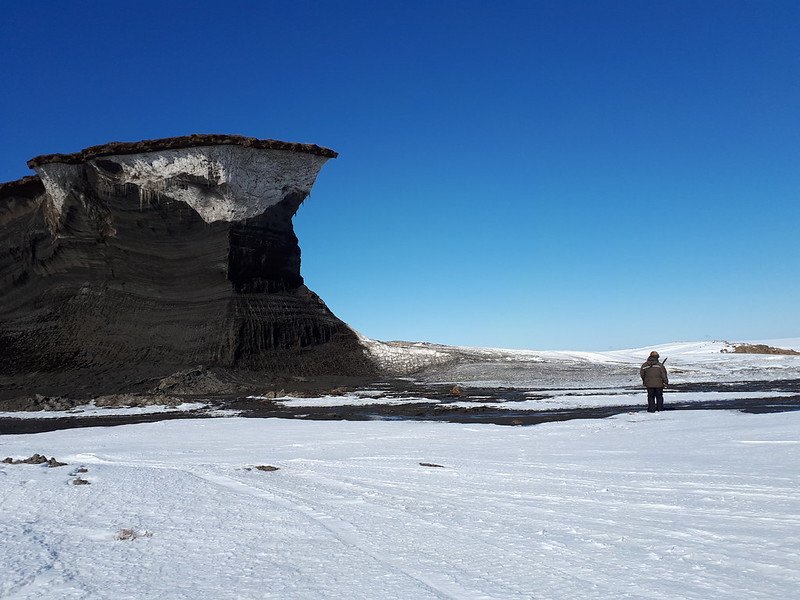 Vincent Sasseville/Nunataryuk Attribution-NonCommercial-ShareAlike 2.0 Generic CC BY-NC-SA 2.0 Deed https://www.flickr.com/photos/gridarendal/49555909433