Soil microbes react in different ways to urbanization
 pxhere CC0 Public domain Free for personal and commercial use No attribution required
 An international study describes the impact on various microbial communities. Although with different responses, bacteria and fungi maintain their basic functions thus ensuring ecosystem services
by Matteo Cavallito
Urbanization impacts diversity of microbes but with divergent effects on bacteria and fungi. Bacteria, in fact, tend to homogenize while fungi retain greater ecological specialization. This was revealed in a study published in Environmental Science and Ecotechnology. The investigation involved experts from Shanghai (Jiao Tong) and Helsinki universities.
“Urban land use typically disturbs soil structure, increases soil nutrient concentrations, elevates heavy metal levels, and degrades and fragments habitats, thereby favoring species adapted to these altered conditions,” the research explains. “Additionally, urbanization often homogenizes species assemblages”. A phenomenon, the authors explain, that involves every species.
Urbanization generates greater homogenization
Indeed, homogenization of functions “has been reported to correlate with changes in plant and animal communities.” However, say the authors, “studies often overlook bacterial and fungal communities in urban habitats, despite their critical roles in ecosystem processes and resilience to disturbance.”
Soil bacteria and fungi play key functions in nutrient mineralization and organic matter decomposition. Although their roles, the scientists explain, often differ at various stages of substrate decomposition.
“Bacterial and fungal responses to disturbances likely diverge because of the greater adaptive potential of bacteria—driven by, for example, shorter generation times and more frequent horizontal gene transfer (HGT)—compared to fungi,” the study further notes. “Such differences may result in asynchrony between disturbance-induced community dynamics and the functional potentials of these taxa—similar to macro-organisms, whose species respond variably to urban disturbances due to their distinct life-history traits.”
The study
The study, conducted on different plant communities-from undisturbed forests to urban parks of different ages in three urban areas. These represent as many climatic biomes: boreal in Lahti, Finland, temperate in Baltimore, USA, and tropical in Singapore. The investigation showed that the similarity between bacterial communities increases significantly in urban environments with an expansion between 79 percent and 85 percent. While fungi are found to be more resistant to homogenization.
“Climate had a strong influence on soil microbiota, yet urbanization still significantly altered both bacterial and fungal communities in all regions,” the study notes.
“Bacterial communities exhibited high adjustability to urban conditions, dominated by generalist taxa – about 90 % – whereas fungal communities consisted mostly of specialists (linked to specific habitats, ed.): about 83 %.” This difference stems from the faster evolutionary rate of bacteria, favored by short generation times and horizontal gene transfer, compared to fungi, whose slower evolution still binds them to defined ecological niches.
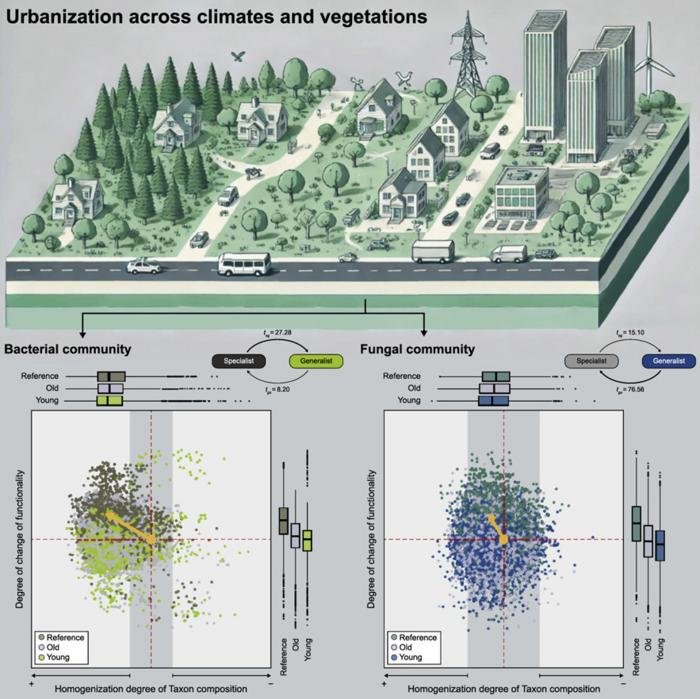
Impact of urbanization on soil microbial communities across different climates and vegetation types. The top section shows a gradient from natural forests to urban landscapes. The lower section presents data on bacterial (left) and fungal (right) community responses, revealing that urbanization leads to bacterial homogenization with a dominance of generalists, while fungi remain more specialized and resistant to change. These findings highlight the contrasting adaptive strategies of microbes in urban environments and their implications for ecosystem resilience. Source: Environmental Science and Ecotechnology, marzo 2025 Licence CC BY
Management of urban spaces must take microbes into account
“Urbanization is a powerful force reshaping soil microbial communities, yet bacteria and fungi respond in strikingly different ways,” Nan Hui, a researcher at Shanghai Jiao Tong University and the University of Helsinki and lead author of the study, said in a statement. “Bacteria swiftly adapt to urban conditions, whereas fungi retain their ecological specialization, highlighting the complex interplay between microbial adaptation and ecosystem resilience.”
Despite the different response to urbanization, in each case, bacteria and fungi continue to perform their basic functions thus ensuring key services such as nutrient cycling and decomposition of organic matter.
The study, therefore, provides a better understanding of the responses of microbial communities to urban pressures, thus providing important insights for the sustainable management of cities. The implications, in particular, relate to the design of green spaces that support microbial biodiversity and soil health. A goal that can also be achieved through the targeted use of soil conditioners and the planting of appropriate plant species.
 Melissa McMasters Attribution 2.0 Generic CC BY 2.0 Deed
 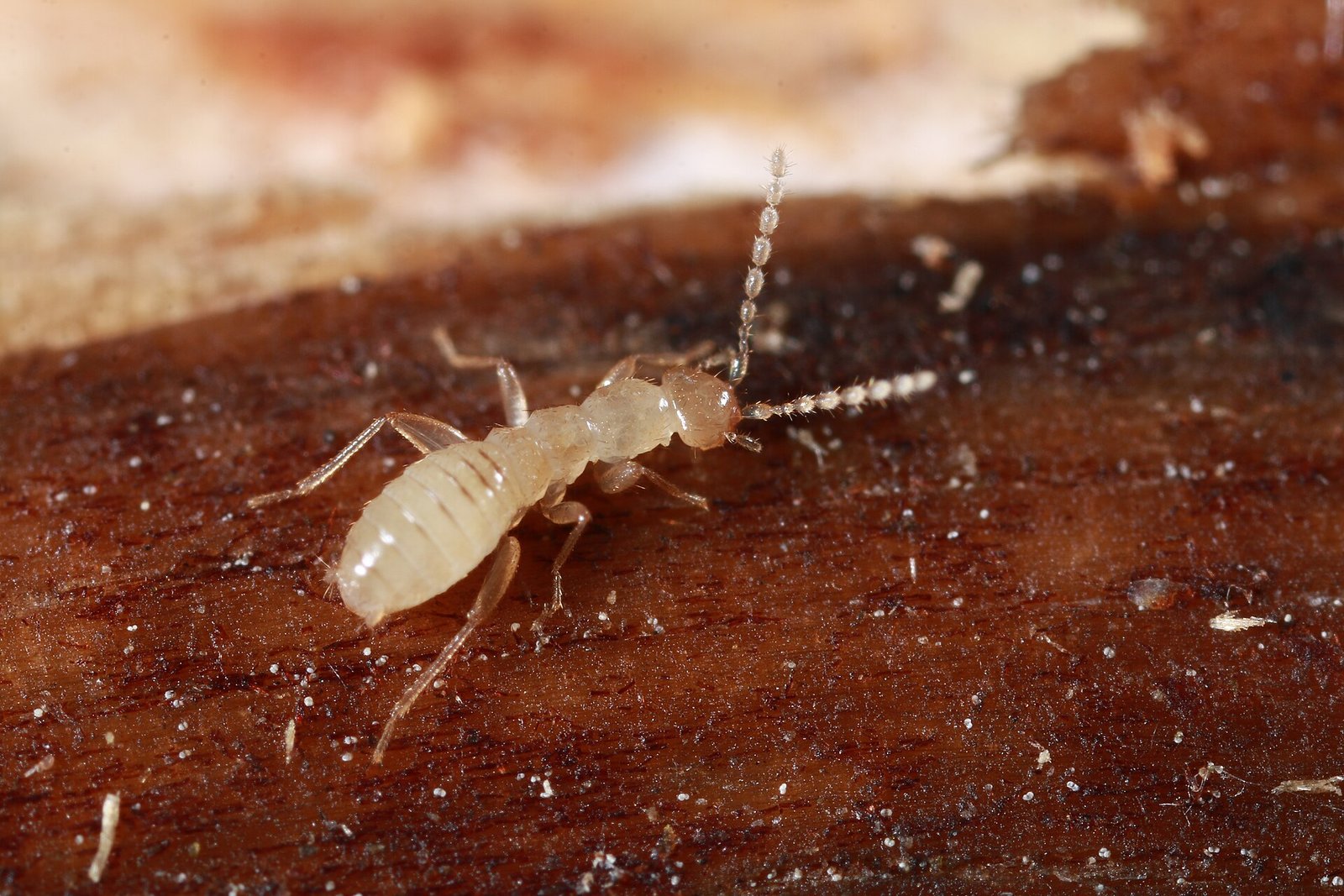 Angal insect Attribution-ShareAlike 4.0 International CC BY-SA 4.0 Deed
  ECHO
ECHO