Compost can be an alternative to chemical fertilisers in urban agriculture
 Oh-Barcelona.com Attribution 2.0 Generic CC BY 2.0 Deed
 Compost made from organic waste could replace 21% of industrial fertilisers used in urban agriculture, says a study by the University of Barcelona UAB
by Matteo Cavallito
From the organic solid waste managed by separate collection in the Barcelona Metropolitan Area (AMB), a not inconsiderable amount of compost is produced today. Thanks to the amount produced, in fact, it is possible to meet8% of the total nutrient requirements of urban and peri-urban agriculture in that area, mitigating water eutrophication and global warming.
In the future, however, the contribution of composting could increase even further reducing the environmental impact. This is supported by a study conducted by the Institute of Environmental Science and Technology of the Universitat Autònoma de Barcelona (ICTA-UAB) and published in the journal Waste Management.
Compost can meet one fifth of nutrient needs
“Cities face the challenges of supplying food and managing organic municipal solid waste (OMSW) sustainably amid increasing urbanization rates,” the authors write. “Urban agriculture (UA) can help with this effort by producing local crops that are fertilized with nutrients recovered from compost generated from OMSW.” According to the researchers’ estimates, 5,568 hectares (5,568 acres) of the city’s municipal solid waste (MSW) are located in the city and require a total of 1,474 tonnes of so-called NPK (i.e. nitrogen, phosphorous and potassium-based) nutrients each year.
From the 5,106 tonnes of compost produced annually from organic solid waste in the same area, 113 tonnes of nutrients (44 tonnes of phosphorus, 37 tonnes of potassium and 32 tonnes of nitrogen compounds) can currently be recovered, representing 8% of the total demand.
In this way, water eutrophication and the impact on climate change can be reduced. In the near future, however, the contribution of compost could increase significantly. ‘”The more ambitious future scenario of 2025 can potentially substitute 21 % of the total NPK demand,” the research continues, with a significant positive effect in terms of reducing environmental impact. This effect is assessed from the direct consequences of organic fraction management: reduction of mixed waste incineration, production of fertilisers and biogas.
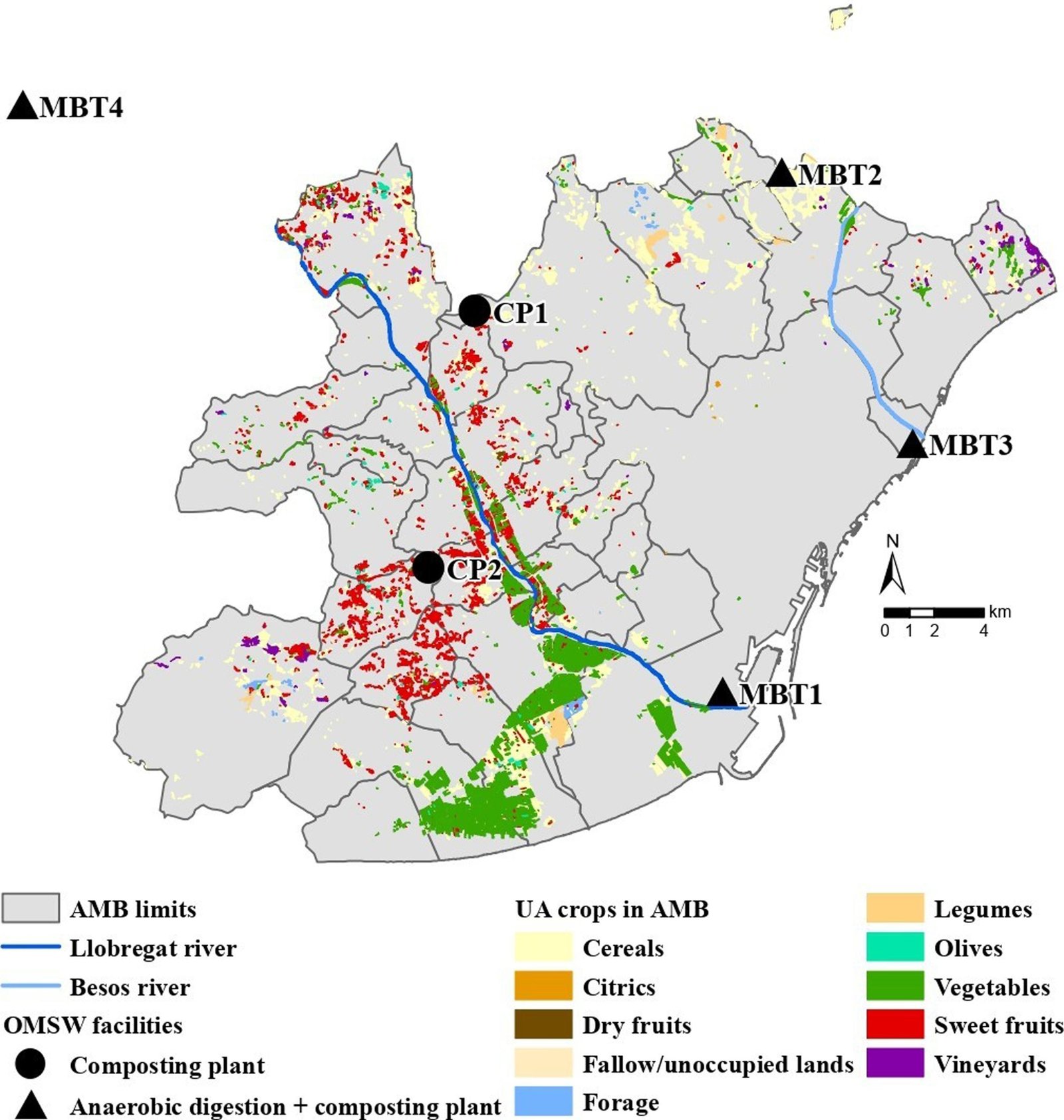
Crops in the Barcelona metropolitan area and waste treatment plants referred to as CP (composting) and MBT (mechanical biological treatment plant of anaerobic digestion and composting). Image: Arosemena et al. Closing the nutrient cycle in urban areas: The use of municipal solid waste in peri-urban and urban agriculture, in Waste Management Volume 183, 30 June 2024, Pages 220-231 Attribution-NonCommercial-NoDerivatives 4.0 International CC BY-NC-ND 4.0 Deed
Less emissions, more water savings
Through effective management of the organic waste fraction, composting prevents the carbon it contains from being converted into CO2. In this way it is not released into the atmosphere, being partly mineralised and partly converted into more stable fractions. By diverting waste from mixed treatment, methane emissions from landfills are also reduced.
In addition, there are other advantages: the substance enhances the water retention capacity of the soil, thus reducing the need for irrigation and saving water.
What also characterises compost is its multiple applications. This product, in particular, can be used as a soil conditioner in various sectors, from agriculture to landscaping. Finally, its use ensures greater workability of the soil, thus reducing the movement of agricultural machinery and the consequent consumption of fossil fuels.
Promoting circular solutions
In summary, in addition to feeding cultivated fields, compost production provides important environmental opportunities for cities, such as reducing emissions and producing clean energy.
“Compost, on the other hand, is made from our waste and provides the same nutrients as the mineral fertilizer; we have to make the most of it, and thus close the cycle,” says Juan David Arosemena, researcher at the Universitat Autònoma de Barcelona in a statement.
However, he adds, “to take full advantage of its benefits, certain barriers that currently hinder the circularity of nutrients in cities should be removed, such as the poor quality of agricultural soil in urban areas, the acceptance of compost as an alternative fertilizer and local regulations associated with organic fertilizer application.”
 Melissa McMasters Attribution 2.0 Generic CC BY 2.0 Deed
  Angal insect Attribution-ShareAlike 4.0 International CC BY-SA 4.0 Deed
  ECHO
ECHO