In grasslands lower plant diversity means less CO₂ uptake
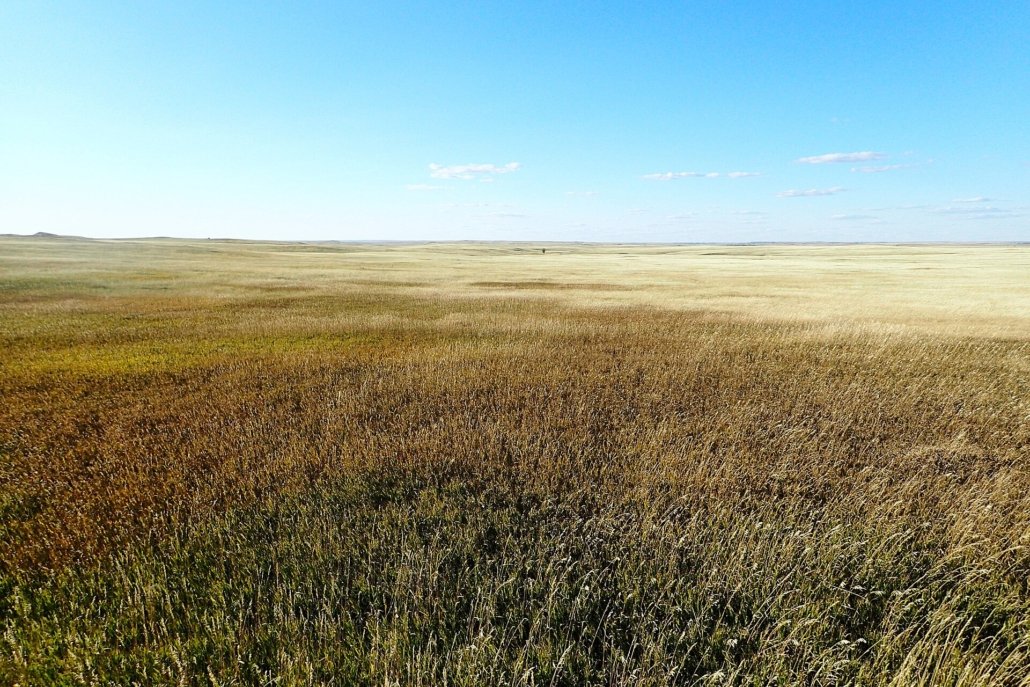 Krzysztof Ziarnek, Kenraiz / Wikimedia Commons, CC BY-SA 4.0
By 2050, meadows and pastures with lower plant diversity could absorb around 15% less CO₂ than those that retain it. With implications for livestock farming and soils
by Matteo Cavallito
Plant diversity helps meadows and pastures adapt to climate change: when changing conditions put dominant plants under stress, others can grow in their place and help maintain biomass production. The loss of this diversity reduces grasslands’ ability to adapt, with consequences for CO₂ uptake through photosynthesis, forage availability and soil carbon stocks. These findings come from a study by the Potsdam Institute for Climate Impact Research (PIK) and Kiel University, published in Proceedings of the National Academy of Sciences (PNAS).
“Climate change could reduce the productivity of plants that at the moment dominate pastures and meadows. But if plant diversity is maintained, other plants that cope better with climate impacts have the chance to become more prominent and stem the decline”, explained Stephen Wirth, a PIK researcher and lead author of the study, in a statement.
Different plant strategies help grasslands adapt
Permanent meadows and pastures cover around a quarter of the world’s ice-free land and provide ecosystem services that support the livelihoods of at least one billion people. Their functioning also depends on functional diversity, meaning the variety of plants’ traits and ecological strategies. “This ‘functional diversity’ influences their productivity as well as resistance and resilience against climate change”, the authors write.
To investigate its role on a global scale, the scientists used a vegetation model called LPJmL-CSR, which simulates vegetation growth and competition between plants with different ecological strategies.
Specifically, the researchers distinguished between competitive species, stress-tolerant species and ruderal species, which can grow rapidly during favourable periods between disturbances. They then compared two scenarios: in the first, existing functional types are retained and new ones can establish; in the second, non-dominant types are removed and no new types are allowed to establish. The latter scenario allows the researchers to explore the consequences of biodiversity loss.
Photosynthetic carbon uptake could be 15% lower by mid-century
The simulations use projections from five climate models and two warming scenarios: below 2 °C and around 4 °C. In both, maintaining diversity provides an overall benefit. “Strong loss of functional diversity prohibits communities’ adaptation to climate change, resulting in loss of gross primary productivity (the amount of carbon produced by photosynthesis, ed.) and soil organic carbon”, the study explains.
According to the estimates, a substantial loss of diversity by 2050 could result in 15% lower CO₂ uptake through photosynthesis compared with a scenario in which plant diversity is maintained.
In the scenario with warming below 2 °C, the difference would amount to around 11 billion tonnes of CO₂ per year. In some of the most affected tropical and subtropical regions, the gap could reach 50%.
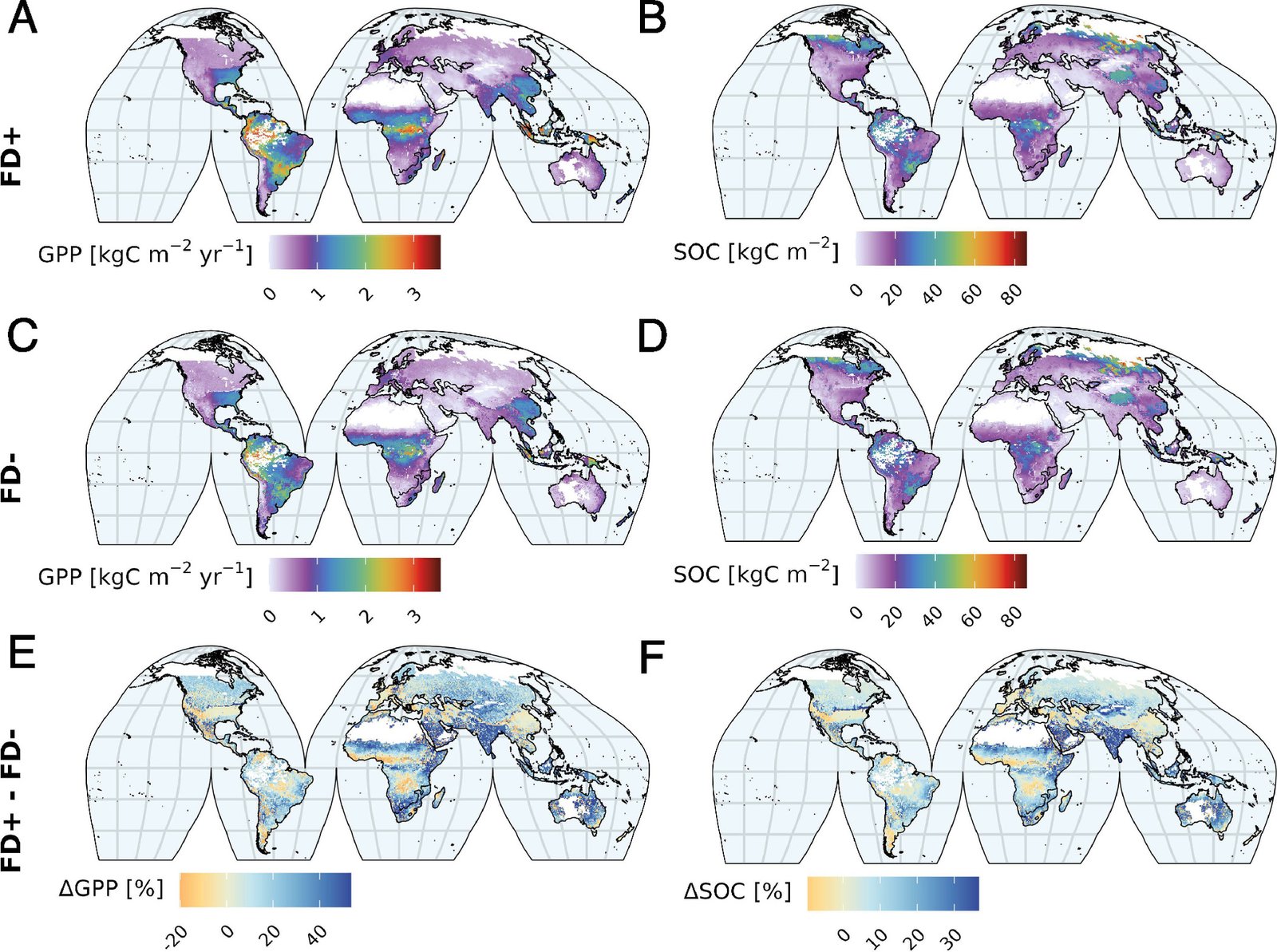
Global distribution of GPP and SOC dependent on functional diversity. Left panels show GPP and right panels show SOC. Panels show the average GPP and SOC for FD+ (A,B), FD− (C,D), and their difference (E,F), i.e., the net effect of higher functional diversity. All distributions show the 2091 to 2100 average of the respective output variable simulated using climate data from the MRI-ESM2-0. Source: Wirth et al., “Global grassland productivity and carbon storage benefit from functional diversity under climate change” (2026), PNAS. License: CC BY 4.0.
Less plant material entering the soil
Lower productivity also affects the soil. Through tissue turnover, plants transfer organic matter to litter and soil, and a reduction in these inputs has important consequences. “The loss of soil organic carbon storage that goes hand in hand with functional diversity loss reduces the terrestrial carbon sink, negatively affecting the remaining carbon budget”, the researchers note.
Average projections for the period 2091–2100 show substantial regional differences: in some parts of Africa north and south of the equator, for example, the remaining plants can compensate for the loss of others, and photosynthetic productivity may even increase.
At the global scale, however, the benefits of diversity prevail. Soil carbon estimates should nevertheless be treated with caution: the values come from the model, which also accounts for the amount of plant residues entering the soil, and have not been directly validated against observational data.
A capacity worth preserving
The study therefore offers useful insights for managing meadows and pastures. As the authors point out, the model simplifies some ecological processes, including the effects of drought and how new plants become established. These approximations should also be taken into account when interpreting the results. The central message, however, is clear: maintaining plant diversity while preventing overgrazing remains essential.
“Our findings underpin the need for development and application of grassland management practices that support functional diversity”, the researchers conclude. Protecting this variety means preserving more ways for grasslands to adapt to climate change, while also supporting forage availability and the livelihoods of communities that depend on livestock grazing.
 Sam Beebe, CC BY 2.0
 Photo: Thomas Bjørkan CC BY-SA 3.0