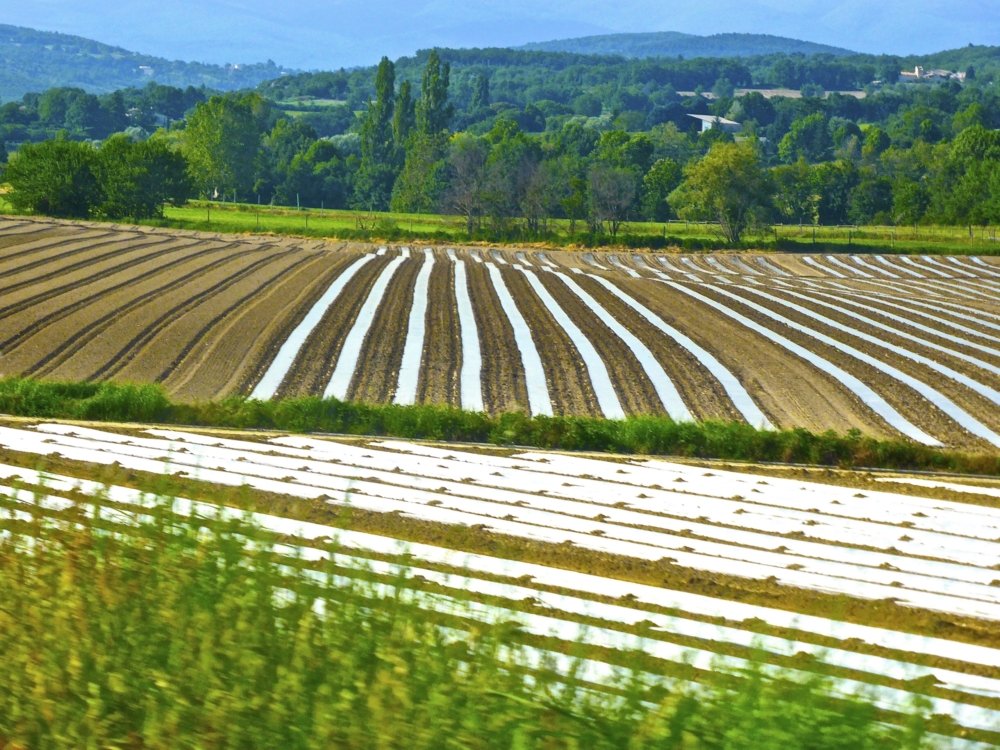
For better soil health, cover crops come out on top
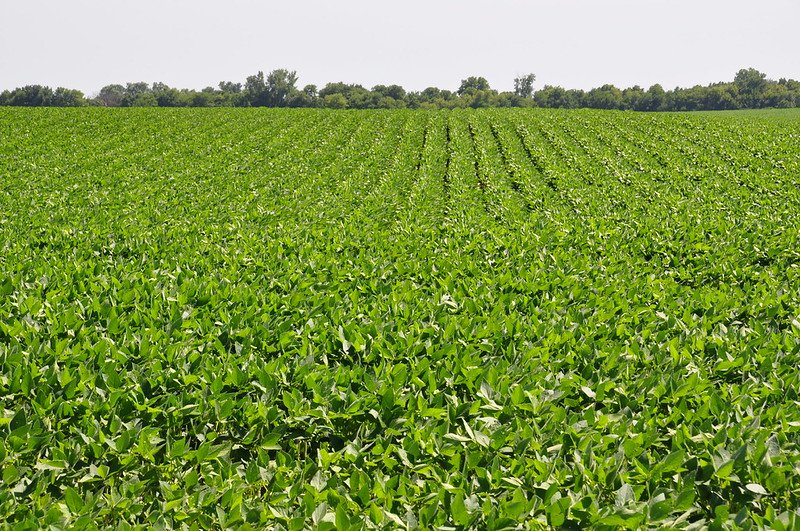 NRCS/SWCS, Lynn Betts Attribution 2.0 Generic CC BY 2.0 License
 A U.S. study has examined 50 years of best practices: cover crops ensure more consistent effects, while tillage, rotations and drainage show less uniform impacts across different contexts
by Matteo Cavallito
Cover crops, implemented with the aim of protecting the soil after harvest, are confirmed as the most effective practice for improving soil health. This is supported by a study published in the journal Agriculture, Ecosystems & Environment, which analyzed data from 21 long-term field trials across the United States. The work, coordinated by researchers from the University of Kentucky with support from the University of Wisconsin, helps clarify a long-standing debate among farmers and technicians about which strategies are most effective for preserving soil fertility and productivity.
Soil health is a central issue in contemporary agriculture
The issue of soil health has become central in modern agriculture in the face of challenges such as climate change and the loss of organic matter in soils. Farmers can act by adopting different practices, from crop rotation to no-till farming (no-till), up to the introduction of cover crops or drainage systems. However, the authors note, “studies exploring the effects of management practices on soil health indicators have reported divergent results regarding which management practices are positively or negatively associated with soil health”.
The variability of the results, they add, “could be due to a range of factors such as soil type, climate, region, management practice interactions, study duration, and soil sampling depth”.
For this reason, “experiments that cover a variety of different soils and climate regions that focus on conservation management practices to maintain or improve soil health are needed to better understand the impact of these practices on soil biological, chemical, and physical indicators”. The researchers therefore decided to make use of existing data, collected in long-term experiments, to obtain a more realistic picture across different contexts.
Cover crops deliver the best results
The study examined trials lasting between four and fifty years, all based on soybean-based cropping systems, focusing on the top 15 centimeters of soil. Researchers compared four key practices: crop rotation, soil tillage, the use of cover crops, and artificial drainage. They also assessed soil health by measuring various indicators, including biological activity, soil structure, nutrient availability, and pH. The results were clear.
“The inclusion of cover crops was associated with greater mineralizable carbon (Min-C) and water extractable organic carbon (WEOC), indicating improved biological activity and labile carbon pools in the soil”, spiega lo studio.
The presence of these two forms of carbon, in particular, indicates an active microbial community and an efficient carbon cycle. Other practices, for their part, showed more variable effects. Two-crop rotations, for example, increased available phosphorus but did not uniformly affect other indicators. Even more surprising was the finding related to no-till practices, which resulted in lower pH values, that is, greater acidity, likely due to the surface concentration of fertilizers.
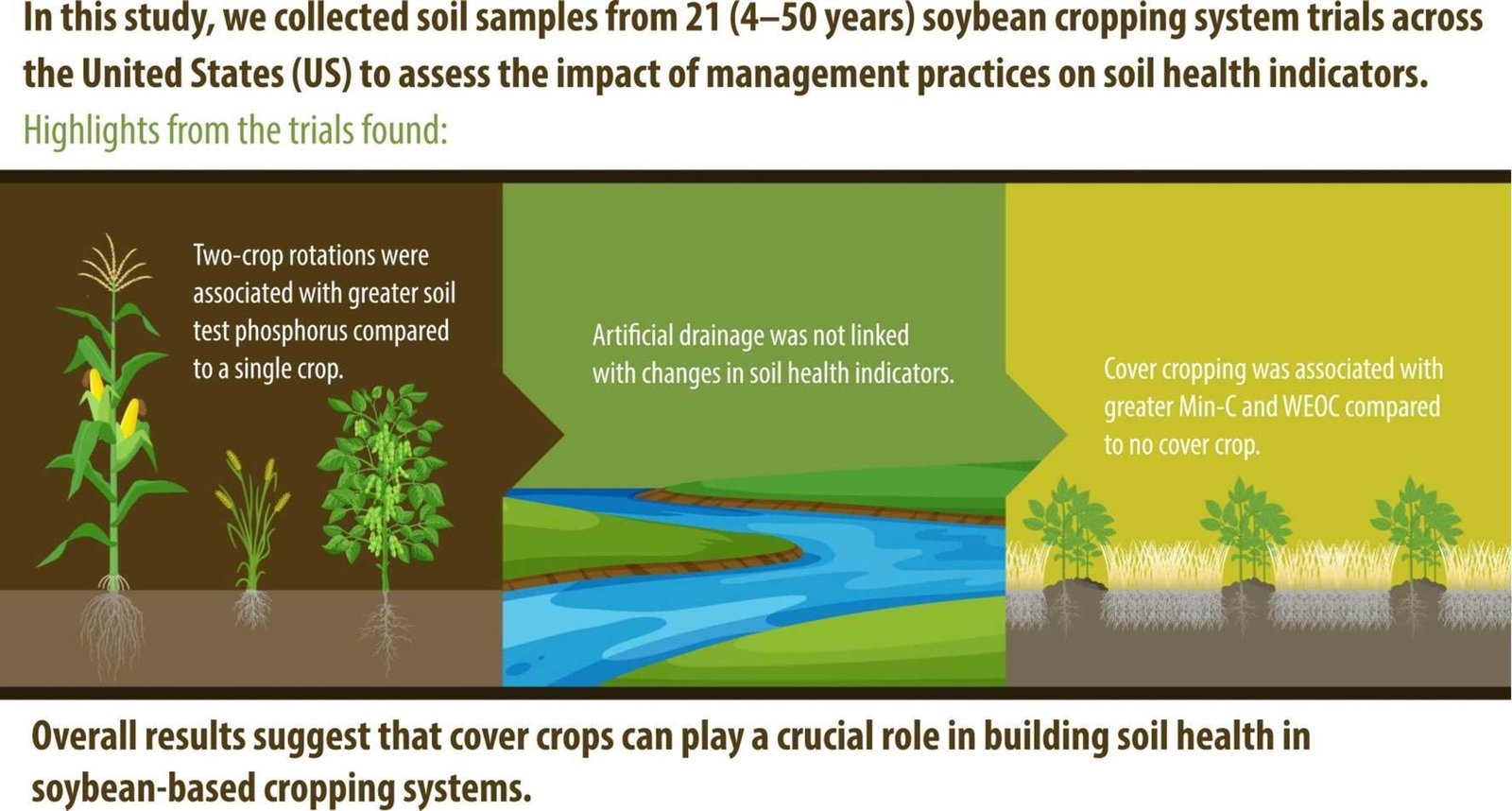
A temporary soybean crop on a rye field in Dallas County, Texas. In the U.S., the area planted with cover crops has exceeded 7 million hectares in recent years, representing a 17% increase in just five years. Source: Tatiane Severo Silva et al., “Impacts of rotation, tillage, cover cropping, and drainage on soil health in soybean-based cropping systems: Evidence from 4–50-year trials across the US”, Agriculture, Ecosystems & Environment, Volume 395, 2026, 109950, ISSN 0167-8809, https://doi.org/10.1016/j.agee.2025.109950
Attribution 4.0 International CC BY 4.0 Deed
An increasingly widespread practice
The study therefore highlighted that there is no single solution valid in all contexts, but ultimately emphasized that some practices prove more effective than others. Gaining, not surprisingly, in popularity. “The adoption of conservation management practices, such as cover cropping is increasing in the US”, spiega lo studio. “For example, the total cropland area planted with cover crops in 2022 (7.2 million hectares) was approximately 17 % higher than in 2017”.
The research, however, the authors admit, did not take into account the impact of these and other practices on yields. Thus leaving open the question of whether there is a direct link between soil health and economic outcomes. Further studies will now be needed to explore this relationship and contribute to improving knowledge for the benefit of farmers, providing increasingly precise guidance for productive and sustainable farming.
 Photo: Thomas Bjørkan CC BY-SA 3.0
 Re Soil Foundation