Vegetation restoration has curbed soil erosion in China (at least so far)
 PickPik Royalty-Free photo
 According to research, soil regeneration in China has significantly reduced land erosion over the last 30 years. More extreme rainfall in the future, however, will raise the risks
by Matteo Cavallito
Soil erosion is one of the most worrying environmental phenomena globally. Its dynamics are also closely linked to the interactions between climate change and vegetation evolution. The restoration of vegetation, in particular, helps to reduce soil erosion, although this mechanism is likely to be offset by the increasing frequency and intensity of extreme rainfall caused by global warming. This is claimed by a Chinese study that highlights the urgent need to integrate resilience to extreme events into global soil conservation strategies.
The balance between rainfall, vegetation, and erosion
“In China, soil erosion is particularly severe in regions such as the Loess Plateau, the upper reaches of the Yangtze River, and the southwestern mountains: its intensification threatens local agricultural production and poses serious challenges to ecological environmental protection and water resource management,” explains the research published in Ecological Indicators. “Therefore, scientifically assessing and effectively controlling soil erosion has become a critical issue for achieving sustainable development.”
The authors point out that rainfall moves soil particles through the impact of raindrops. Surface runoff breaks up soil aggregates and transports sediments downstream.
Globally, the study continues, extreme precipitation anomalies increased by 30% in the period 2006-2016, bringing erosion rates to unprecedented levels in some critical areas. At the same time, however, while amplifying erosive forces, intensified rainfall can also promote stabilization by vegetation through increased canopy interception and root strengthening. “This complex climate–vegetation–erosion interplay“, the scientists explains, “leads to the key question. To what extent can large-scale vegetation restoration in China compensate for intensifying erosion?”
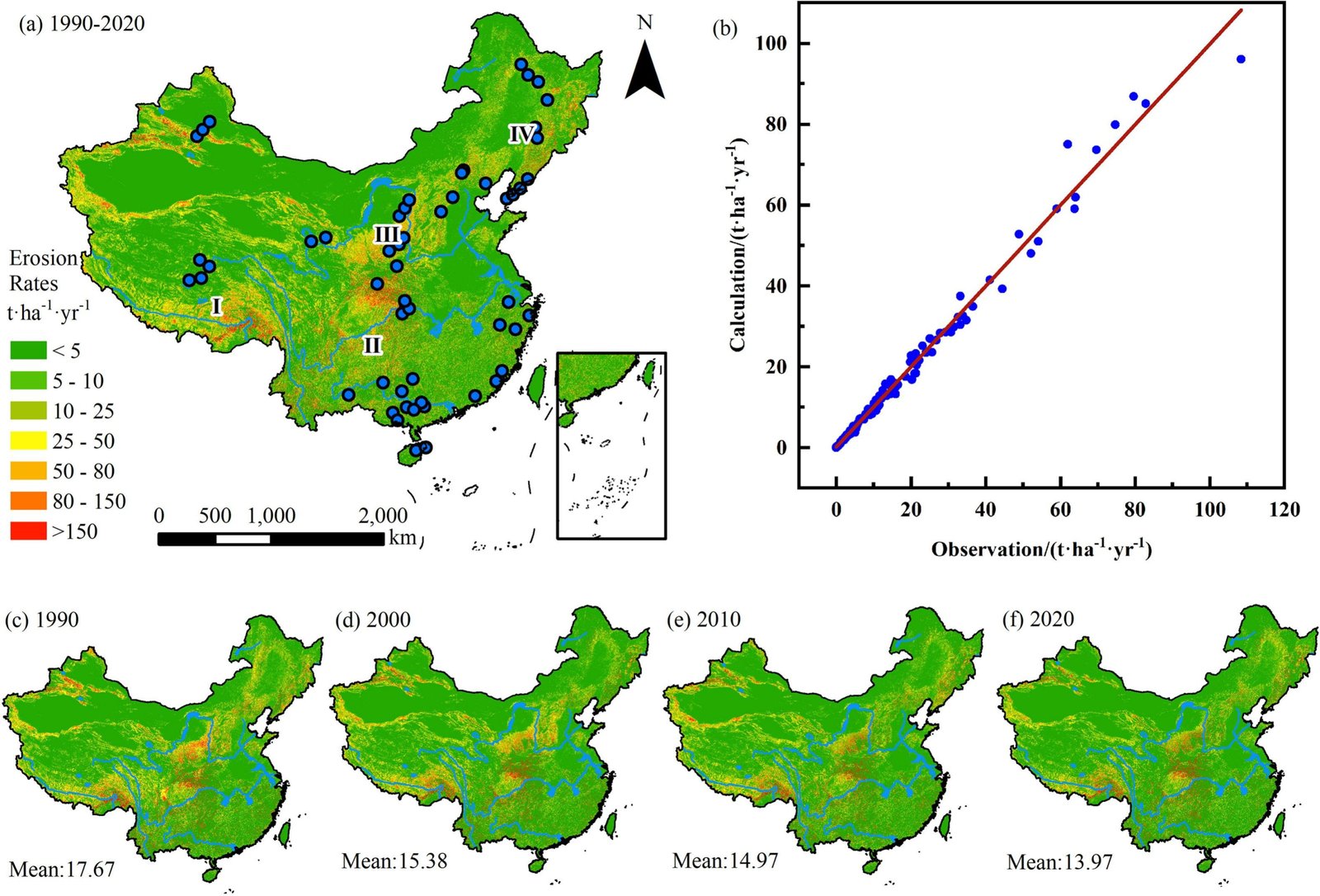
In China, the average erosion rate fell from nearly 17.7 tons per hectare to less than 14 between 1990 and 2020. Source: Wenying Zeng, Yuansheng Tian, Jun Zhai, Wenyi Sun, Ying Sun, Rui Li, Qinke Yang, “Soil erosion resilience under climate extremes: Disentangling the impacts of vegetation restoration and rainfall intensification across China”, Ecological Indicators, Volume 178,2025,113994, ISSN 1470-160X, https://doi.org/10.1016/j.ecolind.2025.113994. Attribution-NonCommercial-NoDerivatives 4.0 International CC BY-NC-ND 4.0 Deed
The study
To answer the question, scientists from various Chinese academic and scientific institutions conducted a nationwide assessment covering the period between 1990 and 2020, integrating high-resolution satellite data (30 meters) and sub-hourly rainfall data into the Google Earth Engine platform using a model known as the Chinese Soil Loss Equation (CSLE). The equation, they explain, “takes into account local terrain conditions and the specific soil and water conservation practices.”
Moreover, “it utilizes a product-based approach that incorporates the dimensional factors of rainfall erosivity and soil erodibility, along with five dimensionless factors, including slope steepness, slope length, biological practices, engineering measures, and tillage practices.”
By carrying out simulations based on different scenarios, the researchers were able to isolate and quantify the respective contributions of precipitation intensity and vegetation changes to the variation in the phenomenon. Indeed, “The national soil erosion rate has gradually decreased from 17.67 tons per hectare per year in 1990 to 13.97 tons per hectare per year in 2020, reflecting a general trend of improvement across the country, particularly in areas with severe erosion.” In the four areas observed, specifically, the decrease in erosion fluctuated between 8.14% and 21.53% during the period under review.
But in the future, the situation could change
In short, over the last three decades, vegetation restoration has significantly reduced the rate of soil erosion in China, the study explains. But this is no reason to declare victory. “Yet, these improvements are now increasingly threatened by intensifying impact of extreme rainfall” the research says. “Compared to the 2000 s, erosion rates increased by 2.9 % due to rising rainfall erosivity, with individual extreme rainfall events contributing up to half of the annual erosivity.”
This means, therefore, that “the benefits of vegetation recovery are being partially offset by the increasing frequency and intensity of extreme precipitation events.”
In the future, therefore, the expected intensification of the latter will pose increasing risks to the long-term effectiveness of vegetation-based soil conservation. For this reason, the problem will need to be addressed with a more in-depth understanding of soil erosion responses to extreme weather events on larger spatial and temporal scales, taking into account, the scientists conclude, global assessments and adaptation strategies.
 Penn State. Attribution-NonCommercial-NoDerivatives 4.0 International, CC BY-NC-ND 4.0 Deed.
 Eric Guinther, CC BY-SA 3.0
 Warren LeMay CC BY-SA 2.0