
An integrated approach is needed for EU soil quality monitoring
 Easy-Peasy.AI Free to use
A new study reviews different soil assessment schemes. The “binary” system is the most suitable for macro evaluation. But tools for local investigations are also needed
by Matteo Cavallito
The approach to soil quality assessment based on a “degradation-free” criterion adopted by the European Union Soil Observatory (EUSO) and provided for in the Soil Monitoring Law recently approved by the EU Parliament is the most suitable for assessing the state of soil at the continental level. However, it must be accompanied by additional tools that, within the framework of monitoring activities, allow for operation on various scales, also ensuring analysis at the local level. This is the conclusion of a study published in the European Journal of Soil Science.
The study notes that a free from degradation assessment system defines soil quality according to a binary scheme (degraded/non-degraded) rather than on the basis of its productivity or specific functions. According to this method, therefore, soil can be considered to be of good quality if it is free from man-made degradation phenomena. Such as erosion, loss of organic matter, salinization, contamination, or soil sealing among others.
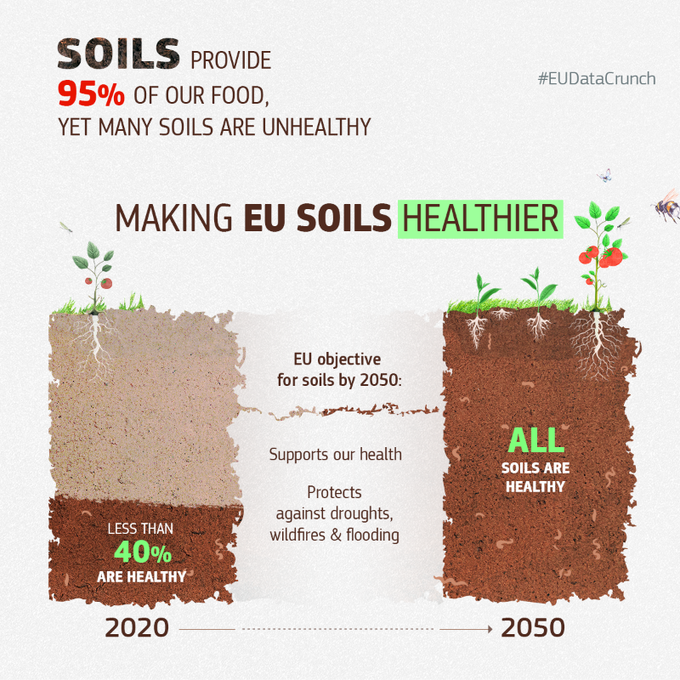
The overall objective of the Soil Monitoring Law is to restore European soils to health by mid-century. SOURCE: European Commission
Soil quality and health
The study, promoted by the Horizon Europe program and conducted by experts from various institutions, including the University of Aberdeen in the United Kingdom and ISPRA, proposed a conceptual framework for assessing the quality of European soils in a manner consistent with the objective of improving the selection and interpretation of indicators. “Soil health is a holistic concept embracing emergence, complexity and highlighting long-term vitality and resilience,” explains the research. “In contrast, soil quality is often viewed through the lens of its capacity to meet specific human needs and functions, typically in a shorter timeframe.”
In practice, the authors continue, soil health analysis is based on accurate indicators—such as bulk density, organic matter, and pH—which tend to provide a reductive picture of the functional complexity of the soil itself.
The indicators, the research continues, are also needed for assessing soil quality. However, choosing them “is challenging due to diverse climate, topography, geology and soil types, resulting in varied soil processes.” Hence the need to “establishing clear principles and criteria for soil indicator selection”. The study, therefore, aims to describe different assessment methods through schemes “which can be categorised within the broader concept of quality.”
Four reference frameworks
The researchers therefore identify four reference frameworks:
- Fitness for purpose, which defines quality based on use by evaluating, for example, agricultural productivity or other ecosystem services.
- Free from degradation, which, as mentioned, considers quality to be synonymous with the absence of anthropogenic degradation.
- External benchmarking, which assesses quality by comparing the state of the land with that of similar soils to promote continuous improvement.
- Value assessment, which recognizes the economic and natural value of soil in the context of natural capital.
All things considered, they explain: “The ‘free from degradation’ approach is particularly effective at large scales, such as national levels, while the ‘fitness for purpose’ framework is also more appropriate at the local level. External benchmarking, which involves using distributions to establish context and goals, is more versatile and applicable across multiple scales, facilitating the integration of different approaches.”
Three actions for the future
In the study, the researchers conclude, “The ‘Free from Degradation’ framework is emphasised for its alignment with soil protection efforts and its relevance to soil threats”. Which makes it “particularly suitable for pan-European assessments conducted by the European Union Soil Observatory (EUSO). ” According to data released by EUSO, the research says, over 62% of soils show signs of degradation.
As they aim to monitor and restore European soils, experts will need to complete three different actions. That means update and harmonize data on EUSO indicators; define accepted thresholds and flexible scoring tools; develop a composite quality/health index.
“Clearly presenting the concept of quality is essential for effective communication and informed decision-making, as well as for ensuring that resource allocation and subsequent actions are properly managed,” the study concludes. “As the Soil Monitoring Law develops and monitoring occurs at various scales, the creation of fitness-for-purpose assessment tools for soil managers, such as scorecards or soil benchmarking, will be increasingly important for examining soils at local levels, with the ultimate aim towards achieving healthy soils throughout the EU by 2050.”
 © European Union 2018 (photo by Pavel Koubek), CC BY-NC-ND 2.0
 Penn State. Attribution-NonCommercial-NoDerivatives 4.0 International, CC BY-NC-ND 4.0 Deed.
 Eric Guinther, CC BY-SA 3.0


