EU 2030 target at risk as microplastics dispersion grows in Europe
 Marco Verch CC-BY 2.0
 According to the European Environment Agency, between 2016 and 2022, microplastic emissions increased by between 7.5 and 8.6 percent. The targeted 30 percent reduction by the end of the decade appears “unlikely”
by Matteo Cavallito
The dispersion of microplastics in the environment in the EU has clearly increased in recent years. And this trend seems to put at risk the achievement of the reduction targets set for 2030. This is the main conclusion of the latest report by the European Environment Agency’s European Environment Information and Observation Network (Eionet), which looked at different sources of contamination, including tire abrasion, pellets and paints.
The authors, in particular, developed qualitative and quantitative analyses based on data from Eurostat and sector reports. Highlighting a less than reassuring picture of a dangerous phenomenon that impacts soil and water and human health.
The study
This study examined progress toward the goal set by the European Union’s Zero Pollution Action Plan (ZPAP). The plan calls for a 30 percent reduction in the release of microplastics by the end of the decade. The difficulty in constant monitoring and the adoption of harmonized analytical methods, the authors explained, made it necessary to define a new indicator capable of describing the phenomenon as a whole, taking into account different sources.
Created by analyzing available data and considering different criteria such as geographic coverage, the new simplified indicator showed a continuous increase in emissions.
Recent studies, such as the Impact Assessment Report published in 2023 by the European Commission, indicate that tire abrasion and pellet losses are the main sources of microplastic pollution. Because the methodologies used in the various studies differ, however, the results should be interpreted with caution.
Tires and paints are major sources of pollution
The authors analyzed four different studies. Three of them, they explain, use similar methodologies to identify potential sources of accidental release of microplastics and estimate their emissions based on sector-specific studies. The fourth, an analysis published in 2022 by the Netherlands Organization for Applied Scientific Research (TNO) adopted instead the so-called Material Flow Analysis (MFA) methodology. This assesses the environmental fate of certain products throughout their life cycle. The different methods used resulted in the identification of significantly different sources.
In each case, the researchers were able to produce a simplified map of the sources. In this way they estimated their contribution to the overall dispersion in the environment.
Although to a varying extent according to the different studies, vehicle tires were found to be the main source of microplastics, Their contribution, in fact, is estimated between 36 and 64 percent of the total. Tires are followed by paints (6 to 46 percent depending on the study) and packaging (29 percent). Artificial turf contribution is estimated between 6 and 17 percent. Pellets are responsible from 3 to 11 percent of the total. As for agriculture, they explain, “Although it is estimated as a major source, it could not be assessed as we could not identify any data source likely to be used for the development of a (proxy) indicator during the timeframe of this work.”
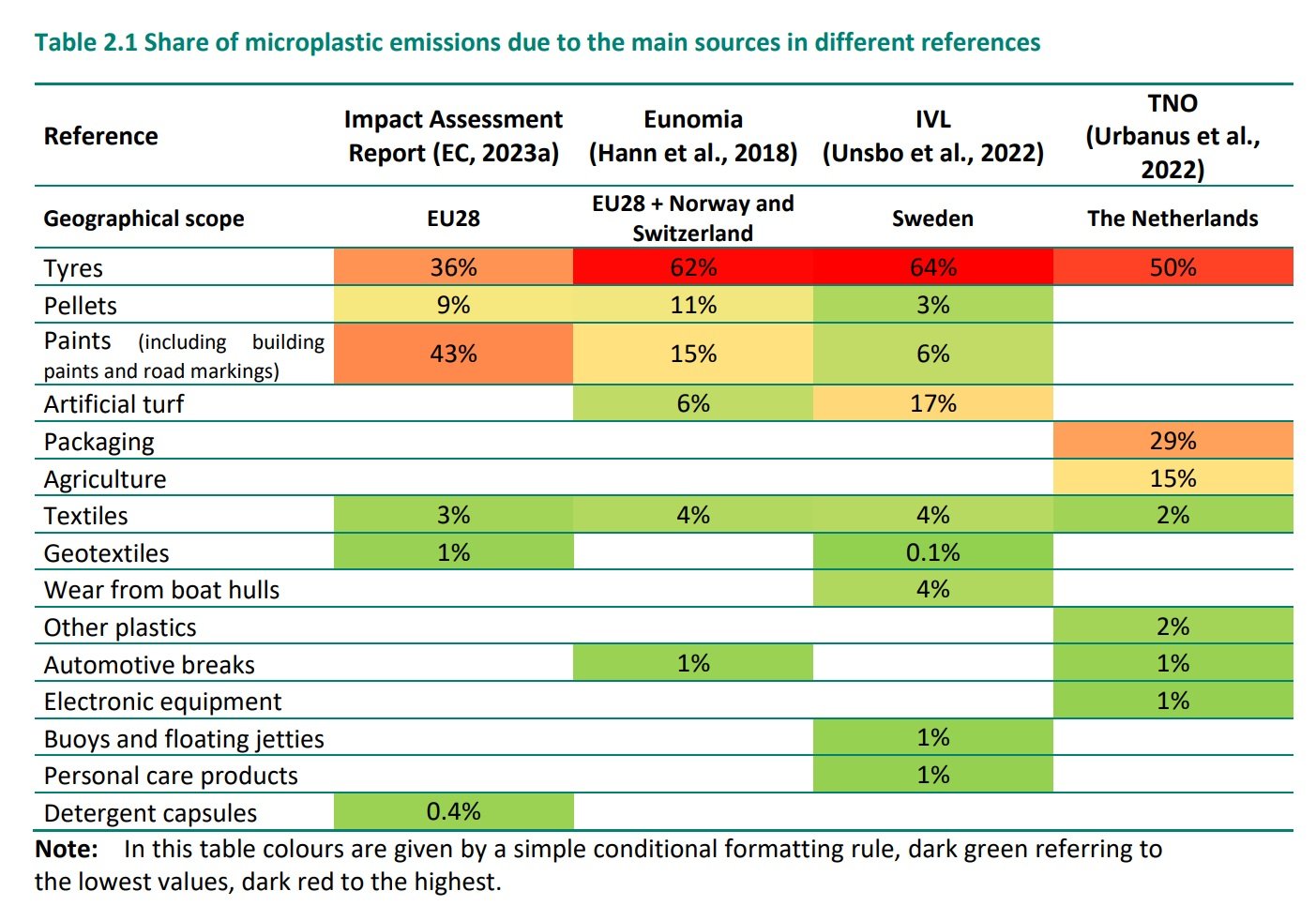
Although estimates of their overall contribution to the phenomenon vary widely, tires, pellets, packaging, paint, artificial turf and agricultural materials are the main sources of microplastic pollution in Europe. Source: Boucard, P., Denize, C. & Aydin, M., “Microplastic releases in the European Union (Eionet Report – ETC HE 2024/15)”. European Topic Centre on Human Health and the Environment, 2024 Attribution 4.0 International CC BY 4.0 Deed
Dispersion of microplastics may have increased by more than 8 percent
The results are clear. Between 2016 and 2022, the release of microplastics has in fact increased to a significant extent. “Based on data from Eurostat and sectoral reports, the report defines a composite indicator which shows a 7.5-8.6% increase in emissions over this period” the authors explain. “Specifically, indicators for tyre abrasion rose by 12.3%, plastic pellets by 7%, and paint by 5%.”
Despite the uncertainties in the estimates, they continue, “the findings suggest that microplastic emissions have not decreased since 2016, confirming the importance of recent or forthcoming European initiatives to reduce microplastic emissions.”
These recent regulatory measures, such as the REACH (Registration, evaluation, authorisation and restriction of chemicals) regulation and the Euro 7 regulation, which sets limits for particle emissions from tire abrasion, are certainly significant. But their results, the authors say, will only be visible in the coming years. The data from the study, in any case, “indicate that the EU is unlikely to be on track to meet the objective of a 30% decrease of microplastics by 2030,” they conclude.
 Steve Daniels Attribution-ShareAlike 2.0 Generic CC BY-SA 2.0 Deed
 Nathanieljoyce, Creative Commons Attribution-ShareAlike 4.0 (CC BY-SA 4.0)
 Hannes Grobe Attribution-ShareAlike 2.5 Generic CC BY-SA 2.5 Deed