
Mixed forest regeneration optimises carbon sequestration
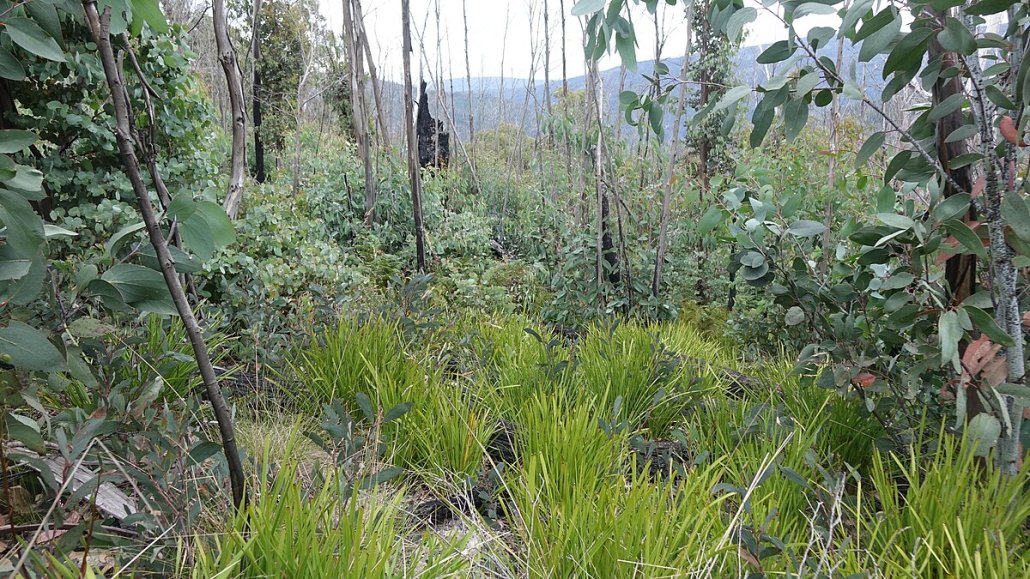 Photo: Neb Attribution-ShareAlike 4.0 International CC BY-SA 4.0 Deed
 An American study quantifies the efficiency of different forest regeneration methods. By applying the most cost-effective system for each location, around 10 billion tonnes more CO2 can be sequestered at the same cost
by Matteo Cavallito
Trought the application of the optimal forest restoration method, low- and middle-income countries can increase atmospheric CO2 sequestration at a lower cost than previously estimated. This is supported by a study by the Nicholas School of the Environment at Duke University in Durham, North Carolina.
Most reforestation programmes currently in place, the research points out, focus only on planting trees. In reality, the scientists explain, in almost half of the cases observed around the world, the most effective reforestation method for making the most of the carbon capture capacity of plants would be to let the forests themselves regrow naturally, i.e. without intervention. This is especially relevant for poorer nations that are particularly affected by deforestation and have fewer resources for reforestation.
Carbon market incentivises forest regeneration
The study analyses possible sources of income related to forest restoration by focusing on the carbon market. Sale of carbon credits to companies seeking to offset their emissions, the authors note, is one way to incentivise reforestation. The research looks at the net cost, which in this case equals the total expenditure required to sequester CO2 from the atmosphere minus the savings and benefits generated.
Among the factors that can help lower the net cost is the sale of timber obtained through “sustainable wood harvests”, recalls Jeff Vincent, professor at Duke and co-author of the study in a statement from the same university.
Scientists’ idea, in short, is that regeneration carried out with the aim of producing timber in a balanced way (i.e. in adequate quantities and at an appropriate time) can offer an economic incentive without nullifying the restoration itself. Which method of regeneration to choose, then? It depends on the conditions of each location, the authors answer, calling into question all possible variables including forest growth rates, proximity to natural seed sources, frequency of timber harvests and many more.
For the same costs, 10 billion tonnes more CO2 could be sequestered
Analysing these factors, the authors created a world map showing which reforestation method is most cost-effective according to location. “Our models suggest that natural regeneration is especially cost-effective relative to plantation forestry in much of Western Mexico, the Andean region, Southern Cone of South America, West and Central Africa, India, Southern China, Malaysia and Indonesia,” the research explains.
“Conversely, plantations are especially cost-effective relative to natural regeneration in much of the Caribbean, Central America, Brazil, North, East and Southern Africa, northern China, mainland Southeast Asia and the Philippines.”
In summary, the study continues, globally natural regeneration could remove up to 21.8 billion tonnes of CO2 at a unit cost of less than USD 50 per tonne. Planting would result in a total of 22.6 billion tonnes. Applying the most suitable system in each location, however, would result in a much better result for the same cost: 31.4 billion tonnes.
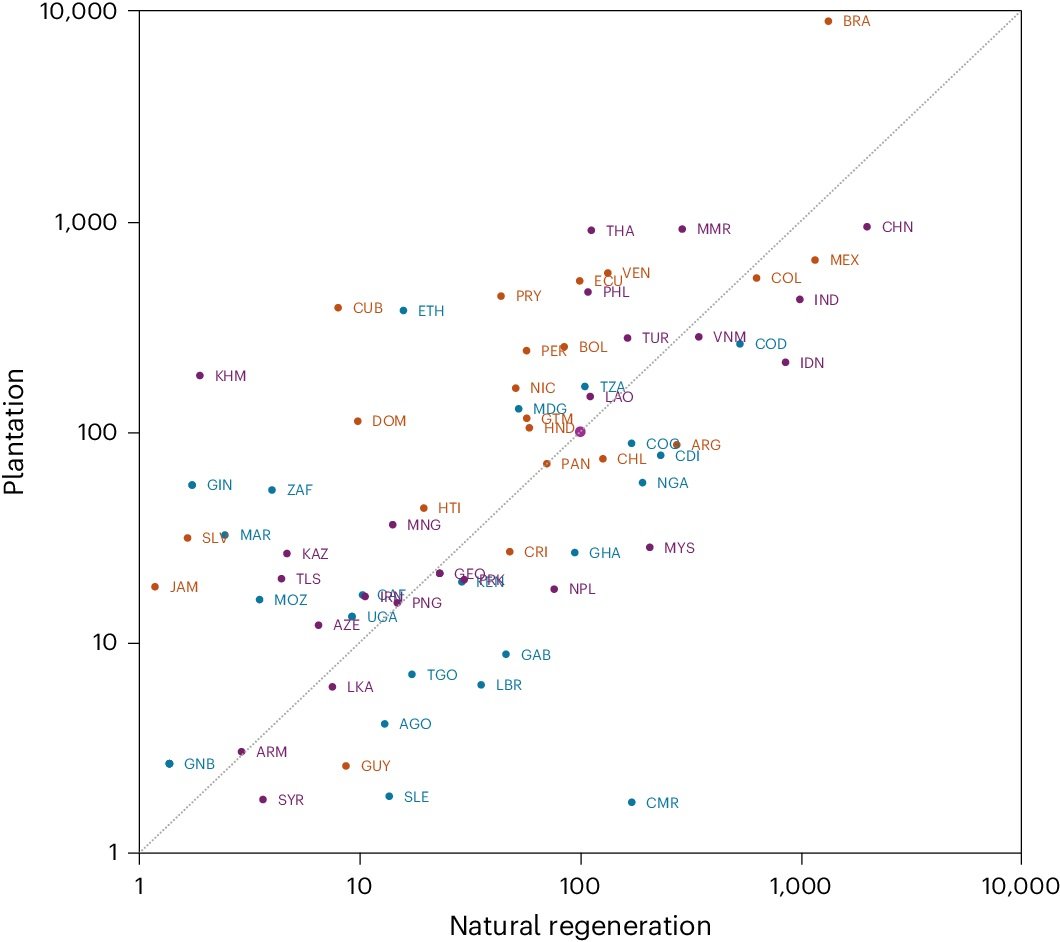
Abatement potential by applying the more cost-effective reforestation method at each site, below US$50 per tCO2, by country (MtCO2). Data are for: 138 low- and middle-income countries; 30 years; time-discounted at 5%; 2020 US$. Americas, orange; Africa, blue; Asia, purple. log–log scale. Image: Busch, J., Bukoski, J.J., Cook-Patton, S.C. et al. Cost-effectiveness of natural forest regeneration and plantations for climate mitigation. Nat. Clim. Chang. (2024). https://doi.org/10.1038/s41558-024-02068-1 Open access
“A vastly underutilized and more biodiverse method of reforestation”
A balanced strategy involving the use of the two reforestation methods in different locations represents a “more biodiverse method of reforestation” that is still “vastly underutilized”, said Jonah Busch, an expert at Conservation International, a non-profit organisation based in Arlington, Virginia, and lead author of the study.
“We hope our map will help governments, companies and other organizations use their forest restoration budgets more efficiently,” Vincent said. “A mix of planted and naturally regenerated forests is often the best way to balance society’s many demands on forests,” he added. “That’s what we find for the case of carbon.”

 Quintin Soloviev, CC BY 4.0


