Indigenous communities in the forest pay the price of drought
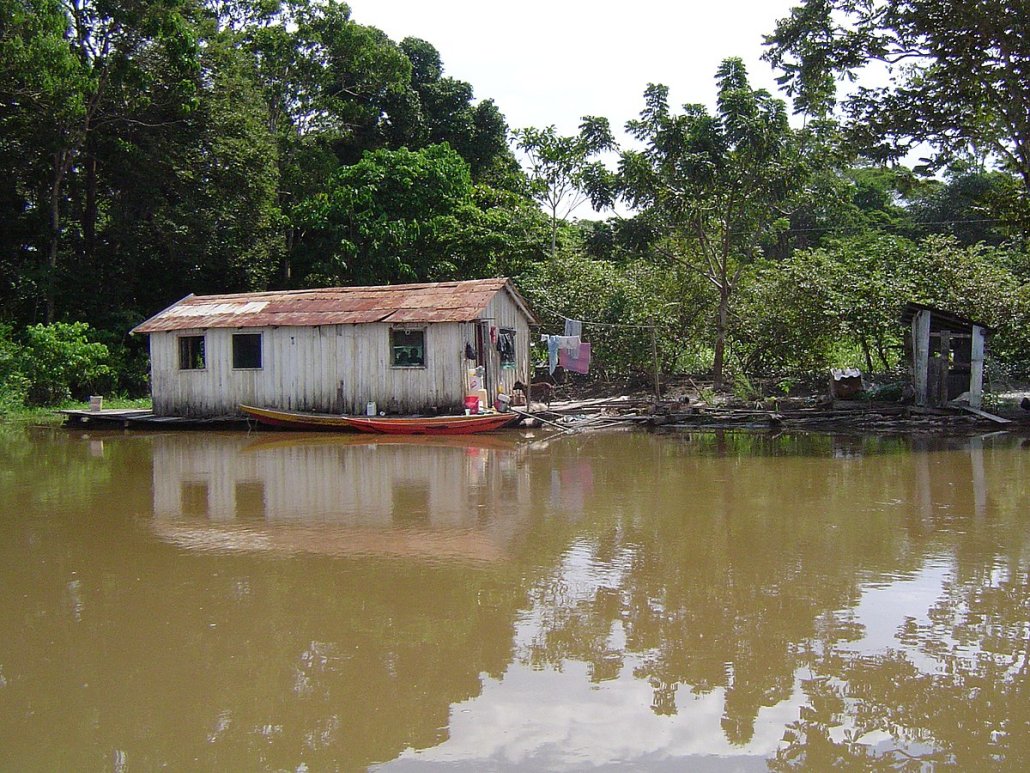 Photo: James Martins Attribution 3.0 Unported CC BY 3.0 Deed
 Drought leads to a prolonged lowering of river levels in the Amazon causing local communities to become isolated, a study by the Autonomous University of Barcelona has found. This problem affects more than 50% of indigenous villages
by Matteo Cavallito
Over the last two decades, the Amazon has experienced increasingly severe droughts. The phenomena have led to a more prolonged than usual drop in water levels in the rivers, impacting the lives of the local population. This was reported in a study by the Institute of Environmental Science and Technology of the Universitat Autònoma de Barcelona (ICTA-UAB) conducted in cooperation with researchers from the Universidade Federal de Minas Gerais (Brazil) and the Woodwell Climate Research Center in Woods Hole, Massachusetts.
Drought impacts the river system
“Amazon River basin covers an area of around 7 million km2, encompassing a vast tropical rainforest and freshwater ecosystems that extend over 14-29% of its total area,” says the research published in the journal Communications Earth & Environment. “The area is home to approximately 47 million people, including Indigenous and non-Indigenous populations, as well as urban and rural dwellers”. The study, in particular, focuses on the impact of the phenomenon on river navigability and the wide-ranging consequences for local communities.
These include isolation, limited access to health care and education, and difficulty in reaching fishing and hunting sites.
‘Most Amazonians rely on navigation as part of their daily lives since rivers are the region’s primary means of medium- to long-distance transportation,’ the study continues. “Yet today this vast river system and the surrounding floodplains and forests are under immense pressure due to the compounding effects of climate change, deforestation, and fire.”
More than one in two villages in the Amazon affected
Using an interdisciplinary approach, the researchers combined spatial analysis, hydrological methods and media content analysis to provide the first spatio-temporal assessment of the inter-sectorial impacts of drought in the area. Under investigation, in particular, have been the severe droughts of 2005, 2010 and 2015-2016, which, emphasises a statement from the University of Barcelona, drastically reduced water levels in a relevant part of the river system for a particularly extended period: exceeding 100 days compared to the usually expected 70 or so.
In the end, the study points out, almost 50 per cent of non-indigenous localities and 54 per cent of villages in native communities in the Brazilian part of the Amazon basin are subject to isolation during the most severe droughts.
“This is the new reality of the Amazon,” explained Leticia Santos de Lima, researcher at the Universitat Autònoma de Barcelona and lead author of the research. “These past droughts as well as the most recent one, 2023-2024, are showing that the impacts on the ecosystems extend severely to the Amazon population.”
Roads are not a solution
In the wake of the acceleration of the phenomenon, the one experienced last year was a drought characterised by a series of extreme events that, the study recalls, included “abrupt decreases in water levels and abnormally high air temperatures triggering fish kills, river dolphin mortality, disrupted navigation, isolation of rural dwellers, and massive wildfires in the central Amazon.” This experience, in short, suggests once again the need for urgent action.
The authors, in this regard, still consider insufficient the government’s response, which they judge too reactive and not adequately based on long-term planning.
They also questioned the policy of road expansion, an intuitive solution to combat the isolation of communities, which, the researchers suggest, would in fact prove counterproductive by altering rainfall patterns and favouring the accumulation of debris in the rivers, making their navigability even more complex.
 Photo: Thomas Bjørkan CC BY-SA 3.0
 Re Soil Foundation