
Drought, climate change, and scientific diplomacy: a collective response from Latin America

Science cannot act alone to combat the climate crisis, and without it, no transformation is possible. Some experiences developed by South American countries highlight the importance of acting jointly
by Anna Stewart-Ibarra , Sofía Kalormakis *
Drought is no longer just a natural or cyclical phenomenon: it is one of the most destructive impacts of climate change in Latin America and the Caribbean. As global temperatures rise—as confirmed by the World Meteorological Organization (WMO), which reported that 2024 was the hottest year in 174 years—extreme events such as prolonged droughts, wildfires, heatwaves, and floods are intensifying. Their consequences extend from agriculture to energy and transportation, affecting daily life and the security of millions of people.
In the face of this growing threat, countries in the region are activating joint strategies to monitor, anticipate, and mitigate the impacts of droughts. During the recent CoP-33 of the Inter-American Institute for Global Change Research (IAI), held in Asunción, Paraguay, several multilateral initiatives were consolidated that combine science, open data, and political cooperation. One of these is the (South American Drought Information System – SISSA), which provides tools co-produced with local stakeholders to strengthen institutional capacities and promote risk governance in key sectors such as agriculture and water.
Good monitoring practices
An example of the use of these tools in agriculture is the initiative developed in the Argentine province of Córdoba, where local climate data is being consolidated and expanded to monitor and predict soil water content. Additionally, the standardized precipitation-stream flow index (TSI) is used to create hydrological prediction models that impact regional hydro energy.
Another pioneering initiative is the (Network of Earth Observation Laboratories for Disaster Risk Reduction – REDLABOT), led by the Paraguayan Space Agency (AEP), in partnership with Geo Lab, ESRI Panama, and NASA. This network was established after the extreme floods of 2019 and now integrates geospatial technology to address droughts, wildfires, and other climate events with real-time information. As AEP Director Alejandro Román stated, the goal is clear: “to bring the benefits of space to our emerging countries and build national capacities in agriculture, education, and emergency management”.
Record droughts in Belize and Panama
Some of the major extreme weather and climate events that affected the region during 2024 occurred in Belize and Panama, according to the WMO’s report State of the Climate in Latin America and the Caribbean 2024. In Belize, extremely dry conditions, worsened by intense heatwaves, caused the worst episode of wildfires in the country’s recent history. In Panama, the drought in the Panama Canal, which began in 2022, was classified in January 2024 as the worst in the history of the interoceanic route. In response to these events, Paraguay, Brazil, Uruguay, and Argentina strengthened the organization of multilateral monitoring and early warning projects, using scientific diplomacy to build joint climate resilience.
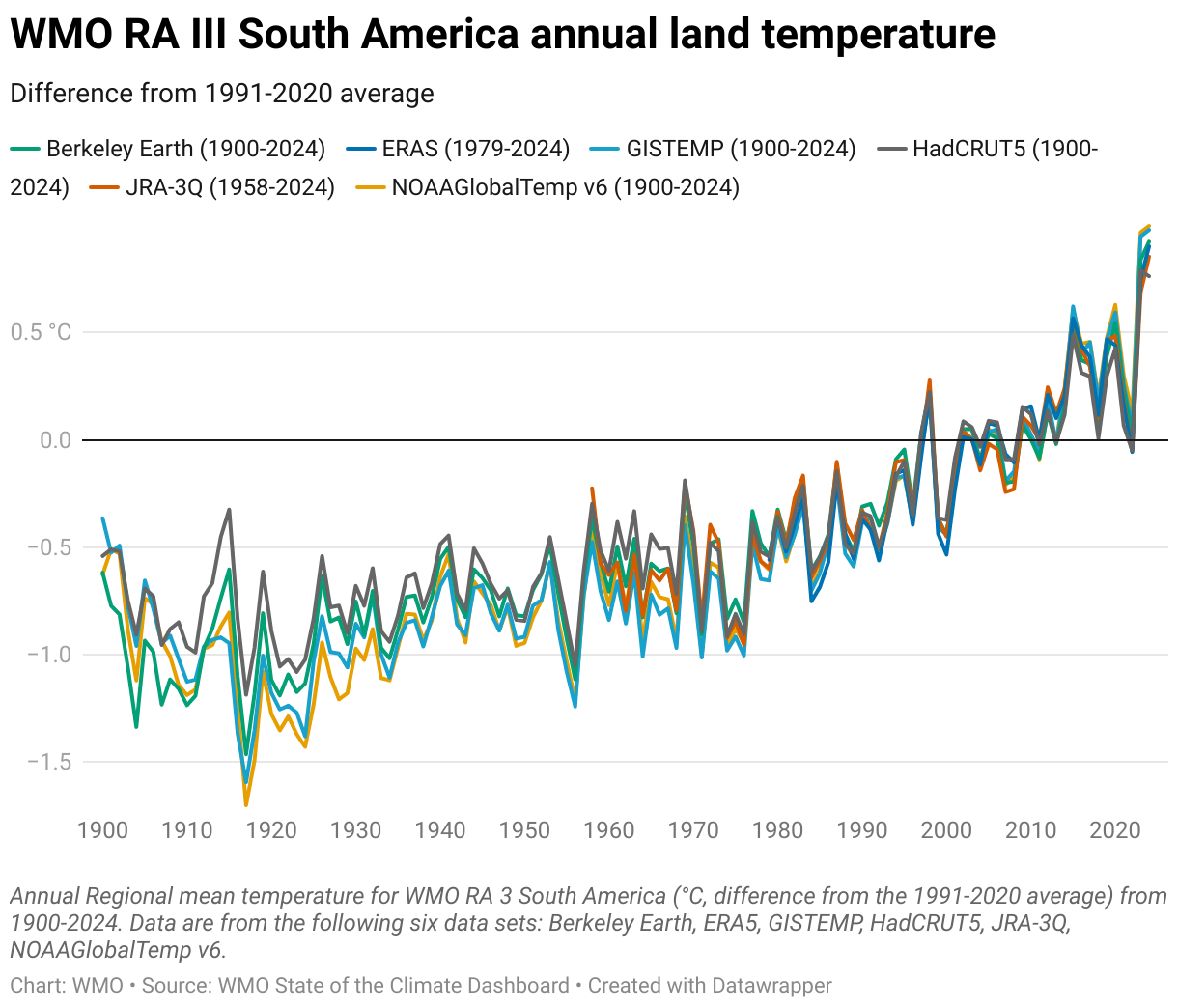
Change in average soil temperature in Latin America between 1991 and 2020. SOURCE: State of the Climate in Latin America and the Caribbean 2024
Without scientific diplomacy, early warning systems are impossible
In this context, early warning systems are not merely technical tools—they are platforms for collective action. But their effectiveness depends on another fundamental pillar: scientific diplomacy.
This practice, which connects researchers, decision-makers, and communities across borders, has emerged as a key pathway for strengthening coordinated regional responses.
During CoP-33, the IAI led workshops and training sessions on scientific diplomacy with participants from Paraguay, Brazil, Uruguay, and Argentina, promoting a shared regional agenda ahead of the United Nations Conference of the Parties (COP30) to be held in Brazil in November 2025.
All of these efforts were acknowledged in the declaration signed by the participating governments and institutions, reaffirming their commitment to:
- strengthen multi-hazard early warning systems;
- integrate scientific, Indigenous, and traditional knowledge;
- share open data and methodologies;
- mobilize financial resources for climate research and action.
This declaration represents an urgent call to act together, putting science at the service of resilient and sustainable policies.
The joint experience of the Yacyretá hydroelectric power plant
An example of this regional cooperation was the coordination between Paraguay, Argentina, and Brazil to ensure the operation of the Yacyretá Hydroelectric Plant during the years of extraordinary low water levels in the Paraná River. Between 2018 and 2021, the countries involved established technical and operational agreements that allowed continued energy generation, safe river navigation, and ensured water supply for riverside communities.
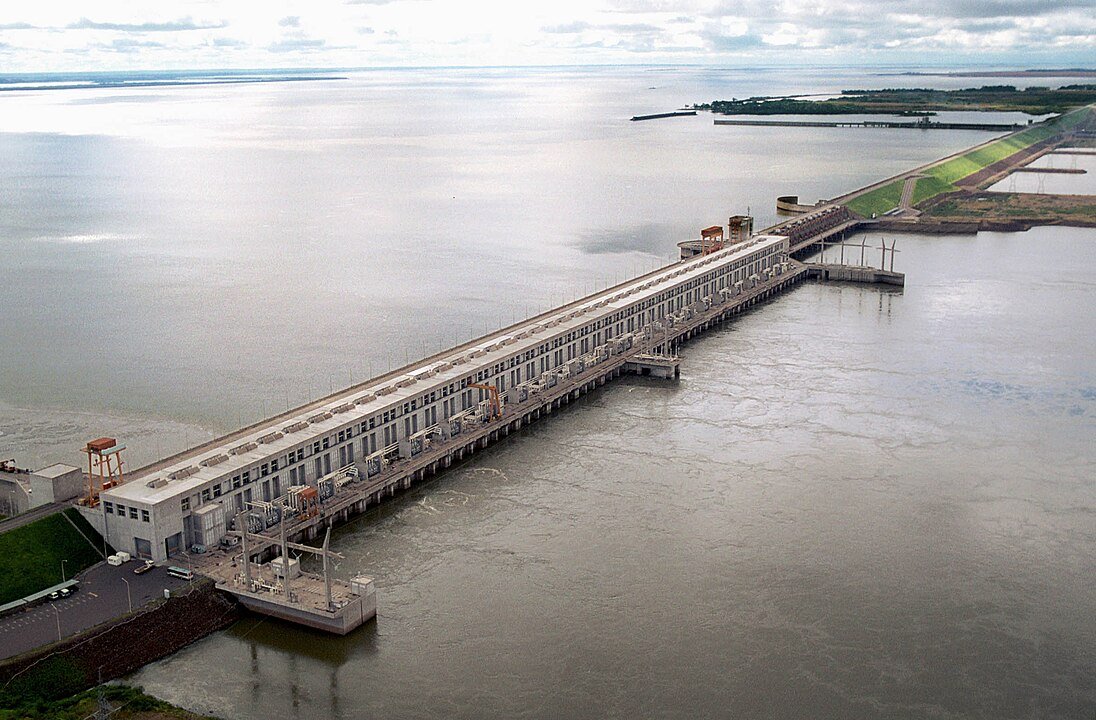
The Yacyretá hydroelectric plant was the subject of a successful collaborative project between Paraguay, Argentina, and Brazil. PHOTO: Wikipedia CC BY-SA 2.5
The so-called “navigation windows” enabled the organized passage of cargo convoys through a joint operation based on hydrological forecasts, shared logistics, and the use of technological platforms. This case demonstrates how technical and scientific diplomacy can be translated into concrete solutions to extreme climate challenges.
Drought is, and will continue to be, a threat, but we are not defenseless. With shared knowledge, strategic alliances, and scientific diplomacy, the region can not only mitigate its effects but also lay the groundwork for a profound transformation. Science cannot act alone, and no transformation will be possible without it.
The authors
Anna Stewart-Ibarra is the scientific director of the Inter-American Institute for Global Change Research (IAI).
Sofía Kalormakis is the CEO and founder of Tink Communications.
This article was originally published on latinoamerica21.com, from the platform Voices of Ibero-American Women, in a collaboration between the Organization of Ibero-American States for Education, Science and Culture (OEI) and Latinoamérica21.
 Melissa McMasters Attribution 2.0 Generic CC BY 2.0 Deed
  Angal insect Attribution-ShareAlike 4.0 International CC BY-SA 4.0 Deed
  ECHO
ECHO 


