A more diversified rotation can halve nitrogen leakage in crops
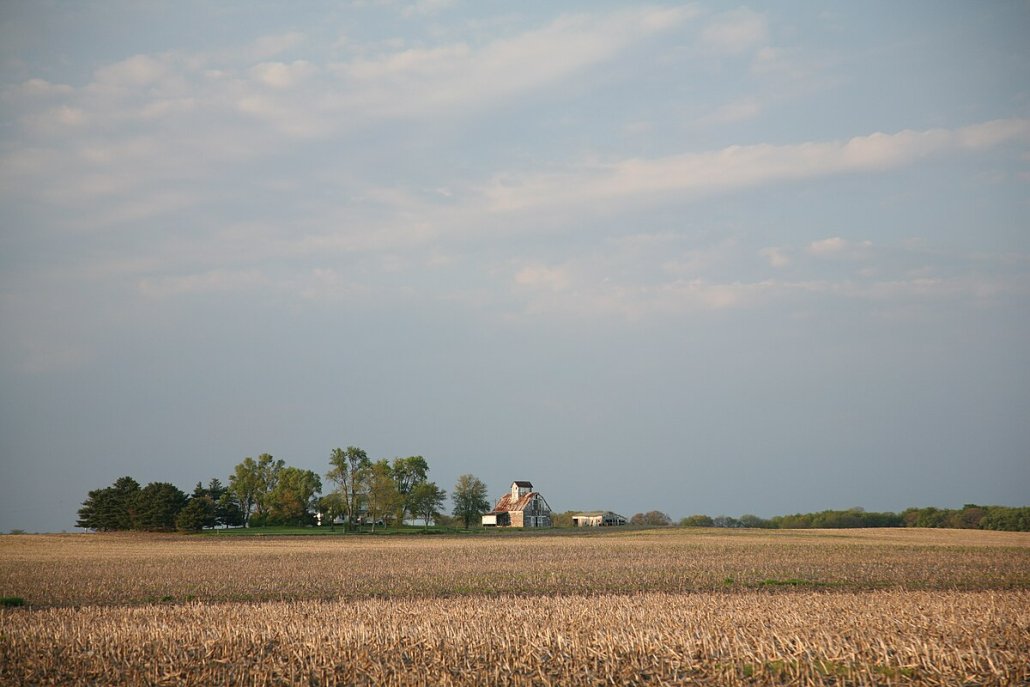
Nitrogen leakage can be cut in half by applying a three-year crop rotation while soil health also benefits, an American research has found
by Matteo Cavallito
Nitrogen is a key element in soil health, as well as an indispensable resource for agriculture. But its excessive accumulation and dispersion in the environment is known to be a problem. This is why a recent University of Illinois study published in the journal Frontiers in Environmental Science seems to take on a particularly important significance.
According to its authors, in detail, nitrate loss in agricultural soils could be dramatically reduced by employing a relatively simple strategy: the use of a three-year crop rotation as an alternative to the traditional two-year corn and soybean cycle.
A link between rotations and nitrogen loss
Nitrate losses from crop fields pose a serious environmental threat, a statement from the university points out. Crucial is the contamination of groundwater that carries nitrates into rivers and lakes, contributing to drinking water pollution. In the past, the authors recall, several studies have illustrated a correlation between longer rotations, improved soil health and reduced nutrient loss.
Based on these assumptions, “We hypothesized that the diverse rotation with a longer duration of living roots and greater carbon input compared to the conventional system could reduce tile nitrate loss,” the researchers explain.
In addition, they add, “we hypothesize that the diverse rotation may support greater corn and soybean grain yields.” To evaluate the effects of a three-year rotation, the researchers monitored nitrate losses and crop yields on an Illinois farm for nine years. The experimental field followed a cycle that included sequential cropping of corn, soybeans and wheat and included winter rye as a cover crop to protect the soil between the first two.
With three-year cycle losses are halved
“Tile flow and tile nitrate concentration were measured from 2015 through 2023 to determine annual flow weighted mean concentrations and loads of tile nitrate,” the study says. The results show that the combination of winter wheat and rye captures excess nitrate during fall and winter, preventing it from leaching into waterways. All with no particular impact on soil yields beyond effects related to adverse weather conditions.
“Overall, tile nitrate loss was approximately 50% less in the diverse 3-year rotational system,” the scientists explain.
Which suggests that “aa more diverse rotational system is efficient at retaining nitrogen, conserving nitrogen in the field, and reducing loss to surface water.” The study, therefore, demonstrates the effectiveness of the strategy and its ability “to maintain crop productivity.”
Clear benefits for the soil as well
The new method, the authors recall, also includes a reduction in tillage. “A key difference between the rotational systems was the amount of tillage,” the research explains. “The control fields were fully tilled in the fall and spring, but the researchers strip-tilled only a narrow swath of the cornfield in the three-year rotation, minimizing the area tilled to one-third of the total field every third year.” This strategy promoted soil stability by reducing erosion.
Another positive effect observed in the experimental fields was increased water infiltration, also a result of reduced tillage. In contrast, conventionally managed soils tended to retain water on the surface after heavy rains.
Finally, the increase in earthworm populations, also indicators of healthier soils, was also significant. “An interesting phenomenon that has occurred in the 3-year rotation is the return and establishment of earthworms,” the study further explains. “Tillage is clearly detrimental to earthworm survivability and no-till systems have been shown to have increased abundance.”

 Jonathan Wilkins Attribution-ShareAlike 3.0 Unported CC BY-SA 3.0 Deed
  Melissa McMasters Attribution 2.0 Generic CC BY 2.0 Deed