Saline and alkaline soils can also contribute effectively to agriculture
 Rheins ATTRIBUTION 3.0 UNPORTED CC BY 3.0 Deed
 Although subject to fertility loss, saline soils represent an important agricultural reserve when treated with appropriate restoration techniques. A recent Chinese study examines them
by Matteo Cavallito
Soil salinisation is known to be a major problem worldwide. Saline and alkaline soils, however, can still constitute an important agricultural reserve and thus ensure food security. Provided, of course, that appropriate management techniques can be implemented. This is underlined by, among others, a recent Chinese publication in the journal Frontiers of Agricultural Science and Engineering.
In the study, in particular, scientists from the China Agricultural University (CAU) in Beijing reviewed a number of good practices including irrigation with fresh water and groundwater control, ground cover and construction of a deep insulation layer, balancing nutrients and salt ions through fertilisation, and more.
Saline soils extend over 800 million hectares
Behind the spread of salinisation, experts explain, there are several factors including excessive or inappropriate use of fertilisers, deforestation, rising sea levels – which promote saltwater intrusion into groundwater – and climate change. The consequences? Lower soil fertility, of course, but also declining biodiversity and erosion.
Worldwide, FAO estimates, excess salt would affect 20 to 50 per cent of all agricultural land on the planet, impacting more than 1.5 billion people.
In detail, the saline and sodic soils detected as such at a depth of between 30 centimetres and one metre extend over 833 million hectares, alongside the 424 million where the phenomenon occurs only or even at surface level. Particularly affected is China where, according to the researchers, there are “36.7 Mha of saline-alkali land, of which the total area with agricultural potential of about 12.3 Mha, 2.1 Mha of which is currently cultivated salt-affected land that is not effectively used, as well as 10.2 Mha of newly formed uncultivated land.”
Different techniques for different contexts
The authors identified several improvement techniques for restoring saline soils, but emphasised the need to choose the best practices according to soil characteristics and different regions. “For instance, in the arid northwest part of China, mulched drip irrigation can significantly reduce water evaporation, control the rise of salts, and improve irrigation water use efficiency,” the researchers explain in a statement released by the China Agricultural University. ‘In the arid areas of north-west China, for example, drip irrigation with mulch can significantly reduce water evaporation, control salt gain and improve irrigation water use efficiency,’ the researchers explain in a note released by the China Agricultural University.
“In the Northeast, rice planting can improve the physical structure of alkaline soils and lower soil pH. In the North China Plain, appropriate utilization of saline water for agricultural irrigation is favorable to salt leaching and can also partially replace freshwater resources.”
Other examples include interventions carried out as part of a special approach to improve the tolerance of plants to saline-alkaline soils. The list of practices adopted includes the planting of halophytes (i.e. plants adapted to these soils, ed), the selection of salt-tolerant crops and the search for functional microbial agents. These interventions, the authors explain, “can not only significantly improve the utilization efficiency of saline-alkali land, but also improve the yield and quality of crops.”
New perspectives
The reclamation and utilisation of saline-alkaline soils in China “has made important contributions to grain production,” the researchers explain. At present, however, there are “still many deficiencies.” Problems include the use of inefficient technologies, the need to balance irrigation for salt leaching with efficient water management, and the dissemination of the necessary tools to farmers.
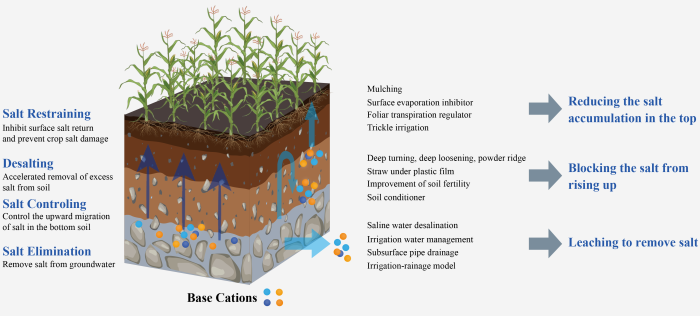
Prospects of future saline-alkali land utilization and management. Fonte: Wang et al., “Saline-alkali soil reclamation and utilization in China: progress and prospects”, in Front. Agr. Sci. Eng. ›› 2024, Vol. 11 ›› Issue (2) : 216-228. DOI: 10.15302/J-FASE-2024551 ATTRIBUTION 4.0 INTERNATIONAL CC BY 4.0Deed
Here are the four main recommendations of the researchers. According to them, it is necessary to:
- develop region-specific restoration technologies, taking into account the various factors involved, including climate and salinity levels;
- regulate and carefully manage interventions in the rhizosphere, the part of the soil close to the roots, which controls the material, energy flow and information exchange in the plant-soil system that also involves microorganisms;
- use water resources according to local climatic, soil and hydrological conditions;
- design simplified and intelligent technologies, increasing their diffusion and application rate and attracting private capital and investment.
 Thpelin Attribution-ShareAlike 3.0 Unported CC BY-SA 3.0 Deed
 Jonathan Wilkins Attribution-ShareAlike 3.0 Unported CC BY-SA 3.0 Deed