In Canada, scientists are studying natural solutions against soil degradation
 Axel Drainville Attribution-NonCommercial 2.0 Generic CC BY-NC 2.0 Deed
 Researchers at Laval University in Quebec are exploring new methods against soil deterioration in Montérégie, a key agricultural region in Canada. Under investigation are straw, shavings and polyphenols
by Matteo Cavallito
Rapid degradation of organic soils is increasingly affecting the Montérégie, one of Canada‘s key agricultural regions. For this area that is famous for its particularly fertile soils, this is a worrying phenomenon that, if no action is taken, could seriously jeopardize agricultural production. That’s according to an article published in the website The Conversation by researchers from Laval University, Quebec, who have been conducting studies on the processes occurring in the fields for years.
Here, they explain, a combination of natural events and agricultural practices that promote the oxygenation and decomposition of organic matter promotes soil degradation. With the risk of making them useless within 50 years.
The research project in Canada
In response to this problem, the Canadian university launched a partnership involving 14 farms a while ago that aims to develop integrated and sustainable management of organic soils by pursuing three specific goals.
- quantify CO2 and nitrate losses on farms;
- determine the impact of adding organic matter to soils;
- identify the optimal agronomic strategy for soil amendment management.
Organic soils, the authors recall, are formed in environments such as peatlands, where large amounts of water prevent oxygen from entering the soil, slowing the decomposition of plant matter.
These soils, which show a concentration of between 30 and 100 percent organic matter, are particularly fertile but also very vulnerable. In order to cultivate them, in fact, it is necessary to drain excess water thus ensuring the entry of oxygen. This process, however, also activates soil microorganisms, which begin to decompose matter, thus releasing carbon into the atmosphere. This is accompanied by related phenomena such as loss of thickness, reduction of fertility and erosion.
Alternative regeneration systems needed
“At the present time almost 16 per cent of the land area of cultivated organic soil in Québec’s Montérégie region is already considered thin and highly degraded due to heavy decomposition,” the researchers write. “This is an alarming finding for the future of vegetable production, especially if this proportion increases.” Therefore, they explain, it is necessary to determine alternative methods to preserve and regenerate soils. The addition of copper, practiced in the past to slow microbial decomposition, has proven ineffective as well as counterproductive in the face of the relative risk of contamination of surrounding ecosystems. Other systems, however, appear promising.
These include the use of carbon-rich materials such as straw and wood chips that can enrich organic soils by improving their physical properties.
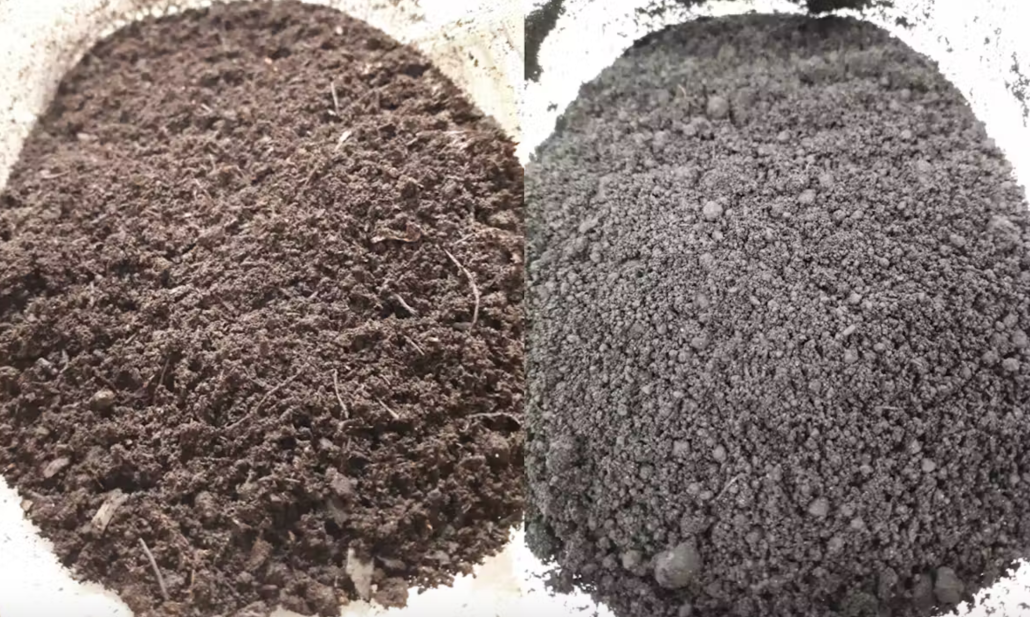
Comparison between a poorly degraded soil (left) and a severely degraded soil (right). PHOTO: Karolane Bourdon, Université Laval (Canada).
Addition of organic matter improves the physical properties of the soil
The mechanism is based on the principles of photosynthesis and exploits the ability of plants to use solar energy to produce biomass by converting carbon in the air into organic matter. This process directly counteracts decomposition, slowing the loss of the matter itself.
“Our research has shown that applying straw or wood chips to organic soils can compensate for the carbon and soil losses caused by microbial decomposition,” the researchers explain.
“What’s more, when mixed with soil in appropriate doses, straw and wood chips have the potential to restore the soil aeration and drainage that are essential for good vegetable growth.”
The needs of plants and microorganisms need to be balanced
The application of straw and wood chips to soils is still being tested in some fields in the region, researchers explain. This technique will be studied further in a new research program that will run until 2029. The goal is to define optimal dose management by ensuring a balance between the needs of plants and those of soil microorganisms.
Indeed, the addition of organic matter to the soil, the authors observe, “stimulates microbial activity, doses must be adjusted to avoid creating too much competition between plants and soil microbes for certain essential elements, such as nitrogen.”
Finally, the same scientists are also studying the use of polyphenols, molecules produced by plants that appear to have the ability to slow decomposition in soils. “This approach has shown promising potential but requires further study before it can be applied on a large scale,” the researchers conclude.
 Melissa McMasters Attribution 2.0 Generic CC BY 2.0 Deed
  Angal insect Attribution-ShareAlike 4.0 International CC BY-SA 4.0 Deed
  ECHO
ECHO