US bio-fertilisers are useful but watch out for contamination
 City of Geneva ATTRIBUTION-NONCOMMERCIAL 2.0 GENERIC CC BY-NC 2.0 Deed
 Used as fertilisers, biosolids produced by wastewater treatment can be very beneficial for the soil. This is also why, according to a study, it is important to analyse their content to prevent contamination phenomena
by Matteo Cavallito
Fertilisers produced from wastewater sludge may contain traces of potentially hazardous organic chemicals. This was reported in a study conducted by researchers at Johns Hopkins University. The research, published in the journal Environmental Science & Technology, makes an important contribution to the topic of chemical analysis of so-called biosolids. The results, emphasises a statement from the university, “could help the U.S. Environmental Protection Agency (EPA) prioritize which organic compounds to investigate further.”
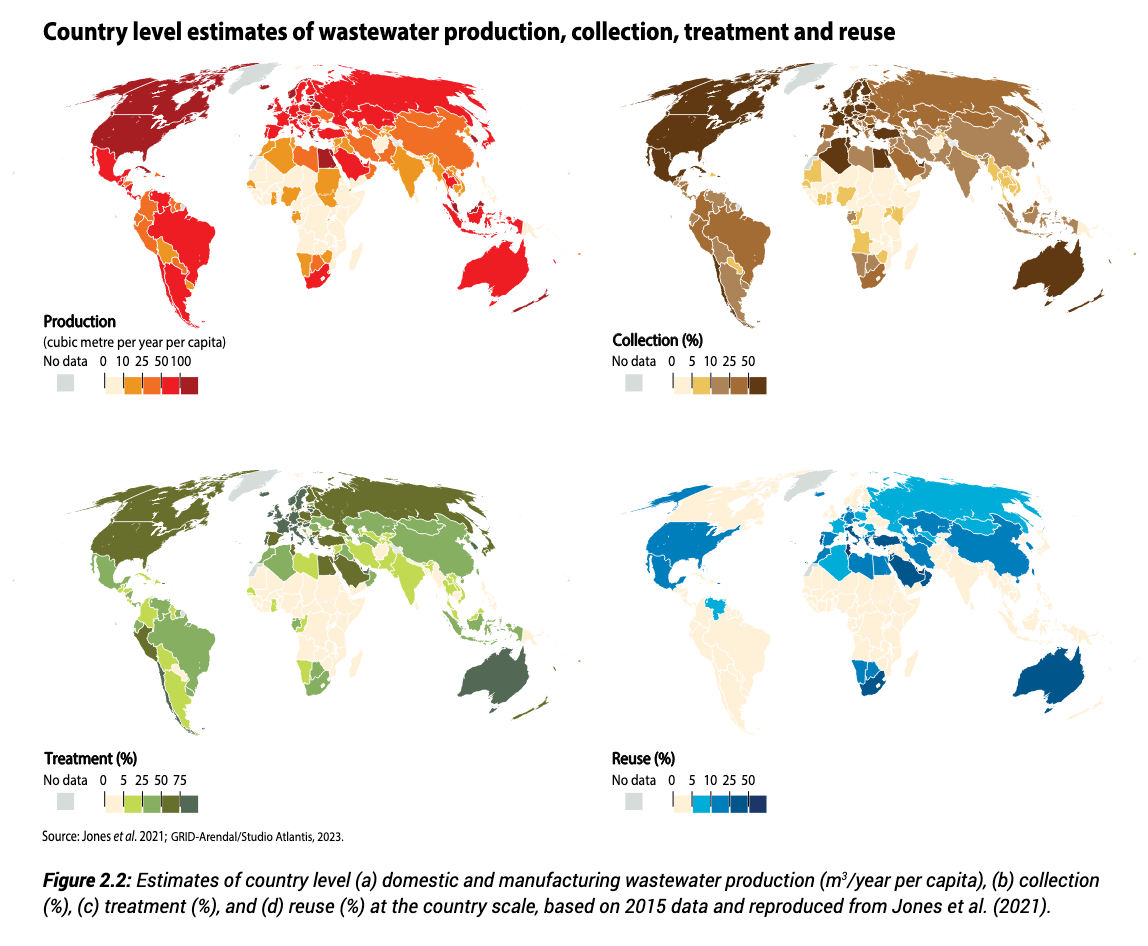
Estimates of levels of wastewater production, collection, treatment and reuse. SOURCE: Jones et al. 2021; GRID-Arendal/STudio Atlantis, 2023.
Valuable fertilisers in agriculture
Biosolids are a by-product of wastewater treatment and can be applied as fertilisers in agricultural soils. “CWhile U.S. regulations limit metals and pathogens in biosolids intended for land applications, no organic contaminants are currently regulated,” the study explains. At the same time, “Novel techniques can aid in detection, evaluation, and prioritization of biosolid-associated organic contaminants (BOCs)”. These include the so-called nontargeted analysis or NTA.
Through NTA, it is possible to identify “a broad range of chemicals, producing data sets representing thousands of measured analytes that can be combined with computational toxicological tools to support human and ecological hazard assessment and prioritization.”
Combining this technique with a US EPA chemical identification computer tool, the Cheminformatics Hazard Comparison Module (HCM), the researchers examined 16 biosolids samples from wastewater treatment plants in nine US and three Canadian cities. With significant results.
Traces of harmful substances in the samples
The samples contained traces of drugs, industrial chemicals and a variety of fragrances such as bisphenol A (BPA), found in plastics, and carbamazepine, a drug used to treat epilepsy and bipolar disorder. The authors then compiled lists of the chemicals detected in each sample and compared them to compounds found in multiple locations across the country.
In total, “Four-hundred fifty-one features were detected in at least 80% of samples, with identities of 92 compounds confirmed or assigned probable structures,” the study explains.
Researchers then cross-referenced these compounds with the EPA’s database, which illustrates the properties, hazards and potential risks of thousands of chemicals. In this way, the scientists were able to identify the chemicals that were most likely to pose a threat to human health or the environment.
3.8 million tonnes of biosolids are produced annually in the USA
Biosolids are rich in important soil elements such as nitrogen and phosphorous and are therefore, the authors point out, particularly useful for plants. Moreover, their production is based on a circular recovery system that uses less energy in comparison with the production of synthetic fertilisers. For this very reason, preventive control is essential to prevent the transfer of contaminants from the soil to humans through the consumption of agricultural products.
In the U.S., the authors recall, biosolids production measured in 2022 reached 3.76 million tonnes. More than half of this amount, according to the EPA, was used to fertilise land for cultivation or other uses.
“We’re not saying that these compounds pose a risk right now, because we haven’t done a formal risk assessment,” said Matthew Newmeyer, researcher and lead author of the study. “We’re saying that these have a potential to be problematic and we need more information in order to make sure these biosolids are safe.” The authors intention is to carry out further measurements and investigations in order to better assess the concentration levels of biosolids in the agricultural soils under investigation.
 Melissa McMasters Attribution 2.0 Generic CC BY 2.0 Deed
  Angal insect Attribution-ShareAlike 4.0 International CC BY-SA 4.0 Deed
  ECHO
ECHO